The A-Rig: Answer to Winter Fishing?
Posted by M.L. Anderson on Feb 24th 2020
By M.L. Anderson
Yamamoto Pro-staffer Tai Au has come a long way since he and his dad went to San Carlos Lake with a single crankbait for their first fishing trip. Tai’s mom and dad were among the original Boat People from Vietnam, and back then they fished to put food on the table. Then a buddy took him to Lake Pleasant for some bass fishing, and he was hooked. Now Tai has been fishing tournaments for a couple of decades, and he highly recommends that beginners enter tournaments as non-boaters, particularly the larger tournaments that draw the bigger names. “I’ve wasted a lot of money over the years on stuff that doesn’t work, so I consider money spent on fishing behind a pro to be a darn good investment.”
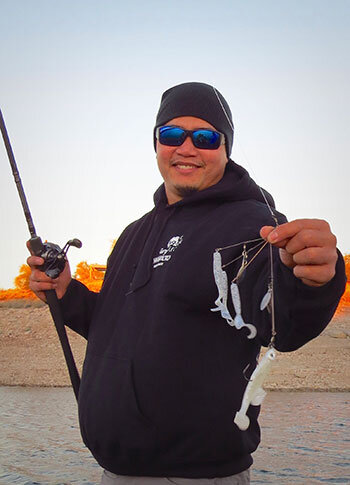
Winter has to be the toughest time for a bass fisherman. The fish have slowed down considerably, and the bite may only come on a few times a day. An A-rig, he says, can be magical this time of year, and when it first came out it was considered to be the answer to tough winter fishing. Tai has learned from experience that A-rigs aren’t magic, but this time of year he always keeps one on tied on. “I may not always use it, but I always have one ready,” he says.
From fall through early spring (around late March) is when he finds the A-rig to be the most effective – more effective than crankbaits or spinnerbaits, he says. Once spring comes around he pretty much puts it down, but he’ll pick it up occasionally in early summer. He has actually caught fish on the A-rig almost year-round, but the colder weather is the most effective time, especially on those low-pressure days.
On days with high barometric pressure you can throw the A-rig deep and work it slow if you have the patience to let it sink, but he’d rather use a spoon for that. The A-rig, however, can be very effective for big bass, so he’ll often switch to it from a spoon to encourage those big bites. Underwater points are ideal for this, and at Pleasant the stripers and bass will push the shad shallow, especially on cloudy, windy days. Those low pressure days are the days that you can fish shallow.
THE RIG
The G-Funk Desert Rig is his weapon of choice. Designed with Arizona laws in mind, it has two longer arms on the bottom for rigging baits with hooks, and three teaser weights. The new Yamamoto Zako Paddle Tail is a fantastic bait for the A-rig, Tai says. “It swims on its own with very little movement from the fisherman, with lots of action in the tail.” He has caught a lot of bass with it on Pleasant.

On an A-rig, you add the jigheads and baits yourself. He uses 3/8-ounce heads max, and ¼-ounce if he’s fishing it shallow. He throws the rig on an 805 or 806 Dobyns Champion CB rod with 16-pound Sugoi fluorocarbon line. The 806 is for the heavier heads. He can cast incredibly far with this combo – at least 60 to 70 feet. He keeps the colors pretty simple: shad colors like Sight Flash (993), Electric Shad (973), or Cream White (036).
Another good bait for the rig, especially at Clear Lake, is the Yamamoto Heart-Tail in shads, whites, etc. He’s caught some really big fish using that bait. Water clarity is very important for the rig, he says: it’s not for muddy water – you need a lot of visibility.
The G-Funk comes with either silver wires or camo, and Tai prefers the camo because they don’t have a lot of flash that competes with the baits. Also, you can use bladed or non-bladed jigheads. He goes with bladed early in the season or when conditions call for more vibration, such as overcast days. Later in the season he’ll use the unbladed heads, especially if a lot of guys are throwing A-rigs. The key to the G-Funk, he says, is the lighter wires. He bends the top two teaser wires straight back in the direction of the bait to keep them from tangling, as this rig has a tendency to get wrapped up.
TECHNIQUE
Although he tends to ignore the shoreline this year unless the barometric pressure is low, he keeps his boat fairly tight to shore so he can cast out toward the center of a cove. This rig will fly a long way, so he can cover an incredible amount of water on a single cast. Once he gets it out there and allows it to sink a bit, he’ll wind it down a couple of times to get the bait ball tight, then pumps it to allow the arms to spread – this is usually when he gets bit. He just cruises down the shoreline and casts out at about a 45 degree angle, covering water. He keeps the rod pointed at the rig.
Key places are underwater points, points near a channel, and bluff walls. Knowing how deep to fish is another key, and you can get a good sense of that from the weather. High pressure days are deep days; low pressure, cloudy days are shallow days. If you’re not sure, he recommends that you find a bluff wall and vary your depth and retrieve until you start catching fish. Early in the morning he runs the bank and fishes toward the middle. Later in the day they sometimes run up and there are almost always shallower fish at that time. Tai also recommends using your electronics to find the shad to help you know how deep to fish. He says that when he finds shad at ten to fifteen feet deep, that’s his favorite time to fish the G-Funk.
ALTERNATIVES
When he puts the A-rig down this time of year, Tai picks up a crankbait, spoon, or a drop shot. He likes the Strike King Pro XD crankbait in Gizzard Shad because it’s silent, and on 10-pound-test it will run fifteen feet deep. If he passes over a school of shad, he’ll drop a spoon, and when it gets ugly tough he’ll slow way down and start fishing a drop-shot rig in the middle of the coves.
On Lake Pleasant, Tai says success has a lot to do with angles. He throws the deep crankbait out toward the middle and runs it back to shore just like he fishes the A-rig. He says people just don’t realize how fast bass can swim, and he thinks that when the bass see the bait zooming toward the shore they get a sense of urgency because the bait is going to get away. When you’re fishing a crankbait, he says you just need to deal with the fact that you’re going to lose one or two out of every five baits. He changes all his crankbait hooks to Gamakatsu EWG hooks and has a much better catch rate now. Also, since switching to the Gamakatsu hooks, he says he hasn’t lost a single fish at Mead. Minor details like that can be the difference between a check or no check.
When it really gets tough, he just fishes stuff out deeper – isolated trees in channels, things like that. And in winter, as the water rises, he just fishes deeper. Fish will move up in the spring, he says, but in the winter they just stay deeper at Lake Pleasant. That Colorado River water from the CAP is cold and it just sis on top of the lake, he says. At the Wild West Bass tournament one January, his shallowest fish was 55 feet deep, caught on a 5-inch Yamamoto swimbait. If you’re throwing an A-rig, very small blades will give it less resistance and get it down faster.
One of the best ways to find the good spots at Lake Pleasant is to go when the lake is down – it falls up to 100 vertical feet every year. Find the isolated trees in the exposed channels, then mark them on your GPS. John Murray used to do this – I’d see him walk the shorelines and mark the structure. In the spring when the water starts to rise, you’ll have a lot of great structure that you can just go right up to. Tai actually keeps records, and he says he averages one fish for every seven trees he fishes. This means you need to mark a lot of trees. He also does a lot of pre-fishing with his huge Lowrance graphs without ever casting a line.
Since gizzard shad are in the lake, you can fish much bigger baits. He cranks that big swimbait really hard for three to four seconds, stops, then cranks like mad for three or four seconds again. This pattern has been extremely successful for him. To be successful in tournaments, Tai says, you need to fish efficiently. Show that bait to as many fish as you can. Use your electronics, mark your maps, use bluffs if you need to, but find the depth the fish are using and pick a bait that will exploit that depth to the fullest. In winter, that is often, but not always, an A-rig.