Handling Postspawners in Different Conditions
Posted by David A. Brown on Jun 28th 2020
By David A. Brown
When bass first come off the beds, the females just aren’t in a cooperative mood. Can you blame ‘em? It’s like visiting a mother right after child birth — yeah, she appreciates the thought, but a very quiet room without all the questions is so much better.
Bass may not ride an emotional roller coaster, but Roy Hawk knows that postspawn bass definitely experience a sharp downturn in activity right after the egg laying deal is done. On the upside, once the fish recover from this strenuous season, it’s game-on.
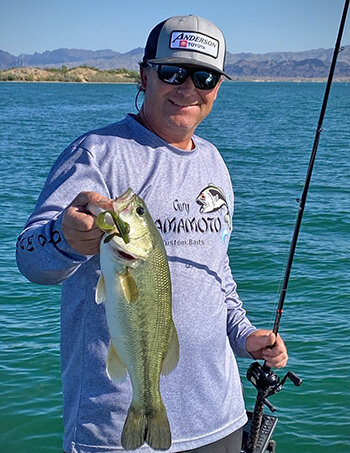
“There seems to be a little lull right after they get done spawning; we call it ‘the postspawn blues,’” Hawk said. “Almost immediately after that, especially if we get good warm trends, it starts to get really good. I enjoy fishing the postspawn period. There are a lot of things in transition and there’s a lot of good opportunity.”
So, we go from singing the blues to “ready to rock-n-roll” in a fairly short period. We’ll focus on the latter and look at how Hawk tempts postspawners in clear and stained water.
MIND THE VARIABLES
As with any seasonal stage, there’s no one-size-fits-all postspawn strategy. That being said, you can narrow it down by considering a few relevant variables.
“It depends on what lake you’re on, but number one, you gotta think about the forage — shad spawns and bluegill spawns coming into play,” Hawk said. “Then, two, the fish are going to either move out deep, or they’re going to get tight to cover.
“I find that the activity windows will be around areas like bluegill beds and shad spawns. Fish will move up, feed on them and go back out. You also want to consider fry-guarding postspawn males that will set up on isolated cover like a perfect bush or one good-looking stump.”
Notably, Hawk points out that fisheries like his Lake Havasu home waters, Kentucky Lake and Lake Guntersville see both offshore postspawn transitions, as well as shallow preference. At times, you can find fish in both scenarios, but there’s usually a general preference, often based mainly on water levels.
“If you have rising water, you’ll have a lot of shallow fish,” Hawk said. “And if the water is going down, most of them will be moving out to deep water.”
Another important point — water clarity. Here’s how Hawk would approach clear fisheries and those with significant stain.
IN THE CLEAR
With high clarity fisheries typically seeing an offshore postspawn preference, Hawk knows he can get the job done with a crankbait, a 1-ounce spinnerbait, a football head jig with a Yamamoto Double Tail Grub and a Carolina rig fitted with a Yamamoto Mermaid or a 5-inch Senko. While he routinely catches postspawners on all three, he tends to lean more toward then latter.

“It makes a lot of sense; it’s an easy way to fish and you can mix it in with your hard baits,” Hawk said. “I’d be targeting offshore brush piles, rock piles, ledges, creek channel bends; anything that presents a target out there where they can concentrate.
“When I move offshore, I want to find a group of fish; I’m not out there to catch one here, one there. I want to fish for an hour and not get a bite, but then catch one every 15 minutes. That’s why I’m looking offshore, because eventually, I can find that gold mine.”
Hawk constructs his Carolina rig with a 3/4- to 1-ounce weight, a 3-foot leader of 14-pound Yamamoto Sugoi fluorocarbon leader and a 3/0-5/0 Yamamoto Sugoi wide gap hook. Initially, it’s just a long cast and a straight drag, but he’ll adjust to focus on sweet spots.
“I think it’s just that weight banging around,” Hawk said of the C-rig’s appeal. “Ideally, if I haven’t located a group of fish, I’ll fish it fairly fast; just cruising along the bottom with occasional stops. It will do quite a bit of stopping, as that weight careens off rocks and stumps. It will make that bait that’s following jerk and twitch, fall and rise and do all kinds of stuff.
“If I locate a group of fish and I’m catching them every cast, at some point, I may want to fish it really slowly through there and almost inch it along the bottom. That might get me another fish or two that might not be willing to bite it as it’s going fast.”
Tackle and Technique: Hawk fishes his Carolina rig on a 7-6 5 power rod with a Daiwa Tatula 8:1 reel and 16-pound Sugoi main line. Designed with a deep bend, this rod suits the C rig well. That means castability and hook setting.
“With the Carolina rig, you almost always want to sweep it, whereas with a football jig, you want to set up,” Hawk said. “I’ve tried it all different ways, but the sweeping hook set just works. When you get a bite, let him start to turn a little and start to pull away if you can.
“When a fish grabs your bait and takes off, there’s kind of a V (with your line going to the weight and the leader going away from the weight). When you set the hook, you want to pull that V out. If you set straight up, it’s throwing that weight in the air and it tends to pull the bait out of the fish’s mouth or you don’t hook them right. I think sweeping it helps alleviate that.”
Bonus Bite: Hawk notes that, in a clear water setting, he’ll also look for early morning shad spawns around docks and laydowns before moving deep. Here, he’d throw a Paddle Tail Zako on a jig head.
MURKY MATTERS
When clarity’s low, Hawk knows it’s all about the shallow water hard targets. Stumps, laydowns, docks, rock piles; all provide cover and ambush spots for hungry postspawners. Flipping is his go-to strategy and bait choice comes down to expectations.
“At the California Delta, I’d flip the Mermaid or the Flappin Hog, but if the bite is off, or I’m around smaller fish, I’d go with the PsychoDad,” Hawk said. “I’ll use a 3/0-5/0 Sugoi wide gap hook and a 1/2- to 3/8-ounce weight based on the type of cover. If I need to get down into the cover, I’ll go with the heavier sinker.”

In stained water fisheries, Hawk knows the importance of seeking shaded spots where fish get balled up under docks, in grass or amid tules. In fisheries with current — be it river flow, or tidal — he want to find what he calls “energy zones.” These are the flow-throughs in tule berms, breaks in riprap, little drains and cuts — anywhere that concentrates water and creates a food funnel.
“In a stained lake, as I’m working down a bank and hitting these isolated targets, I’m going to get one fish here, one fish over there,” Hawk said. “But (in a current-oriented fishery), I might be able to find one good little spot that has three or four bites in it, because the current positions them right and gangs them up a little bit.”
Bonus Bite: As with those clear fisheries, Hawk will keep the Paddle Tail Zako on deck, in hopes of finding an early shad spawn. Also, a D-Shad or a 5-inch Senko rigged on a 5/0 Sugoi wide gap hook serves him well, if he finds bream beds.
Whatever the scenario, Hawk knows that the right mindset greatly impacts a day’s outcome: “I think if you’re fishing offshore, you have to be patient you have to find that group of fish. It may take you two to three hours — that stuff takes time and energy — but it’s worth the effort. In the shallow water, you just get in there, put your head down and hit as many targets as you can. You have to make really accurate casts and keep watch for the things that will concentrate the fish.”
And most of all, be aware that this time of year holds a lot of opportunity. You just have to stay committed to finding it.”