Football Season All Year Long
Posted by M.L. Anderson on Aug 16th 2021
By M.L. Anderson
Justin Welch is a well-known name in Arizona. He’s been running the Chandler Bass Club since last July and he started Another Damn Derby a year ago — these are night tournaments mid-week at Saguaro, fishing from 6:00 p.m. to 10:30 p.m, and they’ve proven to be immensely popular. He’s been fishing since he was five years old, and credits fishing legends Tommy and Bobby Crawford for making him a “jig-loving fool”.
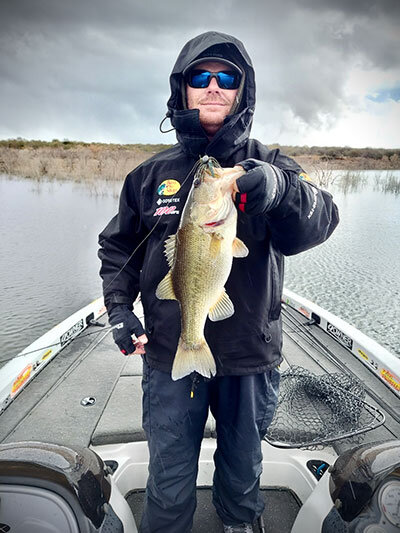
For Justin, every day is a good day to throw a jig. “Jigs aren’t just a winter bait,” he says, “I use them all year because they are so versatile. There are just so many ways to fish them that you can fish virtually any structure at any depth with the right jig.” He keeps it simple, fishing Hula Grubs on football head jigs nearly all the time. His favorite jigs are made with Owner 2/0 hooks and he has the jigs poured by Jack Lewis. The hooks have a small curve that sinks the hook into the mouth of the bass, and each jig has two bait retainers that really button up the bait even when it gets bit, Welch says.
Equipment
The five-inch twin-tail Hula Grub is Welch’s weapon of choice and he fishes them on 15-pound-test fluorocarbon or 50-pound braid with about a four foot long 15-pound fluorocarbon leader. The braid and fluorocarbon assist with getting the bait down quickly so he can cover water efficiently, and the lack of stretch means faster and more solid hooksets. A high-speed Diawa Tatula 8:1 or 7.5:1 lets him catch up to the fish if they head toward him — keeping pressure on the fish is crucial when you’re fishing a jig, because a big chunk of metal gives a fish a lot of leverage, and if you let him shake it too much, he can throw it. He likes the 8.1 for flipping and shorter casts, and the 7.5 for open water.
Gary Dobyns has a new line of rods out called the Kaden series, and those are the ones that Justin has been using. He uses the KD715C, KD744C, and KD745C along with the DC744C. The last digit is the power of the rod, and he’ll drop down to the 4 power if the bite is light or the fish are coming unbuttoned.
Hula Grubs
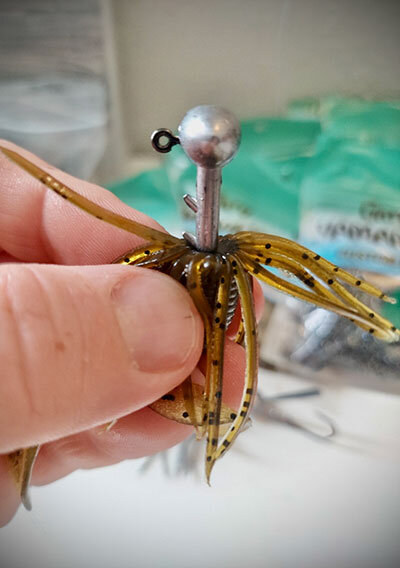
Keeping your Hula Grubs in the cooler makes them snug on the keepers, even in summer.
Justin goes through a lot of Hula Grubs. In fact, he told me that if he was given a choice between a million bucks and a lifetime supply of Yamamoto baits, he’d choose the baits — he could win a million bucks with those. In hot weather, he keeps his Yamamoto baits in the cooler. It makes them go on snugger and he says it makes a real difference in longevity — he can get two or even three more fish per grub that way. Another trick he uses is to stretch the grub a bit to let some of the salt come out. That also makes a subtle color change in the baits. He rarely uses scent with Hula Grubs, but if he does, it’ll be a little bit of Bang garlic in spring and summer, or anise Bang in fall and winter.
Welch likes to keep things simple, so he has a few colors that he particularly likes, including 221 cinnamon brown with black and purple flakes, 318 green pumpkin with red flakes, 238 smoke with black and holo, 176 cinnamon black flake, 208 watermelon with black and red, 284 root beer with red and gold, and 387 Mowed Grass. Occasionally when he is swimming a jig, he’ll put a little bit of chartreuse JJ’s Magic on a smoke holo Hula Grub’s tails to give the bait a bluegill look. He often uses single tail grubs when he’s swimming a jig, especially when he’s swimming a jig through grass. To get the old-school look of the double skirts, he sometimes buys several bags of Hula Grubs and uses a plastic worm welder to slice the skirts off and weld two together. That little bit of change in profile often makes a big difference. He likes brighter colors in dingy water and glitter flakes really help as well.
Rigging Tips
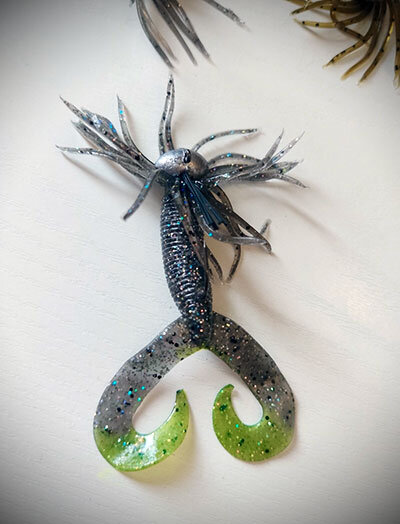
A bit of chartreuse on the tail mimics a bluegill.
If his bait is getting beat up and he’s pressed for time or he’s running low on a hot color, he’ll pinch and untwist the grub, then turn it around and pinch it back on with the hook coming out the opposite side. Also, he says if you’re missing fish or they’re coming unbuttoned, it can help if you take your pliers and grab the hook just under the barb and kick it out just a bit. Justin almost always colors the jig heads in some way, either using an indelible marker or getting them powder coated, usually in a dark natural color like black, brown, or olive green.
When he’s swimming a single-tail, Justin likes to rig it on a lighter football head jig or an Owner Blockhead Jig, which looks like a Ned rig jig. He uses a 3/16-ounce head with a 1/0 or 2/0 hook. He keeps five or six rods on deck at all times, each rigged up with a different color of grub and/or weight of jig so he can make quick switches if the structure or depth he’s fishing changes. This is particularly handy when he’s using the jig as a search bait.
Another great rig that Justin uses for Hula Grubs is fishing them on vibrating jigs like Chatterbaits. “The whole rig flairs out when you kill it, and it flares every time you hit something — that’s when the bass just annihilate it,” he says. He swims the bait slowly then kills it or gives it a twitch to get that flair. He doesn’t use scent; he just does his little ‘stretch the bait’ trick to bring salt to the surface of the grub, and that salty taste makes them hold on.
Techniques
A jig makes an excellent search bait, and Justin often switches between crankbaits and jigs when looking for active bass. He fishes a 3/8-ounce football head jig just about as fast as he fishes a crankbait, casting it to shore and fishing it just partway back to the boat, maybe just working it for ten to fifteen feet. It’s quick, but thorough. He just casts it out, lets it sink, and gives it a couple of short hops or a bit of a drag across the bottom, then three to five more short hops before re-casting. You can cover the bank quickly and he often has his partner running a crankbait from the back of the boat. This technique often catches fish even after another angler has just gone over it.
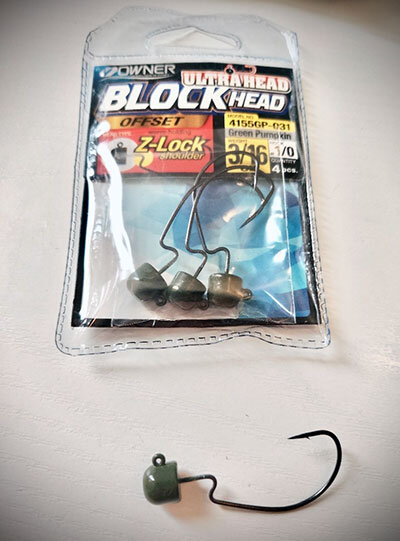
The Blockhead keeps the Hula Grub standing on the bottom with its tails up.
In summer, Justin starts off fishing at about twenty to twenty-five feet, and if they’re not there, he’ll move out a little farther. Rock type is often the key to location, he says, and it pays to make a mental note of what kind of rock you catch your fish on – whether big chunk rocks, boulders, or smaller river rocks. He’ll hit a couple of different kinds of banks and fish for two to three miles using a jig as a search bait. Sunny days are great for bluffs, and on cloudy days he usually does better fishing smaller rocks.
Varying your cadence is one of his keys to success with jigs. He’ll start out by throwing the jig, waiting for it to sink, then taking up the slack and waiting five to six seconds before dragging the jig just a little bit and giving it three small sharp hops. If this retrieve doesn’t do the trick, he’ll slow down, employing a longer drag, one or two hops, then waiting for about ten seconds. If his partner with the crankbait starts to get bit, he swims the jig. The beauty of a jig vs a crankbait, he says, is that the jig with the Hula Grub usually catches the bigger bass.
A jig bite is often just pressure, especially when the fish takes it on the fall, and when he feels that pressure he just reels up the slack and sweep-sets it. If he’s dragging or hopping it on rocks, it’s usually a hard tic or bump, and when that happens, he says you need to reel up the slack and hit it hard, getting a good solid hookset – straight up and down. This is when you really appreciate the fluorocarbon or braid.
On flats with less structure Justin will use a sweeping side action retrieve, pulling the rod to the side then taking up the slack before pulling again, a lot like fishing a Carolina rig. When he gets bit while sweeping the jig on a flat he’ll reel up and sweep hard, just like setting the hook on a Carolina rig. On rock walls, dams, and riprap when he’s hopping a jig and it gets snagged, he’ll lean back to tighten the line, then give the line a good hard snap. If two or three good pops don’t free it up, he’ll usually go in for it. If you can get the boat behind the jig you can usually just pick it up off the rocks, and that’s a lot faster than having to re-tie.
The Takeaway
A jig and a Hula Grub will catch fish all year long and can be fished at any depth and over and through any kind of structure or cover. Use a lighter jig with a weed guard and a single tail for swimming in grass and weeds, and a heavier jig for swimming over rock and open flats. The deeper you need to fish, the heavier your jig can be. If you want the lure to stay in the water column a bit longer, use a light jig. A Blockhead jig can be hopped on the bottom at any depth and will keep the tails waving around straight up from the bottom like a crawdad. A Hula Grub can look like a craw or a bait fish depending on how you rig it and how you fish it. With the huge variety of colors available, you’ll have no trouble matching the forage at your home lake. Take a tip from Justin Welch – tie on a variety of jigs and Hula Grubs and go fishing. You’ll be amazed at how versatile they are.