Beatin' the Bank - 2019 Lake Tenkiller BASS Elite
Posted by Bernie Schultz on Nov 7th 2019
By Bernie Schultz
After securing a solid finish at Cayuga Lake, I was finally back in position to make the Angler of the Year (AOY) Championship — gateway to the Bassmaster Classic. My job now was to remain there.
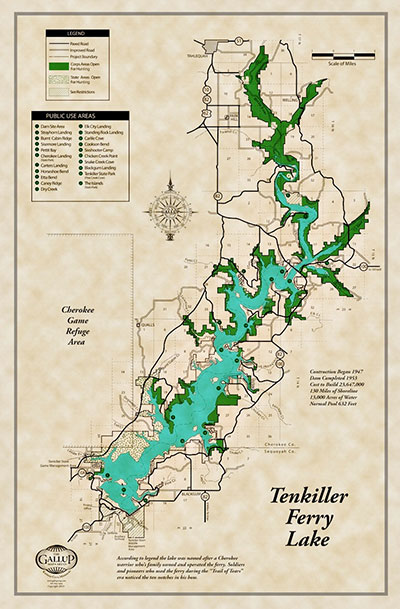
Lake Tenkiller is typical of other highland reservoirs. It's made up of various types of rock with some wood and almost no vegetation.
To say I was on edge would be an understatement. My entire season was on the line. To make matters worse, B.A.S.S. announced a venue change for this event. Because of major flooding, they were forced to postpone and relocate from Ft. Gibson to nearby Lake Tenkiller. When I got the news, I began studying Navionics charts and Google Earth, as well as monitoring several web pages … hoping they would provide some insight on a lake I had never seen.
When the time came, I had prepared as well as possible. The one thing I didn’t plan for, however, was an imposed 16-inch size limit for both largemouth and smallmouth. That tightened the screws even further.
Practice Begins
Having secured lodging near to the town of Tahlequah, I opted to ramp in and out at a park next to the Hwy 82bridge. There I would have easy access to the part of the lake I wanted to concentrate on most.
My first stops were to transition banks, where bluff walls turned to sloping chunk rock. Trying a variety of different lures, I immediately connected with fish. Unfortunately, most were spotted bass under 12 inches (their minimum legal size). The only exceptions were where I found wood associated with those banks. Then I scored better quality spots and a few largemouth in the 14- to 15-inch range.
Later in the day, I caught a legal, 18-inch smallmouth from a shallow point, but that was it. I was unable to repeat that or catch a single, legal largemouth.
On day 2, I traveled farther up the reservoir, hoping to find a better grade of fish. Regrettably, all I encountered were white bass and more small blacks. Both species were frenzy feeding on massive schools of shad. Although they were fun, they wouldn’t get me closer to the AOY Championship. I needed to find the right fish.
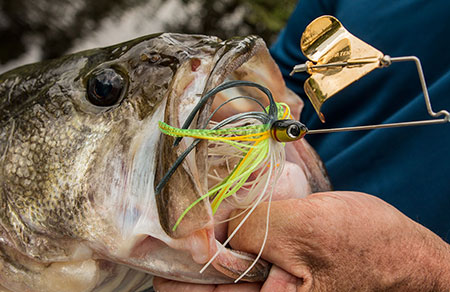
Buzzbaits were particularity effective early, and on shady banks as the sun got higher. - photo by Walker Smith
From there I moved to flatter pockets, where I caught a few largemouth flipping bushes. But as I fished, I noticed the water level had fallen. I knew then, I was on the backside of a dying pattern.
On day 3, I decided to head south to the official take-off area.
Running to the backs of several small creeks, I noticed what appeared to be legal-size largemouth feeding on shad. Rather than fish for them, I marked the numbers on my Garmin GPS and moved on. When the sun got higher, I switched to some flat points on the main lake.
Starting super shallow, I moved progressively deeper, connecting with small spotted bass at varying depths. The bite was random and produced virtually nothing for weight. After that, I tried a few docks. And they produced a few bites, but they were getting way too much pressure from other competitors, so I wrote them off.
Frustrated and out of time, I headed back to the hotel to prepare my tackle for the battle ahead.
Competition Time
Since this was the final qualifying event of the regular season, B.A.S.S. sent us out according to our AOY points standing. I was 49th, which put me in the third flight. When my number was called, I idled directly to the back of the take-off creek where I saw schooling largemouth the day before.
Once in place, I began fan casting the shallows with a Hildebrandt “SqueakEasy” buzzbait. Flanking me was another competitor. Together we began connecting with fish. Unfortunately, for me, three of his were above the 16-inch size limit. None of mine were. It was a devastating blow, right off the bat.
When that bite died, I left and headed to the back of another creek. There, I managed two keeper spots. After that, it was to the main lake transition banks that produced for me in practice.
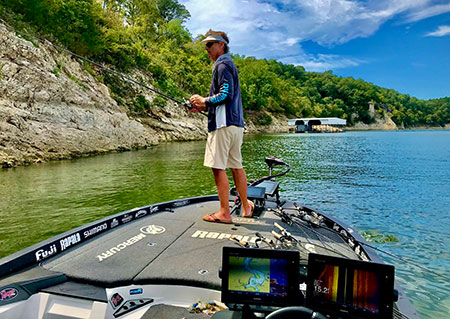
Bluff banks played a significant role in catching mixed bags of spots, largemouth and smallmouth.
Again, I connected with fish, but most were small spots — only a few exceeded the 12-inch size requirement. As the day progressed, I caught a number of nice smallmouth and largemouth — none of which, however, would reach the 16-inch minimum length requirement. It was disheartening.
By weigh-in time, I had caught more than 30 fish, but the only five I could keep weighed less than five pounds.
Back at the hotel, I was surprised to learn that I was still in 49th place in the AOY standings. That gave me renewed hope. If I could just stay inside the top 50, I could make it to the AOY Championship on Lake St. Clair, and possibly advance to the Bassmaster Classic.
The Bump Man
The next morning, tournament officials reversed the take-off order and, one by one, we exited the park. Watching as others moved to the back of the take-off pocket, I decided to try my other creek. Upon arrival, I found another boat ahead me there as well. Rather than leave, I took the opposite bank and went to work with a Rapala DT-6.
In minutes, I had two keeper spots in the boat. I knew I needed something over the 16-inch size limit to have a chance. Two hours later, with nothing added to the livewell, I pulled the trolling motor and headed to the main lake transition banks that had produced for me on day 1.
As the hours passed, I kept catching undersized bass. Finally, at 1pm, I added a 16-inch largemouth to my creel. Thirty minutes later, another keeper spot. With only minutes to spare, I decided to move closer to weigh-in.
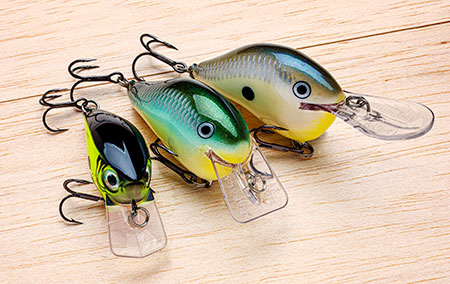
Crankbaits, like these from Rapala, were top producers throughout the event.
Casting the DT-6 over a shallow, submerged boulder, I watched as a large spotted bass grabbed the crankbait. Two quick surges later, the fish rose to jump. Seeing an opportunity, I tried swinging it aboard. As it crested the gunnel, I watched in terror as it popped loose … landing briefly on the deck, then flopping back into the water.
It would have been my limit fish, but no.
At that point, time had run out. Having only four fish to weigh, I feared the worst.
Back at the scales, the weighmaster declared my weight of 6 pounds, 10 ounces. I thought perhaps I might have enough. It wasn’t meant to be, however. Once they tallied the numbers, I was two points behind fellow Yamamoto pro, Jay Yelas.
He was going to the AOY Championship. I was going home.
To blame that single lost fish for my shortcomings would be pointless. The truth is, I dug this hole much earlier in the season — when I caught only one keeper on the third day of the St. Johns River; or when I failed to finish a limit on day 2 at Winyah Bay; or perhaps when I did so poorly on day 1 of the St. Lawrence River.
These setbacks were cumulative and costly. And as I reflect back, all serve as reminders that I’ll have to perform at a higher level next season … if I hope to reach my goal of another Classic berth.
Stay tuned!