2020 St. Johns River B.A.S.S. Elite
Posted by Bernie Schultz on Mar 11th 2020
By Bernie Schultz
The St. Johns River is nearly 300 miles long. It flows northward along Florida’s eastern side until it meets the Atlantic Ocean at Jacksonville. Tidal influence reaches all the way to Lake George, approximately 100 miles from the ocean.
Our tournament boundaries for the event stretched from the I-295 Bridge at Jacksonville, south to approximately 30 miles below the town of Astor.
I decided to begin my search at the most southerly section, then work my way north. Here’s an account of what I found and how the event shook out.
Practice Begins
Accessing the river below Astor, my first stops were to a pair of nearby canals where I noticed the water temperature was in the mid-50s. After a nonproductive pass there, I moved to a large field of lily pads at the mouth of Lake Dexter. That’s when I found two key areas holding some bass.

After a two-day weather delay, conditions finally stabilized to begin the competition. - image courtesy of BASSMASTER.com
The first was a section of pads supporting mats of floating pennywort. The other was a trail through the pad field where I noticed some schooling fish actively feeding. Neither spot produced any size, but I felt I could rely on them to fill out a limit during the competition.
From there, I moved to some canals at Astor and found more fish. All appeared to be buck bass guarding schools of fry. I recorded their exact locations on my Garmin and then headed for Lake George.
The west side of George features a number of clear spring runs — places providing warmer, more stable water. In one particular run, I discovered a number of bedding bass in the 3- to 4-pound range. That boosted my confidence tremendously.
On Day 2, I accessed the river at our official take-off point in Palatka. From there I headed north to some main river shell bars — hoping to find fish actively schooling on a moving tide. However, after hitting four different areas without a bite, I decided to try some nearby canals.
The water temperature was noticeably cooler to the north, so I pulled the trolling motor and moved south of Palatka to try a few canals.
Finally, I was seeing a few fish. All were the right quality, too — mostly 3 pounds or bigger. I punched the numbers of each bed on the GPS, then kept looking until the sun was gone.
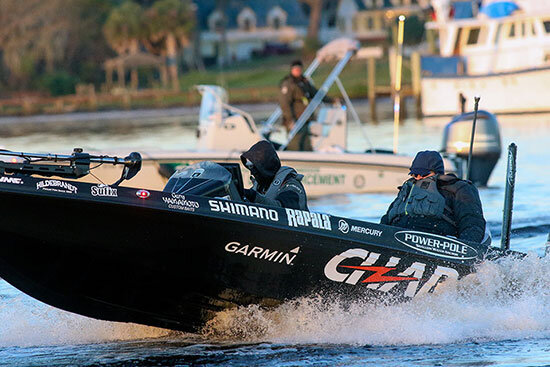
Although clear and calm, the temperatures dropped to the low 30s on Day 1 of the competition. - image courtesy of BASSMASTER.com
On Day 3, I decided to return to Astor, to expand on what I learned from day 1.
Moving slowly through a series of canals, I got some random bites here and there, but nothing of any consequence. The time passed quickly and before I knew it, practice was over.
Competition Time
After a sleepless night of pondering my options, I decided to commit to the spring runs in Lake George — at least in the morning — then move to Dexter if I ran into trouble.
Knowing a full moon was rapidly approaching, I believed more fish would move into the spawning areas. But as I entered the first spring that morning, I could see the water was super low. Evidently, strong south winds combined with a full-moon tide had drawn the river down and, consequently, spooked most of the fish off their beds.
My first bite was a 3¾ pounder, but the next was a dink. Following that, I moved from waypoint to waypoint, hoping to add to my catch. Unfortunately, all I found were empty beds. It was disheartening.
At 10:45am, I decided to run to Lake Dexter and try the schoolies. Because they were holding in 4 to 5 feet of water, I felt they would still be there. Upon arrival, however, I discovered that they, too, had left. I also noticed the lily pads on an adjacent flat were half out of the water. Seeing that, I knew the flipping bite was also done.
As a last-ditch effort, I moved to the deeper canals in Astor, hoping the fry-guarding bucks would save my day. As it shook out, I managed only one additional keeper. And on the long run back to weigh-in, I had plenty of time to consider my game plan for Day 2.

Lily pads fields produced well for some, but not this angler. - image courtesy of BASSMASTER.com
I decided to abandon Astor and try my luck in the Dunn’s Creek area. The next morning, I started at the mouth of the creek, working a stretch of lily pads and shallow wood. After an hour without a bite, I moved further into the creek, to some deeper bends. That’s when I scored my first bite of the day — a 12-inch keeper.
Two more hours passed, and nothing. I tried several different stretches, even a few canals, but with such low water, nothing was working. Even worse, the creek was becoming crowded with other boats. Seeing that, I decided to move to the main river and flip some pads.
In minutes, I had my second fish — a fat 3 pounder. I thought I was on to something, but as the time ticked away, it proved to be a fluke fish.
Next, I tried several shell bars, and I could see plenty of fish on my Panoptix. But none would react to the lures I threw. It made me wonder if they were even bass. The St. Johns is full of gar and stripers and other species of fish, so the images on a graph can be deceiving.
As the clock wound down, I realized there would be no late-in-the-day heroics. My tournament was finished, and it was time to concede. Disgusted, I pulled the trolling motor and headed toward check-in, wondering how I could have adjusted to the falling water levels.