Rods & Rigs - My Prespawn Preference
Posted by Gary Dobyns on Apr 8th 2020
By Gary Dobyns
Bass fishermen love catching big fish and prespawn is the absolute best time to do so. The big females are up shallow, they’re eating aggressively to pack on weight for their spawn and their aggression level is at its highest.
Historically, this is the time of year when you have the best chance to catch your giants. Just look at tournament results and lake records — the majority of the biggest fish consistently are caught during the prespawn period.
Even if the spawn is starting in certain areas, we’ll still have plenty of prespawn activity into April. You definitely want to find these big fish when they’re still big, fat and healthy — before they spit out all their eggs — so don’t miss any opportunities to fish during the prespawn.
What Drives It
When we look at what prompts these big fish to start staging outside the spawning areas and eventually move up to spawn, the moon definitely plays a role, but I don’t think it’s as big a deal as warming trends. From my experience, when you have three to four warm days in a row, that triggers a massive wave of fish to move up.
Exact water temperature varies lake to lake and it’s all relative. In parts of California, I’ve seen them spawning in the mid-50s, but most of the time, when the water reaches that mid-60 range, you’re definitely going to have spawners.
I think it really depends on where you are in the country. For example: Clear Lake gets cold; most of the time in the winter, it’s 44-46 degrees. When that water hits the upper 50s, you’re going to have some spawners. But, you take a lake like Berryessa, where most of the time, winter temperatures are 53-55. They fish there don’t normally spawn until water temps hit 63-65.
Wherever you are in the country, when that water warms up 10-12 degrees, they’re going to spawn. So, if you can find these fish right before they make that shallow move, you’ll be amazed at what the prespawn can deliver. Here’s how I like to target them.

Swimbait
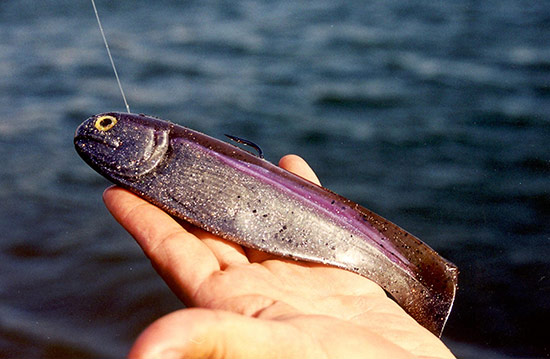
Hands-down, my favorite way to target big prespawners is with an 8-inch Huddleston swimbait with a rate of fall (ROF) of 12. I’ll fish that on 20-pound fluorocarbon with a Dobyns Champion 806 HSB rod and a 5:1 reel. That outfit enables me to make long casts with a big bait and keep it swimming slowly near the bottom.
I want to be fishing a swimbait close to deep water because the fish are moving up from their wintering spots. They’ll pull up on points and secondary points; places where significant depth comes close to a point leading into a spawning flat. I also like to see some type of structure, like isolated rock or stumps on these points, because the fish will relate to these spots.
I’ll fan cast the area and cover water. The fish are not bedding up yet, so they’re still in feeding mode. These points are ideal because the fish will come up onto that lip and feed on shad, bluegill and whatever they find.
I typically do best by casting uphill and reeling down. I’m going to have fewer hangups that way and tracing that bait down the natural slope of the point allows me to find what depth the fish prefer.
If you’re in a really good area, like a point near a feeder creek, you may not necessarily catch them one after another, but you can often find multiple fish. You’re likely to encounter some of the biggest fish you’ll find all year, so make sure you get a good hook set and control the fight.
I make a solid sweeping hook set and then maintain steady pressure on the fish. This technique requires that big rod and big line so you can horse those big fish. You can’t let them jump, or they’ll sling that bait out of their mouth.
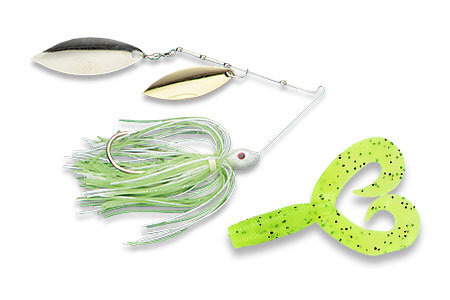
Spinnerbait
I like to slow roll a 1/2- to 3/4-ounce, white/chartreuse bait with tandem willow leaf blades — usually gold in the front and a bigger nickel blade in the rear. When I’m after big fish, I will put a good size trailer on the back. I like using 5-inch Yamamoto Single Tail Grub, but I may go to a 6-inch “Stretch 40” grub. It has a smaller tail than the 5-inch grub, but it gives you a bulkier presentation.
I like to slow roll that bait down around 10-15 feet; that’s just always been a magic depth where I catch a lot of big fish.
I’m using a lighter action rod with the spinnerbait than with the swimbait, but I still give it a good firm sweep on the hook set, I get a lot of load in the rod, and then I get on the reel to make sure I keep a hard load in the rod.
I’ll fish my spinnerbait on a Champion 735 C — that’s a fast action rod that loads really quick. I’m using 15- to 20-pound fluorocarbon on a 5:1 or 6:1 reel and I’ll pop the spinnerbait a couple of times on the cast just to make it quickly flutter and act like it hit something.
Jerkbait
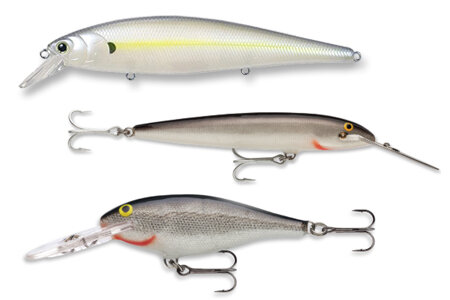
I caught my personal best fish — a 12.89 at Folsom Lake — on a jerkbait and I’ve caught a lot of other 10-pound fish on this bait. I’ve actually caught more big fish on a jerkbait than I have on any other bait.
Some of my favorites are the Luckycraft Pointer 128 (ghost minnow and chart shad), Rapala Mag 18 (black back/silver) and a No. 9 Shad Rap (black back/silver, chartreuse/pearl belly). For all of these, I like 12-pound fluorocarbon and a Champion 706 CB — a mod-fast crankbait rod that still has some power to pop those big baits and get some reaction out of them.
I’ll jerk-jerk-pause, jerk-pause; never the same thing every time. The strike is always after a pause, when you go to hit it. This is a good technique for covering water. That’s why I like it.
Football Head
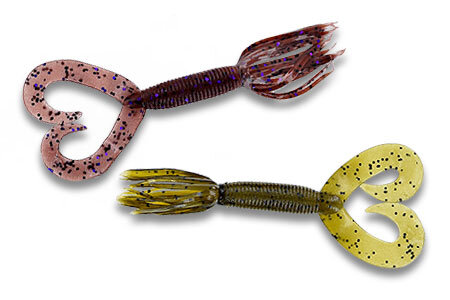
Along with these traditional reaction style baits, I’ll also keep a 1/2- to 3/4-ounce football head rigged with a Yamamoto Hula Grub in green pumpkin or cinnamon purple flake. I’ll fish this on a 14-pound line with a 6:1 or 7:1 reel with DX 745-C casting rod or a Champion 744 C — both are powerful rods that pair well with this technique.
The presentation is the key that time of year for big bites. I’m making 45-degree angle casts into shallow water, working down off the deeper edges and I keep it moving; I don’t work it slow. Those fish are up there to feed, so I’m covering a lot of water and looking for reaction bites.
Some days are weird and the big fish don’t want to respond to the traditional reaction baits, but they will jump on a jig. Spring is the time for big fish and you have to be prepared to take advantage of what the day offers.