In Praise of Red Ink
Posted by Pete Robbins on May 4th 2020
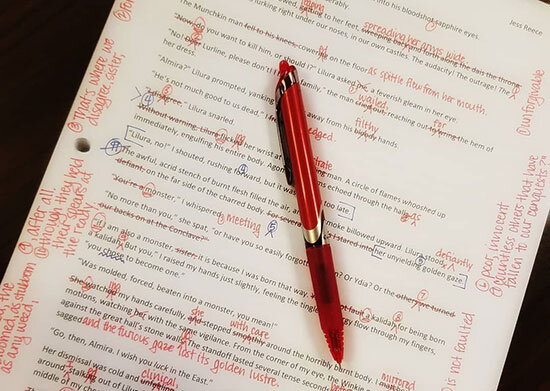
Early in my career, I worked for a self-absorbed and overconfident law firm partner who loved to spill red ink by the barrel just for the sake of editing.
If you wrote, “The boy was happy,” she’d return it with “happy” crossed out and changed to “glad.”
When you gave her the next iteration of the memo a few days later, she’d cross out “glad” and change it back to “happy,” along with a withering note explaining that no one in their right mind with a shred of professional competence would ever use the word “glad” in that sort of document.
That was 25 years ago, and it left a lasting impression, both about wasted time, and about the power of red ink. In other words, nothing you can write in the margins of my paper or in the comments section of my articles is really going to cause me to lose sleep. I might respond in kind, but you won’t shake my confidence.
However, there is also a little-known codicil to that lesson. When used properly, and to make a product better, it is the most welcomed sort of professional guidance I can get. In reality, most of my published articles get very little editing. That’s not because I’m a brilliant writer, or because they’re afraid to hurt my feelings. Rather, I think it’s just a sign of how our industry has historically worked – as long as something is reasonably good, it gets a paint job, but doesn’t get picked apart.
On the other hand, as a lower-case-j-journalist, I’ve actually been thrilled lately to received some heavy-duty, much-needed red ink. On my recent pieces for MeatEater, editor Joe Cermele has sent me redlined copies of my drafts back for my approval, with fairly heavy doses of changes, and each time he has made my articles more refined. For the feature about Keith Combs that I wrote for Texas Monthly, not only did their very accomplished editors put my piece through the ringer, but they also subjected me to multiple rounds of fact-checking. For the first time in my career, I had to extensively annotate each fact, claim or quote that I offered. I’m not sure I’d like to do that every day, for every piece, but it was a fantastic experience – reinforcing the idea that collaboration can enhance the creative process, and that red ink should be embraced.
I wish that all of us could experience that satisfaction of being able to be improved in every aspect of life – in writing, in work, in marriage and perhaps most importantly in fishing. It’s hard to embrace, because it often seems like “right” and “wrong” more than mutual assistance. It’s also a matter of who is distributing the red ink. If you don’t trust or respect them, or they’re inconsistent, it’ll fall on deaf ears. But the bottom line is that if you are afraid to be edited, critiqued or taught, then you are likely not confident in your skills, and not really interested in improving.