Bronze Medal: Dropping a Hundo
Posted by Pete Robbins on Jul 28th 2020
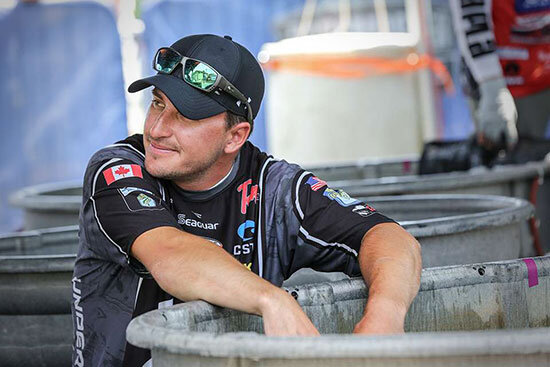
*Images by James Overstreet, courtesy of B.A.S.S.
My parents were tough graders. I’d come home and brag about getting a 97 on a test and the invariable response was, “What happened to the other three points?” Fortunately, they know nothing about professional bass fishing, but I feel like we’re living that phenomenon all over again.
Chris Johnston slapped 97-08 on the scales last week the St. Lawrence River, becoming the first Canadian angler to win an Elite Series tournament, and all I can think about is, “What happened to the other two and a half pounds?”
That’s 40 ounces, spread over 20 fish.
Two ounces per fish.
A spit-up goby per fish.
Seems so close, yet so far away. If he hadn’t done it, maybe Paul Mueller, who led the first three days, could’ve hit the mark. After a weather-related struggle on Day Four, he ended up with 95-14. Sixty six ounces. We know that the fish are there, because each of them weighed in a 27 pound stringer. Mueller’s included a 7 pound 13 ounce smallie, believed to be the biggest piece of bronze ever weighed in B.A.S.S. competition. Nevertheless, once again, no one hit the Century mark. Others have come close. Last year Chad Grigsby set the pace with 97-08 in an FLW event on St. Clair. In 2008, Kota Kiriyama caught 93-06 to win an Elite Series tournament on Lake Erie out of Buffalo.
Clearly, the fish are there to make it happen, but despite that fact – as well as increasing angler skills and improved technology – it has yet to happen. It may never happen, although I wouldn’t bet against it. Here are the impediments we’ve seen so far:
Right water
Simply put, you have to go where they live and grow big. How many places are there big enough for a 100 or 150 boat tournament that can consistently produce those types of weights? As mentioned above, the St. Lawrence, St. Clair, and Erie have come closest. Escanaba has the potential. Clearly Mille Lacs does, too. Maybe someplace out west like the Columbia River. It has to be someplace where the community will fork out the cash to hold a major tournament and the anglers won’t balk at driving, too. That may rule out some of the more rural western places.
Right time of year
While certain largemouth fisheries – like Clear Lake, Falcon and Fork – have the potential to pump out 100 pound weights all year long, others are more seasonally-specific. Preston Clark won at Santee Cooper in 2006 with 115-15. Five others topped the century mark that week, and two more exceeded 99 pounds. Nevertheless, I’ll be surprised if anyone approaches that mark when the Elites return in the fall. The fish shouldn’t be as concentrated or as fat. It’s similar with smallmouths – you’ve got to go when they’re biggest, which likely means when they’re about to spawn (which is a time when they’re protected in many northern waters) or after they’ve been feeding up to recover from the spawn.
Right number of days
Seth Feider might have hit a hundred during last year’s AOY Championship on St. Clair. He “only” needed to weigh in 22-01 on Day Four to add to his 77-15 weight from the first three days. Unfortunately (for us, not necessarily for him), it was a three-day tournament. We’ll never know what he could have done. Same as in 2016, when he won the AOY Championship on Mille Lacs with 76-05.
Not sharing fish
Despite the fact that most of these smallmouth slugfests take place on massive bodies of water, the “juice” is often quite small. If you find the ultimate school of fish, or simply a few spots that have better-than-good caliber fish, you’d better have them all to yourself. If during your milk run someone slips in behind you and catches that 7-pounder that would have allowed you to make the big cull, that’s one critical fish you can’t weigh.
Can’t stumble
Despite the way the pros make it look, even on the best waters 5-pound and up smallmouths are not common. For those of you more familiar with largemouths, think of it this way: the numbers of big fish does not increase linearly as their weights rise. For each number of 8-pounders in a lake, there are only a fraction of that many at 9, and for each group of nines, there are only a fraction of that many tens. With smallmouths, it’s just as compressed. For each 10 that weigh four and a half, there may be only one true 5. For each 10 that weigh 6, there may only be one true 6. For each 4-08 you weigh in, you need a 5-08, or two that weigh 5-04. That’s tough. And while a 22-pound bag of brown bass is more than respectable, if you weigh that in on day one you need a 28 pound bag, or two that weigh 26-08, to make up the difference.
Right weather
Too much wind, too little wind, blistering rainstorms, a too-dry summer — something always seems to happen in smallmouth country to booger things up. Mueller may have been damned by the brutal winds on Day Four. Johnston said that he relied on his “22 pound areas” because of the wind. If nothing else, it prevents an angler from running around as much. The corollary to this, of course, is that even if you get “good” weather (defined subjectively) a mechanical breakdown can have the same impact, limiting your range or your time on the water.
A few good breaks don’t hurt, either. Johnston had two hooked fish jump into the boat. I hope his parents take it easy on him.