2020 Lake Guntersville B.A.S.S. Elite
Posted by Bernie Schultz on Oct 25th 2020
Bernie Schultz
Lake Guntersville is one of the most productive bass fisheries on the planet. It’s home to a huge population of largemouth, many of which are trophy size.
When B.A.S.S. announced the north Alabama impoundment as site of a makeup event, most of the Elite anglers were excited about the prospects of fishing there. That was before practice began. Once on the water, the reality of a tough fall bite set in.
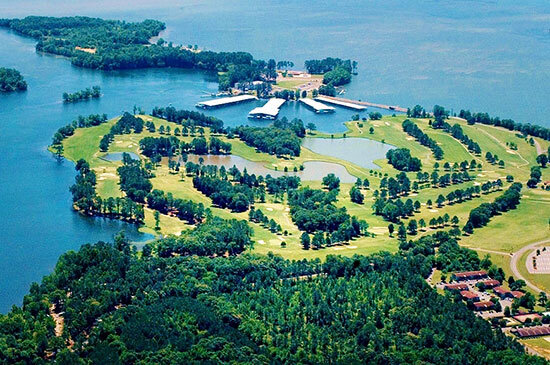
Aerial view of Goose Pond Colony Marina — official take-off and check-in for the event.
Add to that a 15-inch minimum length requirement, and things became nearly insurmountable for many.
Here’s my account.
Practice Begins
My plan was to flip and frog my way to a high finish … maybe even win.
Those were the exact tactics that worked for me a year earlier, which also produced the biggest bass of the event — a 7-pounder. It seemed only natural that they should work for me again.
I started in a large field of grass near our official take-off at Goose Pond Colony, on North Sauty Creek. For the first hour, I threw various topwaters and enjoyed good success with small, keeper-size bass. As the sun climbed higher, I switched to frogging and flipping the topped out mats of hydrilla.
Having no success there, I backed out and used my Garmin LiveScope to target isolated grass clumps in deeper water. That’s when I connected with a school of solid fish using a Texas-rigged Yamamoto Kut Tail Worm in a plum pattern.
After shaking off a number of fish, I decided to try the pattern across the lake … and it worked. The next school I found had fewer fish, but their size was good. At that point, I believed I was on my way.
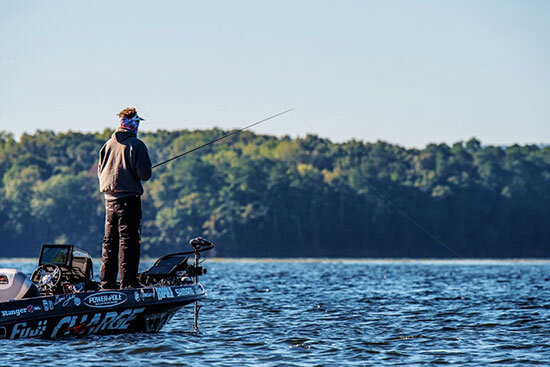
Concentrating on isolated grass clumps outside large fields of topped-out hydrilla was where I found the better fish. Unfortunately, stiff winds took that bite away.
Unfortunately, the rest of the day was spent fishing in and outside matted fields of grass, pretty much to no avail.
On day two, I opted to run up the river and try some areas that proved productive in the past. In one particular creek, I discovered an abundance of schooling bass feeding on shad over shallow eelgrass. Most fell for a white swim jig with Zako trailer. Although the bulk were non-keepers, enough made the minimum length requirement that I fully expected to return at some point during the competition.
From there, I ventured farther upriver to try some similar creeks but, by day’s end, that one school of fish was all I found.
On day three, I decided to flip and frog the main river channel in the upper end of the lake — a decision that proved futile. After covering miles of lush, beautiful grass, it seemed no fish were relating to it at all.
Reviewing what I had learned in practice, I decided to take my chances near take-off, then run upriver if I got into trouble.
Competition Time
On the first morning of competition, I started on the edge of a topped out hydrilla near take-off, hoping a topwater bite might materialize. But after a lengthy effort with no results, I decided to move deeper to the isolated hydrilla clumps that paid off in practice.
Soon, a stiff breeze began to blow. I boated a solid 2-pounder and missed another that pulled the hook. Thirty minutes later, the spot was blown out by a steady 15 mile-per-hour wind.
I moved across the lake to my other offshore spot, hoping to finish a limit there. I got one bite — another 2-pounder. Two hours later, I still only had the two fish. With the clock ticking toward an early weigh-in time, I considered my options: Go upriver to the schoolie hole or stay and pound the same grassbed.
I opted to leave.
When I arrived to the shallow flat in the back of the schoolie creek, the fish were busting everywhere. In minutes, I had my first fish on the white swim jig … then another, and another. In no time, I was culling to a 10-pound limit.
Having a long run and little time before check-in, I pulled the trolling motor and headed that way.
Back at the scales, I learned I was just outside the cut to the top-40. I decided right then that I would abandon everything else and fully commit to the schoolie hole on day two.
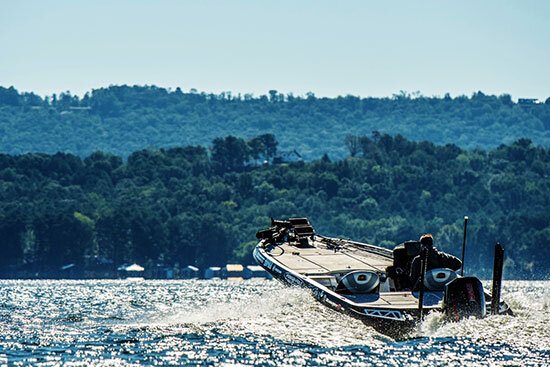
I had to cover miles of water on day-1, just to fill out a limit.
The next morning, when my number was called, I headed straight there — only to find two other competitors ahead of me. Chris Groh and Gussy Gustafson were sitting on the prime stretch. I fished the perimeter, hoping some active fish might be within reach, but nothing was happening there.
We watched as Chris managed a couple of keepers — Gussy and I struggling just to get a bite. By 8 o’clock, Gussy decided to leave and Buddy Gross showed up in his place. Gross boated several keepers in short order, which made my stomach churn.
Apparently it was too much for Chris Groh to watch, as well, as he pulled his trolling motor and headed back to the river. I fished away from Buddy and finally caught my first keeper — a 2-pounder. Then came a run of short fish — all heartbreakers just shy of the required length.
The minutes turned to hours and I eventually caught a second keeper, but that was it. I boated more than 25 other fish, none of which would help.
Back at the scales, I learned the bite was equally tough for others. Even so, it didn’t improve my standing. I finished an abysmal 75th out of 85anglers, and feared my Classic hopes were dashed.
I returned to the rental, gathered my gear then drove toward Santee-Cooper — site of the second event in the Southern Swing.