2024 Lake Murray B.A.S.S. Elite
Posted by Bernie Schultz on Jun 4th 2024
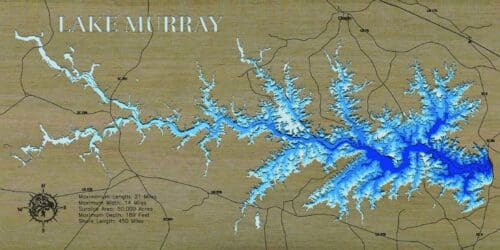
When B.A.S.S. announced Lake Murray as part of this year’s Elite Series schedule, I got excited. The tour visited there in 2023, and I made it to Championship Sunday and cashed a big check. The fishing was fun, too. But that was a few weeks earlier in the season, so I wasn’t sure what to expect this time around.
Murray is one of the best schooling bass lakes in the South. Its 50,000 surface acres are defined by countless pockets and points, and the points are precisely where the bass intercept their favorite forage — blueback herring.
The schooling activity on Lake Murray is so widely known, that thousands of anglers ply its waters each year — many during the workweek. So accessing the better points is oftentimes a challenge. When you finally do get something to yourself, then it’s a process of figuring out how to fool the bass into biting.
Lake Murray’s largemouth population is among the best-trained fish in the country, and they are not easy to trick. Nevertheless, this event was sure to be a shootout.
Practice Begins
At daylight on day 1, I launched at Dreher Park — our official headquarters for the event. From there, I ran a series of small points within sight of take-off.
As expected, the fish were up and schooling, but not in the numbers I experienced the previous year. Among my lure choices were a small Hildebrandt Drum Roller swimbait, Pencil Popper, Shimano World Pop, Zumverno and World Minnow, Zoom Fluke, and Yamamoto D-Shad.
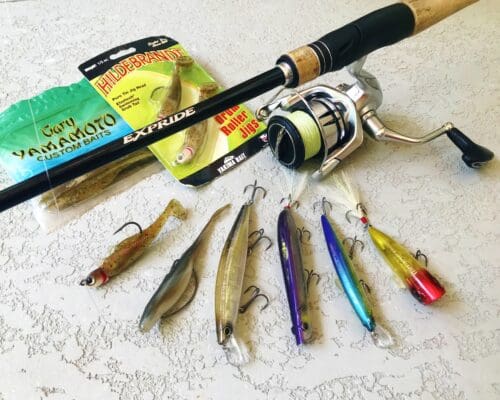
In just two stops, I figured out their preference for the fluke-style baits. By late afternoon, I had found more than a dozen productive points, but none that I felt held the winning fish.
Would this be a run-and-gun type of derby, or could I find one or two places that would carry me through to the final? That was the dilemma, and I had less than two days to figure it out.
On day 2, I ran up a major creek to try the riprap on a small bridge. In minutes, I put several 14-inch keepers in the boat. But that was it. No big ones.
From there, I started running small points from the back of the creek. When I hit the third one, I found a school of three-pounders eager to bite. Filing that away, I continued from point to point, heading back to the main lake. But as I searched for prominent points, it was apparent my fellow competitors were making the same moves. As soon as a good-looking point would open up, another boat would move in.
To avoid the congestion, I ran way south toward the dam. That’s when I found what I was looking for.
On one of the largest, most obvious points on the lake, I found large numbers of bass and stripers feeding in a frenzy. In the middle of the melee was a local boat, struggling to catch them. Rather than crowd them, I stayed on the perimeter, watching intently to pinpoint the key spots. Thirty minutes later, I knew where to be when I returned.
From there, I started running the bank in search of late-season spawners. Almost immediately, I found male bass guarding their nests, and others guarding fry. Some were in the 3-pound class. Seeing the potential, I continued the search throughout the rest of the afternoon.
On day 3, I returned to the southern portion of the lake to look for other productive points. At the mouth of a big bay, I found one holding a good number of schoolers. Unfortunately, other competitor boats stopped while I was there, and I knew the chances of securing it during the competition would be slim.
I spent the remainder of the day looking for bedding bass and males guarding fry.
Tournament Time
As luck would have it, I drew out boat number eight. That meant I would likely get to start where I wanted.
After the Morning Prayer and National Anthem were complete, take-off began.
When my number was called, I proceeded through checkout and then raced south to the large flat point where the local boat sat during practice.
Would they be there when I arrived, or would someone else be there?
Knots formed in my gut, but as I got closer, I could see the point was unoccupied. My adrenalin instantly spiked. And when I got the boat into position, the fish started blowing up right on cue.
Unfortunately, as they schooled, their focus was on the herring exclusively. I tried switching lures and the angle of retrieve, but all that got were swipes and short strikes … not a single hookup.
Finally, I broke the ice with a 2-pounder. But that was it. And not long after, they stopped schooling altogether. I tried provoking them with a variety of topwaters and bottom-probing soft plastics, but they showed zero interest. It was sickening; within a cast of my boat swam 100-plus pounds of Lake Murray largemouth, and I couldn’t make them bite.
Fully dejected, I moved to try the other point closer to the dam. But when I arrived, two boats were already sitting directly on the juice. Seeing that, I decided to try some nearby bedding fish. That’s when I caught my next keeper — a 3-pounder.
By this time, it was getting close to noon and I desperately needed a fish.
Finally, a half-hour before check-in, I caught my third keeper. But that was it. When I reached the scales, I registered a pathetic weight of 7 pounds, 9 ounces.
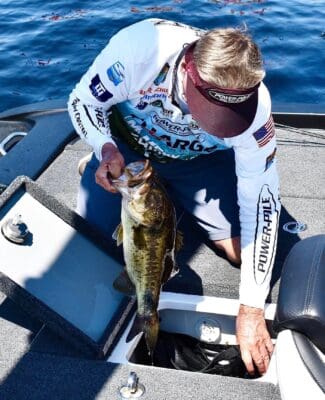
Complaining to fellow pros David Gaston and Todd Auten, I learned my presentation was off. They claimed the fish didn’t want an erratic, fast-paced retrieve. They wanted a lazy, slower presentation … something I failed to deliver during that morning’s feeding frenzies.
Filing that away, I headed for the nearest gas station, then back to the house to rig my tackle.
A Chance for Redemption
On day 2, the take-off order reversed and I was now boat 95. I figured there was no chance of getting on the big point down south — at least not to start — so I opted to try a small, inconspicuous point nearby.
When they called my number, I exited take-off and headed straight there.
As I pulled in, I noticed a strange calm. It was almost too still, and within minutes, it was obvious the fish weren’t going to school. Apparently, others within range were experiencing the same, as none of them were casting to breaking fish. Still, I managed to trick two into biting — a bare keeper and a hefty 3-pounder.
Unable to fool any others, I decided to try the small bridge at the back of the creek — the spot where I got several keeper bites in practice. But after a quick pass and no action, I told my marshal we were headed south, to see if we could get on the big point.
Twenty minutes later we arrived and, to my surprise, no one was there. The same calm we experienced earlier still pervaded. Ignoring it, I cast the D-Shad to the highest percentage areas, hoping for a connection.
Ten minutes later, I set the hook on my first quality fish of the event — a 4-pounder.
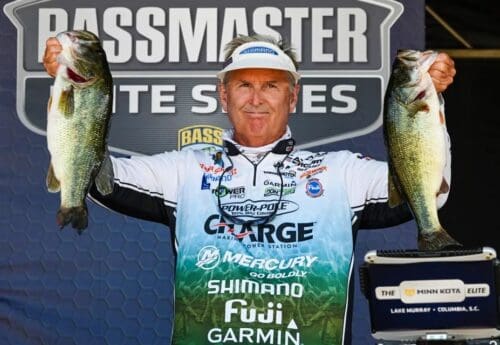
A short while later, I connected with another slightly bigger. The slower presentation was working! And by day’s end, I managed to put 20 pounds of Lake Murray largemouth in the livewell — enough to make a check and salvage some pride.
Next is Lake Wheeler in Alabama. Stay tuned…