2024 Toledo Bend B.A.S.S. Elite
Posted by Bernie Schultz on Mar 24th 2024
Certain tour stops on the Bassmaster Elite Series are considered favorites. Toledo Bend is one of them. Big fish swim in that lake and, during early spring, the chances of catching a trophy-size bass are high … especially if the weather is favorable. That’s when the first wave of spawners moved to the shallows, and that was my hope going into this event.
However, after learning of an impending cold front, I knew the larger percentage of fish would remain offshore. With that, I knew that forward-facing sonar (FFS) would likely play a significant role in the outcome.
Part of the Sabine River drainage, Toledo Bend Reservoir separates Texas from Louisiana. It’s nearly 65 miles long and chockful of prime bass-holding habitat. Finding the most productive areas would be the challenge.
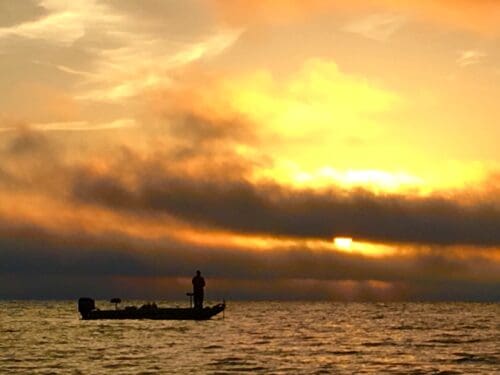
Practice Begins
On day 1, I launched on the Texas side of the lake, near the Indian Mounds. After spending an hour or so there, I rounded the corner into Hausen Creek — a large tributary known for its expansive grassbeds and countless numbers of fish.
Advancing along the bank, I began noticing empty beds. Apparently, a previous front had pushed those fish back out into open water. Left behind were some cruising males, some of which were in the 3-pound class. I recorded their locations with my Garmin GPS and continued along the shoreline, eventually stopping at a shallow grass flat. Using the Panoptix, I found a drain leading into a spawning pocket, and with it, what appeared to be staging fish holding on the drop-off.
Immediately, I scored several fish up to 5 pounds by jerking a Shimano World Minnow in a shad pattern.
After that, I moved to the next drain down and scored again. The remainder of the day was spent trying to replicate the pattern. Unfortunately, only the first two spots produced.
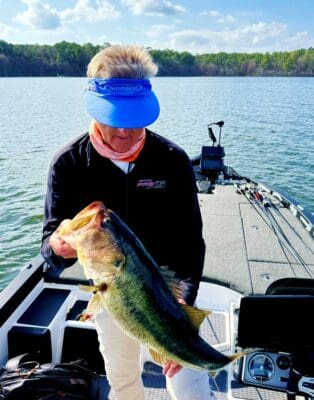
On day 2, I trailered to Cypress Bend — our official launch site for the tournament. The area was smothered with thick fog, so I idled cautiously to nearby Negreet Creek.
By 9 am, the fog lifted and I decided to head upriver to a large spawning flat. There, I caught several random fish on a red Rat-L-Trap, but nothing more. Debating my next move, I decided to go south and expand on what I had found the previous day.
On the final day of practice, I launched at Indian Creek near the dam. And within the first 30 minutes, I discovered a school of fish off a main lake point.
Utilizing my Garmin Panoptix, I targeted individual fish by throwing a Yamamoto D-Shad on a 1/4-ounce jig head. And nearly all reacted positively to the bait.
From there, I moved to the dam but found nothing.
My next stop was to Six Mile Creek, a large tributary located just below Hausen. Again, I found healthy grass, but very few fish. Of those I could identify as bass, none would respond to any of my presentations.
The rest of the afternoon was spent searching between Six Mile and Indian Creek to no avail.
Tournament Time
On the first morning of competition, I decided to make the long run down to Indian Creek and try the scope fish first. On arrival, I deployed the trolling motor only to discover the steering on the foot pedal wouldn’t respond. In a panic, I called the service tech back at the ramp and asked for help. He advised me to kill the power for 30 seconds and allow the trolling motor to reboot. I tried that twice with no success.
At that point, I was limited to a handheld remote, which in some cases is fine. But I was trying to sight-fish using FFS in heavy winds.
Picture trying to steer with a remote in one hand, spinning rod in the other, and a foot on the trolling motor for power … all while chasing moving targets on a 12-inch Garmin Echomap screen. Needless to say, it was a serious challenge. And by day’s end, my weight reflected it.
I managed only two fish— a two-pounder and a seven-pounder. What made matters worse was when I reached the service yard and discovered I was tripping the wrong breaker. Unlike the trolling motor — which is connected to a breaker leading to two 36-volt lithiums — the foot pedal was wired to the 12-volt side. All I had to do was trip that breaker and the trolling motor’s steering would have been restored. I felt like an idiot.
Exhausted and humiliated, I left to refuel and prepare for day 2.
Another Chance
When they called my number the next morning, I exited Cypress Bend and raced to my starting spot, then dropped the trolling motor. This time, my Panoptix wouldn’t function. Without it, I was lost.
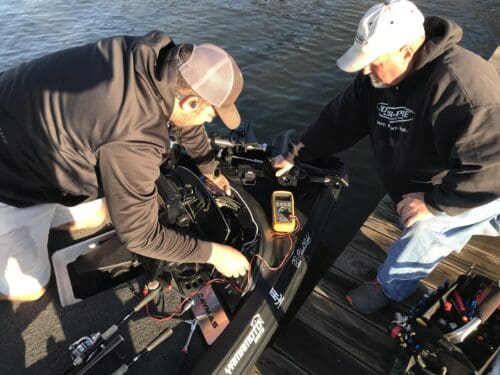
I called the Garmin tech and he walked me through several procedures, hoping to troubleshoot the problem. But nothing worked. So I decided to make the long run back to take-off, to let him work on it firsthand. That’s when we discovered a wiring issue that was starving the ‘black box’ for power. And without adequate juice to that box, Panoptix cannot function.
Immediately, the entire service crew jumped in to assist. And with some temporary wiring, I was back on the water by 10:30. Thirty minutes later, I was casting at individual fish cruising through the water column.
It took a while to settle my nerves, but I eventually put three fish in the box. Then the bite died. I decided to move to Hausen Creek and try a jerkbait in the two drains found during practice. Before I knew it, however, the day was done.
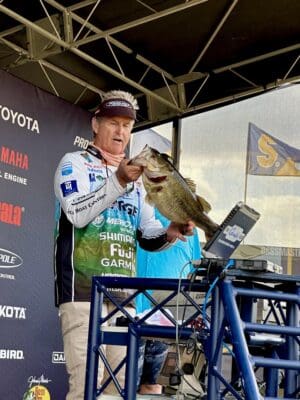
Back at weigh-in, I registered a measly six pounds of bass. My tournament was done, almost before it started. And I was fit to be tied.
Although mechanical issues are a part of the game, they’re never welcome. And they can be very costly. My hat’s off to the guys in the service yard. Without them, I would have finished dead last.
Next is Lake Fork, so stay tuned…