Beatin' the Bank - 2020 Lake Champlain B.A.S.S. Elite
Posted by Bernie Schultz on Sep 2nd 2020
By Bernie Schultz
Stretching more than 100 miles north to south, Lake Champlain is a massive fishery. It’s deep like an ocean and when the wind blows from the south, watch out! It can produce swells capable of capsizing even the largest vessels.
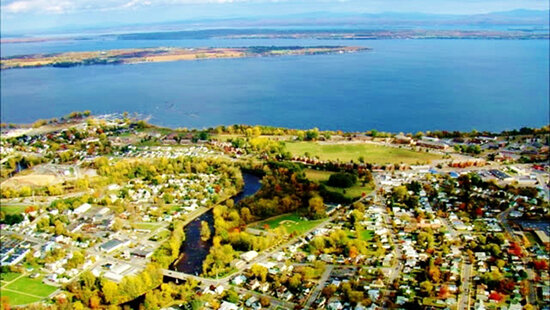
A view over Plattsburgh, NY with the Inland Sea in the distance.
For the bass angler, Champlain offers a diversity of habitat — including shallow weedbeds for largemouth and deep structure for smallmouth. Both species thrive there, and when it comes to tournaments, it’s imperative to find quality-sized fish.
Coming off a strong finish at the St. Lawrence River, I was anxious to keep the momentum going. Although Champlain is only a few hours from the Seaway, it fishes completely different. Its smallmouth feed more on perch, alewives and crayfish — not gobies. The smallmouth are plentiful and healthy, but not quite the average size of those found on the St. Lawrence.
The largemouth, on the other hand, are bigger. And they’re often grouped in large schools. In fact, it was green fish that constituted the bulk of my catch during our last event on Lake Champlain.
Anxious for a repeat performance, they were my initial focus.
Getting Started
On day one of practice, I drove straight to Ticonderoga — some 70 miles south of our headquarters in Plattsburgh, New York. That’s where the biggest number of largemouth are found. “Ty,” as it’s referred to, is covered in grass, and the bass use it almost exclusively.
Upon arrival, I noticed a dramatic drop in the water level; it was 4-feet lower than normal. Consequently, most of the grassbeds were too shallow to hold any quality fish. Forced to the edge in most areas, I rotated through several lures — including a Terminator Shuddering Bait with Yamamoto Zako trailer, 1/2-ounce Hildebrandt Tin Roller spinnerbait with tandem willow blades, and a Rapala Brat crankbait.
Although I caught good numbers of fish, all seemed to come randomly in no specific areas. The largest was four pounds. The rest were just two pounds apiece.
By day’s end, I had decided to abandon the area completely and shift my focus to the upper sections of the lake.
The next morning, I ramped in at Wilcox Park — near our official take-off site at Plattsburgh Marina. From there, I ventured to the Inland Sea, fishing a few spots along the way.
One stop was to a shallow bay, topped out in milfoil. Using a Terminator Popping Frog, I coaxed three nice bass to the surface — one of which was five pounds. I stored the numbers on my GPS, then headed farther east. As the day wore on, I moved from shallow to deep — finding smallmouth holding at a range of depths.
By early afternoon, I moved to a flat adjacent to a large island. Using my Garmin side imaging, I found fish relating to a deep grass edge in 16 to 18 feet of water. They were eager, too. In minutes, I caught several quality smallmouth using a Yamamoto Shad Shape Worm rigged to a VMC size-2 Octopus hook and 3/8-ounce Terminator tungsten weight. It was almost too easy.
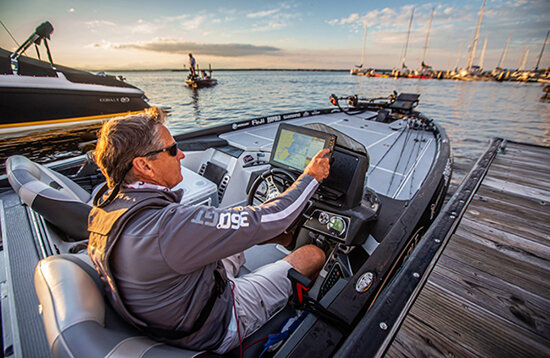
Making a last-minute decision on where to begin the competition.
Recording those numbers, I moved to other deep grasslines looking for more of the same.
On day three of practice, I decided to try Mallet’s Bay at the town of Burlington, Vermont. There, I concentrated on docks and mooring buoys. Although I caught a number of largemouth, only one or two were of the size required to do well in the event. At that point, I knew my best chances were with the deep smallmouth I found in the Inland Sea.
Competition Time
Having an early draw in the take-off order, I decided I’d make a quick stop on the mat of milfoil where I caught the 5-pound largemouth. When my number was called, I headed straight there.
The conditions were calm and warm, almost muggy. There was very little surface activity. I threw the frog with no success. Determined, I switched to a punch rod with a heavily weighted Yamamoto Fat Baby Craw in the green-pumpkin color.
The minutes passed when I finally got my first bite. It was a 4½-pounder, long and lean. With that one in the livewell, I kept pitching to the mat’s edge … hoping for another strike. It never happened.
Anxious to try something else, I pulled the trolling motor and headed to my smallmouth spot.
In minutes, I was catching quality fish — all of them falling for a perch-colored Shad Shape Worm. Just as it was in practice, the bites came frequently. And in a few hours, I culled to a 17-pound stringer. Satisfied, I opted to leave some for the next day.
On day two of the competition, I decided to reverse the order and start on the smallmouth first. Again, I caught fish at will. By noon, I was culling 3-pounders. Believing I had enough weight to make the cut, I decided to try some shallow docks and grassbeds for largemouth.
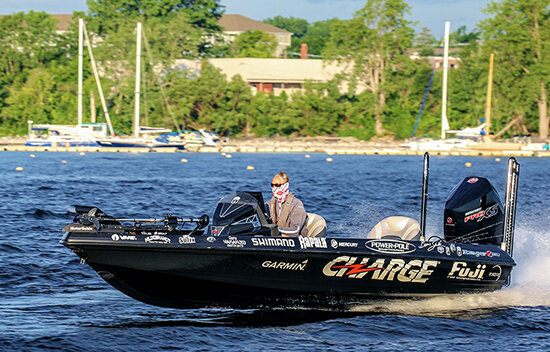
Heading for weigh-in at the Plattsburgh Marina.
In one particular bay, I skipped a 1/2-ounceTerminator Jig with Fat Baby Craw trailer beneath the catwalk of a super-shallow dock. My line started swimming sideways. When it came tight, I set the hook on another 4-pound largemouth.
Again, I was taking 18 pounds of fish to the scales … knowing I had enough to fish on Saturday.
Fishing on the Weekend
Having plenty of fish and no company to worry about, I looked forward to the day ahead. When my number was called, I exited Plattsburgh Marina and headed straight to my deep-water smallies.
Upon arrival, I decided to begin at the opposite end of the grassline and work into the breeze. Rather than going deep, I moved inside and started with a Rapala Skitter V topwater walking bait. That produced two quick strikes, one of which was a hefty 4-pounder.
An hour later, I had three nice smallmouth in the box. When the topwater bite slowed, I moved to the outside edge of the grass and switched to a drop shot.
By noon, I was culling 3-pounders. Having one well over four pounds, I knew with a couple more I could make the Top-10 cut for Sunday.
An hour later, I caught another 4-pounder. Pumped, I kept working the sweet spots within the grassbed — pounding it like there was no tomorrow. Unfortunately, I wasn’t able to coax any more big fish. In a Hail Mary effort, I raced to some shallow docks near Plattsburgh … hoping for one last largemouth to get me over the hump. It never happened. I finished the event in 19th place, two pounds shy of the Top-10.
In all, it was a good couple of weeks in New York. I climbed more than 30 places in the AOY standings, and next up on the schedule was Lake St. Clair in Detroit — another smallmouth bass factory.
Stay tuned …