Beatin' the Bank - 2020 Lake fork Texas Fest
Posted by Bernie Schultz on Dec 3rd 2020
By Bernie Schultz
After a long, drawn-out season of postponed tournaments, the Bassmaster Elite Series was finally down to one final event — Texas Fest on Lake Fork. A lot was riding on it, too. My hopes of qualifying for another Bassmaster Classic were at stake.
I could see the finish line, but how would it end?
Those thoughts filled my head as I reached Sugoi Lakes Lodge — Gary Yamamoto’s hidden retreat, 15 minutes from Lake Fork. There, along with Jay Yelas, Brandon Card, Cliff Prince, Scott Canterbury and Chad Pipkens, I would spend the final week of the season.
Last year, I finished strong at Lake Fork, and I was hoping for a repeat performance. But that was a springtime, sight-fishing event with plenty of schooling fish. This was late fall and the water had receded to the point that many of the places I fished before were now too shallow.
It was a new lake to dissect with little time to do it in.
Practice Begins
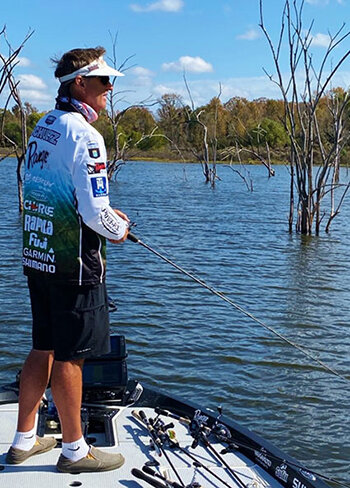
Shallow standing timber and stumps became my primary targets on Lake Fork.
On day one of practice, I accessed the eastern side of the reservoir at the Minnow Bucket — a popular ramp and tackle shop. From there, I ran north to the Hwy 154 Bridge to scan its pilings. Seeing nothing that resembled a school of bass, I moved to a nearby point. Almost instantly, my Garmin SideVu lit up revealing a school holding at 12 feet of water, and another at 20 feet. Although none reacted to deep-diving crankbaits, they did fall for a finesse approach.
After shaking off numerous fish, I marked the location of both schools on my GPS then moved farther up the reservoir to some similar points.
By afternoon, with nothing gained, I abandoned the deep search and started fishing creeks and coves. In one particular area, I got several bites around shallow, standing timber — cranking a square-bill and pitching a ½-ounce jig tipped with Yamamoto Fat Baby Craw trailer. One fish was pushing four pounds.
After that, I moved to a stretch of bank down lake. Fishing a series of small pockets along the shoreline, I connected a few nice fish — the largest of which weighed six pounds.
On day two, I started at the dam throwing a variety of topwaters. In one particular stretch, I got two quality bites using a Rapala SkitterWalk. From there, I ventured up the west fork to check several stretches of main lake bank. Again, I caught fish, but they were short of the 14-inch minimum length requirement.
In the afternoon, I tried the backs of a couple of coves. One held some decent fish, but the boat traffic was too excessive. I knew others would likely return during the competition.
On day three, I returned to the western fork and fished toward the backs of several large creeks. The fish were scattered at best, but I did manage a few nice keepers up to five pounds. Although I was unable to zero in on anything specific, I still felt the patterns I developed would carry me through the event.
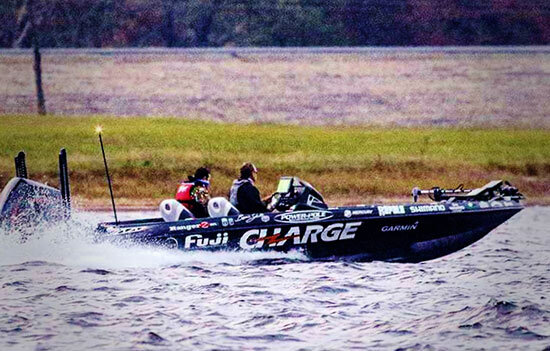
The dam was one of my first stops on Lake Fork.
Competition Begins
The first morning of the competition was crisp and clear with temperatures in the upper 40s. When my number was called, I exited the take-off area and motored toward the dam to start my day.
As I approached the best stretch, I noticed fellow Florida pro John Cox already there. I immediately spun the boat 180 degrees and headed up the east fork to the point near the bridge. When I lowered the trolling motor to activate the Garmin LiveScope, I couldn’t find the schools of fish I’d found in practice. They were no longer there.
I made a few casts anyway, hoping for a stray bite or two, but they were all gone.
Thinking they might have moved shallower, I fished the entire point all the way to the bank. After catching a couple of short fish, I realized it was futile. From there, I relocated to a nearby cove of standing timber, where I scored a few bites in practice.
The minutes turned to hours and, by early afternoon, I had scored only two fish — a bare keeper and a 4½-pounder.
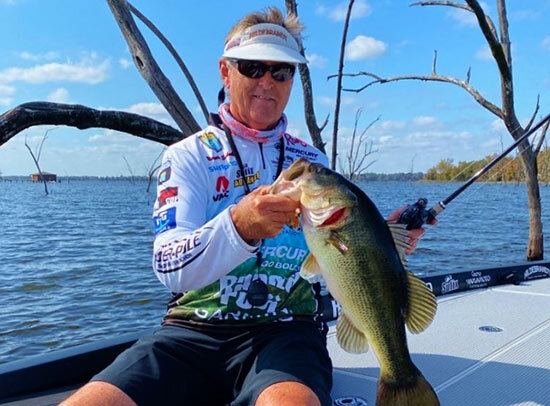
This 4-pounder gave me hope on day one of the competition.
Having little time to spare, I moved closer to weigh-in to try the stretch of main lake bank I found in practice. I banged the square-bill off every piece of wood within range, hoping for a reaction. Suddenly, out of nowhere, a school of bass erupted in the shallows … shad flying everywhere. I fired the crankbait toward them and as soon as it touched down, one struck. I set the hook and watched as a solid 3-pounder jumped out of the water and sling my lure.
With that one gone, I reeled as fast as I could to make another cast … but, as quickly as they had appeared, the school vanished.
Ten minutes later, I plowed the square-bill through a leaning tree and another 3-pounder grabbed it. After two jumps, I guided the fish toward the gunnel when it, too, pulled free. I watched as another three pounds of raw weight went back into the lake.
Disgusted, and with only minutes to spare, I pulled the trolling motor and headed to check-in … the whole way thinking my Classic chances were gone.
Back at weigh-in, I learned I was only a few pounds off the pace. There was still hope. I just needed a solid second-day effort and I could still make it.
One Last Gasp
The next morning, I raced to the best stretch on the dam to begin my day. An hour later, I had nothing to show for the effort. I then pulled the trolling motor and ran back to where I ended the previous day.
Things were quiet and still … too still. After an hour of cranking the stumps and timber there, I decided to gamble and go way up the left fork to the back of Birch Creek. Some of the guys at the lodge reported having good catches in the backs of creeks, so I thought I’d give it another try.
Dodging a gauntlet of logs and stumps, I fished my way toward the very back. In minutes, I had my first fish — a bare 14-inch keeper. Two hours later, nothing.
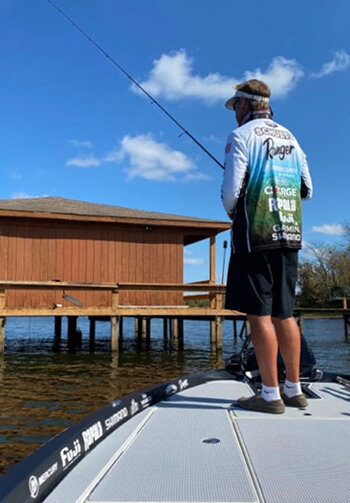
Shallow docks held fish, some of which were big.
With only one other boat in sight, I wondered if I was in a dead area. Pondering that, I tried mixing it up with a variety of lures and techniques. Nothing seemed to work. If not for the amount of shad present, I would have left much sooner.
Finally, after another wasted hour, I pulled up stakes and moved to another creek.
After idling through a large field of stumps, I eventually pulled up to a row of shallow docks surrounded by giant lotus pads. Because of the pads, I switched to a Chatterbait with Yamamoto Zako trailer, skipping the lure at all angles beneath each platform. When I reached the shallowest dock, I made a lengthy skip-cast to the backside when a large fish engulfed the bait.
Leaning hard, I pulled it free of the first group of pilings, then a second. As the fish cleared the final set, it ripped line to one side and came thrashing out of the water. It was a solid six pounds! Attempting to pull her back in my direction, she stopped, turned, then tore free and swam back beneath the dock. I slammed my rod to the deck and shouted in horror. I knew then, my Classic hopes were gone.
In the remaining hour, I forced one more keeper aboard but the tournament was over … and with it, my season.