Hawk Uses a One-Two Punch for Lake Mead Win
Posted by David A. Brown on Sep 24th 2020
By David A. Brown
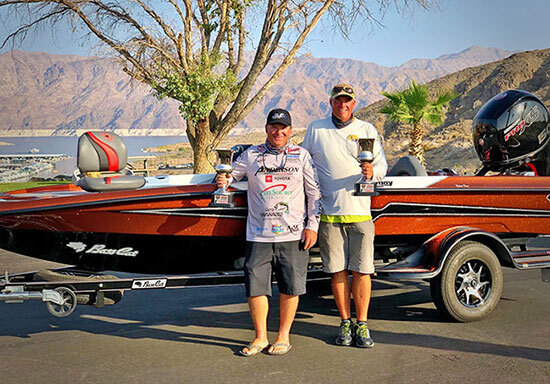
Knowing how fickle fall can be, Western stick Roy Hawk employed a seasonally-savvy game plan to win the Wild West Bass Trail’s Arizona Team Championship, Sept. 19-20 on Lake Mead. Partnering with Mark White, Hawk mounted a two-stage attack designed to capitalize on active and inactive fish to thoroughly exploit his areas.
The result: A dominant performance that yielded a 2-day winning weight of 27.76, which outpaced the second-place team by nearly 7 1/2 pounds. Such heroics don’t just happen. On this often inconsistent autumn playing field, it takes not only physical performance, but also a solid cerebral element — discerning what your finned opponents are up to and making the necessary adjustments.
“The key was rotating different baits in each given area,” Hawk said. “Once you locate a good area, you can catch a few on a reaction bait early or if you get a little bit of wind and then things kind of settle down. If they’re not feeding on shad, they hunker down in certain areas; it could be by a little grass clump, a big rock, or a dock.
“On Lake Mead, it was mostly rock and grass and brush that they’d sit by. They’re just chilling out in these scenarios, so slowing down with plastic lures is definitely the deal..”
Now, that’s a solid generalization offering a workable baseline. Consistency, however, requires constant awareness, analysis and open-minded flexibility.
“The key is to not get locked into one idea,” Hawk said. “You have to pay attention to what the fish are doing and respond with the right presentations.”
Hawk offers a few more pointers on fall fishing.
TRANSITION TIME
Once fall establishes a firm hold, Hawk’s principles become increasingly more relevant. The Wild West Bass Trail event, however, took place on the seasonal transition’s leading edge. Mead had just starting shifting from summer to fall and, while a good number of fish remained deep, Hawk was able to capitalize on the emerging patterns.
“We fished a whole section of the lake and targeted fish in the backs of pockets,” Hawk said. “That’s pretty standard this time of year; stripers push bait back into the pockets and largemouth sit back there and ambush them.
“You start by visually looking for shad or striper activity — fish blowing up. It’s like ‘Oh yeah, that’s probably a good spot. It’s pretty obvious, but in some (pockets), you just have to go in a fish around and see what you can find.”
As Hawk explains, the active fish could be aggressively feeding practically anywhere in the center of a pocket or bay. Between feeds, inactive fish will move to the edges, where they’ll always relate to some type of cover — a bush, a grass clump, a big rock.
“A lot of times, you can pattern it and that gives you a starting point when you go from one pocket to the next pocket,” Hawk said. “So, if you caught one on a secondary point or a bluff wall, or something like that, you can go to the next pocket and try it; at least start there.
“But you may find them in one pocket on a bluff wall and then you go to the next pocket and you find them on the outside grass line. But it’s good to have a starting point; something you can drive right to and match up with the previous spot.”
Essential to fall fishing is realizing that, despite the season’s often scattered complexion, there’s typically a formula for dialing in your search. Fish preference changes often and for whatever reason, some set of variables typically makes a particular scenario a consistent producer
“Just knowing that they’re going to be by some type of structure is really key; it’s not just random casting,” Hawk said. “If they’re not on a bluff wall, you’re trying a secondary point, or you’re trying an individual rock, or you’re trying the outside grass line. So when you get into an area, you’ll end up with four or five different targets to try and extract as many as you can out of one spot.”
Something to mention: The notion of bouncing from pocket to pocket, versus camping on a key area has a lot to do with what the lake has to offer. Simply put, some fisheries are blessed with greater numbers. It is what it is, but understanding your playing field helps with the game day decisions.
“In the Lake Mead event, we hit 10 different pockets,” Hawk said. “Having a milk run in the fall is key, especially on fisheries like Mead where the bass-per-mile is low. But on a heavily populated fishery like Lake Roosevelt, I’ll stay in one good area all day.
“A school on Lake Mead is like four bass, but a school on Lake Roosevelt can be 50-plus. I won an ABA team tournament on Roosevelt and we spent 90 percent of our time in one little creek and caught a ton of them.”
WHAT TO THROW
During the Lake Mead win, Hawk started with an Evergreen Shower Blows topwater for about an hour, but surprisingly, the fish weren’t interested. After that, slowing down with a jig got the party started.
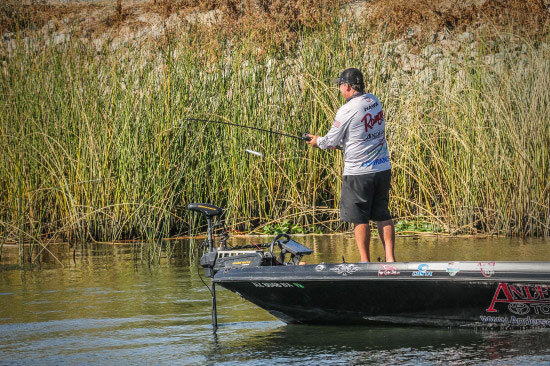
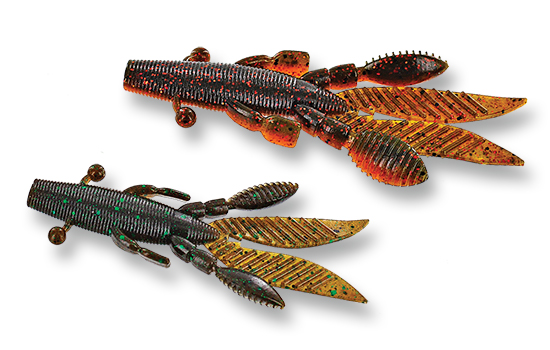
Hawk alternated between a 1/2-ounce green pumpkin flipping jig with a green pumpkin 5-inch Yamamoto Twin Tail and a light wire football jig with 4-inch Yamamoto Twin Tail. He also mixed up the presentations by pitching a Texas-rigged Yamamoto Mermaid, which showed the inactive fish a different look and triggered a few bites.
Every now and then, Hawk would check for active fish by cranking his areas with an Evergreen Flat Force. As he notes, fall bite windows could turn on throughout the day, so mixing in a few high-speed retrieves often leads to brief rallies.
Depending on where he’s fishing, Hawk’s fall 1-2 punch game plan might also include:
Yamamoto Buzzbait — He’ll remove the skirt and add a Yamamoto Ika, YamaFrog or a D-Shad. This bulky profile allows for long casts to schooling fish and shallow isolated targets. (Read about how and why Roy does s this here.)
D-Shad — Rigged on a wide-gap hook, this baitfish profile is a good choice for quick hits to breaking fish and for bringing a different profile past those shallow targets.
Shad Shape — A superb choice for the dropshot, this subtle form does a great job of subtly probing cover and tricking the ones that are taking a siesta.
“Generally in fall, there will be peak windows when they’re going to be active,” Hawk said. “That could be early morning, or when the wind comes up, or later in the afternoon when the water’s a little warmer. It could also be stripers pushing bait and activating the bass.
“When these windows occur, you want to use something you can cast fast and take advantage of the opportunity. But once the bite slows down, switching to a different presentation will allow you to clean up the area, target specific structure and get a few more bites.”
THE TAKEAWAY
Fall is a dynamic time. Fish move out of their summer lethargy with one objective: feeding up for winter’s lean and mean reality. That often means great potential, but with fish typically scattered, it may require a lot of fuel consumption. On the other hand, lucking into a stacked pocket could be the day-maker.
“In the Lake Mead event, we stuck to a region of the lake that can work really good in the fall,” Hawk said. “From practice, we knew that fish were in (certain) areas and we just had to slow down in those areas.”
A big part of the equation is the ability to read the conditions and realize that nature changes. There’s not always a definitive explanation, but assuming that past success ensures an annual repeat is folly.
“I won the 2015 U.S. Open on Lake Mead almost on the same weekend as the Wild West Bass Trail event,” Hawk said. “Water level was exactly the same and conditions were very similar. But the way that I won was totally different.
“In 2015, I caught 90 percent of my fish on a topwater bait. I moved from one spot to the next spot, to the next spot, to the next spot. In this year’s event, I moved to only a few spots, slowed down and extracted what was there. The fish were telling me they were there, they just weren’t that active. This time taught me to slow down a little bit.”
Hawk’s summary: “In the fall, you can have amazing bite windows where everything’s biting and it’s fun. But a lot of times, it’s just not that way.”
That’s why you gotta know the 1-2 punch.