Rob Gee and The Shad Shape Worm
Posted by Mark Fong on Sep 13th 2024
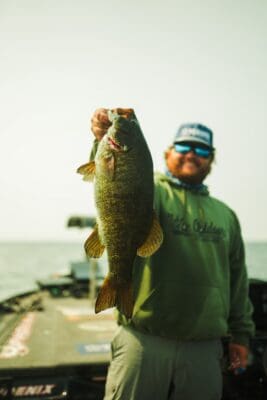
Robert Gee of Knoxville, Tennessee has had quite the start to his young Bassmaster Elite Series Career. With four top five finishes, he has spent a lot of time competing on Championship Sunday. During the latter part of the season, Gee has been on fire with a 2nd place at Smith Lake, a 3rd place at Lake Champlain and most recently another runner up finish at the St. Lawrence River. Much of Gee's success can be attributed to his knowledge of offshore fishing, his proficiency with forward facing sonar and his skill with a jig and minnow combo. Recently the Yamamoto Pro, spent time with the Inside Line, sharing some of the key particulars that have fueled his success, including how he relied on an old Yamamoto favorite, the Shad Shape Worm.
Smith Lake
Gee spent the Smith Lake tournament in open water chasing big spotted bass that were keyed in on schools of herring and threadfin shad. He focused on both individual and groups of suspended fish. During the four day event, 16 of the 20 fish he took to the scales were caught on a Natural Shad colored 3.75” Yamamoto Shad Shape Worm.
The deepest fish Gee caught were suspended at 40', over 200', however the majority of his fish were taken in the 25' range. Gee was casting at fish a long way from the boat and trying to hit them accurately. “The Shad Shape Worm is flat sided and it shoots down in the water column quickly,” he explained. “It really allowed me to get to the fish fast when I saw them and not miss them. It also has a super realistic profile and when I shake it on a 3/8 oz head, it has a lot of action, much like a drop shot.”
Gee concentrated on an area near Smith Dam that held the clearest water on the lake. “I am talking about 10 feet of visibility,” said Gee. “The fish were really skittish because it's Alabama and those fish have seen plenty of minnow baits and are conditioned to anglers with Livescope. Usually on non pressured lakes you can throw at fish 50' away from your boat and get them to bite, but if these fish were within 75' of your boat, you could not catch'em. I would try to find them out past 80' and if they came closer than that I knew I would get just one chance to catch them. If I didn't catch them on that cast they weren't gonna bite because they would feel the presence of the boat. Whenever I found them at that 120' range, I would run the boat so that I could get them into that 80' to 100' range. I would cast pass them to the 110' range and bring the bait to them. It's kinda of like bed fishing where you don't throw right on the bed, you throw past the bed and bring it to the fish. When they're out past 80', you have to be really good at putting your bait right on them. You have to line them up with brightest return you can get and cast at that bright return and that's where you have to hit them. It takes a lot of practice. It's kind of like Tom Brady throwing a deep post route to Randy Moss.”
When Gee saw a fish move towards his bait, he would start shaking it. If the fish started to track his Shad Shape Worm, he would attempt to get it to commit by speeding up his retrieve. “Usually the fish just barely grabbed it,” he explained. “ A lot of the fish at Smith were very finicky so they would come up and grab the back end of the tail and if you jerked on that first feel, you would just reel your bait in with no tail. I had to keep shaking it and reeling until the rod loaded up and then I would just pull into them.”
Lake Champlain
“Champlain was my favorite tournament of the year, it was incredible, I caught a lot of fish everyday, it was so much fun,” said Gee. “I focused on two areas of the lake, the Inland Sea and Mallets Bay, where the smallmouth were feeding on alewives and perch. The bait fish at Chaplain were different than I was used to. I saw schools of alewives up high in the water column but I also found schools of perch that were sucked down to the bottom. The perch were really the key, all the four plus pound fish I caught were eating perch and all the three pounders were eating alewives.”
Gee fished water from 35' to 50' deep. “The fish were eating the perch near the bottom but I could only get the fish to react and eat my bait whenever they were swimming back up from the bottom,” he explained. “They wouldn't swim around down at the bottom that much, they would only swim around in the middle of the water column and that's where I would throw to them. Most of the fish I caught were probably 20' deep and I wasn't really finding a whole lot of schools of bass, except on the last day. Most of the fish were singles or doubles.”
In order to best match the size of the perch, Gee chose a 5” Natural Shad colored Shad Shape Worm. He primarily threw it on a ¼ oz tungsten jig head but would upsize to a 3/8 oz size if the wind was blowing.
St. Lawrence River
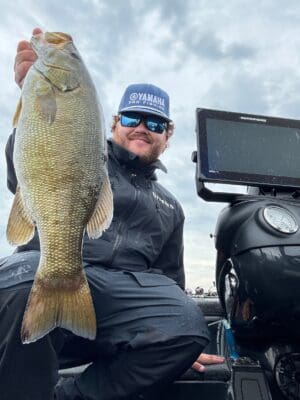
Gee had a horrible practice period at the St. Lawrence River. He found only one good area, a single 70 yard stretch of river near Carleton Island that he described as a ledge similar to the Tennessee River. It was here, that he ended up fishing the entire four days of the tournament.
“I kind of figured them out better day one,” tipped Gee. “I discovered that if I threw a ¼ oz head in the current, it took longer to get down to the fish, and I wasn't throwing at fish like I was at Smith Lake and Champlain. I was throwing at rocks and shelfs that were facing into the current and the fish were so tucked down in the little eddies down there at the bottom that you couldn't see them on Livescope but I could see them come up out of the rocks to eat my bait.”
According to Gee, he spent the entire tournament casting to rocks in 30' to 40' of water and the smallmouth would show themselves as he worked his 5” Natural Shad colored Shad Shape Worm jighead minnow combo 5' or so above the rocks. During the course of the event, Gee said that the fish were very skittish and that they showed a preference for a slower natural fall created by the ¼ oz head and in fact, the only time the fish would bite a 3/8 oz head was when the wind was blowing hard and it was difficult to fish.
A final factor that positively impact his success was the manner in which he worked his bait. “I was putting a lot of action into the bait,” explained Gee. “The current puts a lot of drag on the bait and dilutes its action, so I had to over exaggerate the action I was putting into the rod, I really had to shake it to get them to bite.”
Gearing Up
When Gee targets spotted bass or largemouths, he opts for a Loomis NRX 852 7' 1” medium action spinning rod that he pairs with a Shimano Stella 3000 reel. “The rod has an extra fast action and I feel I get really good hook penetration with it,” he explained. “The Stella reel is a powerful reel and it allows me to horse the fish a little bit more.”
Gee prefers a different rod and reel combo for smallmouths, a Loomis Conquest 842 7' medium action spinning rod matched to a Shimano 3000 Exsense reel. “The rod has a deep parabolic bend that has a bit more give,” Gee offered. “When those smallmouth do all there crazy head shaking and jumping, my rod is always bent and I feel like it keeps them pinned. I am throwing a different reel as well, the Shimano Exsense is more appropriate for finesse applications and it is a lot lighter so when you have a spinning rod locked in your hand all day, it's a lot easier.”
Regardless of which rod and reel combo Gee selects, he spools up with 10lb braid mainline that he connects to a 6' leader of 8lb P Line fluorocarbon with an FG Knot. On the business end, he ties a loop knot to attach his leader to the jig head.
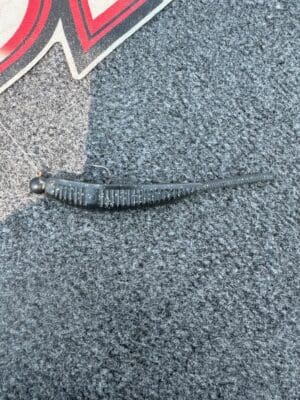
Gee favors tungsten jig heads because they create a stronger signal return than lead when viewed on his Livescope. As a general rule, from the surface down to 5' he will use an 1/8 oz head, down to 10' a 3/16 oz, down to 20' a ¼ oz, down to 30 a 3/8 oz, down to 40 a ½ oz, and a ¾ oz for any thing deeper.
In ultra clear water, Gee's go to color is Natural Shad, however he relies on Baby Bass, Pro Blue, and Sexy Shad as well.
Photo Credit: Robert Gee & Jack Leventry.