2021 St. Lawrence River B.A.S.S. Elite
Posted by Bernie Schultz on Aug 23rd 2021
By Bernie Schultz
My track record in major tournaments on the St. Lawrence River is solid. I’ve had numerous top-10s, and even won there twice. It’s a great fishery, full of largemouth and smallmouth. And they bite! That’s why I love it so much.
I’ve been competing on the river since the late 1980s, so I have a long history there. Much of what I know lies on the Canadian side of the channel, but that posed somewhat of a problem this time around.
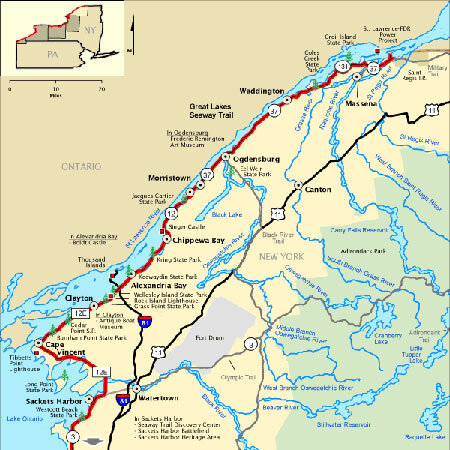
Tournament waters ranged from the Massena Dam to Lake Ontario and beyond, but only on the U.S side.
Due to COVID restrictions, Canadian waters were declared off limits. That left the U.S. side of the river, from the dam at Massena to Lake Ontario and beyond. A lengthy playing field, indeed. But also a risk to those ambitious enough to make the trek from Waddington, our official checkpoint.
Scheduled in late July, the fish should have been in a post-spawn phase. But because of a prolonged winter and cool summer, there were still a few smallmouth trying. My focus, however, was purely on the post-spawn fish and where they were headed.
PRACTICE BEGINS
I chose to spend my first day of scouting near Chippewa Bay, on shallow shoals and sand flats featuring patchy grass.
In several areas, I was able to locate small groups of aggressive fish. The best baits were a shad pattern, 3/8-ounce Hildebrandt Drum Roller swimbait and 1/4-ounce Ned-rig 4-inch Senko in green pumpkin/watermelon laminate.
From there, I ventured toward Clayton to a series of shoals that had produced in the past. Again, I found fish, but not in any concentrations. Most were rogues, swimming aimlessly across the shallows.
Late in the afternoon, I moved to the lake to scout the flats adjacent to Fox Island. There, again, I found lone fish cruising. But none I felt were reliable.
On day 2, I returned to Chippewa Bay, hoping to expand on what I had found previously. As I arrived at the first stop, a small cool front began to push through. With it came low skies.
Seeing that, I switched to a selection of reaction lures — a tandem willow, ½-ounce Hildebrandt Tin Roller spinnerbait and a Shimano World Minnow jerkbait. Both produced on nearly every shallow spot I tried, and the fish were solid.
Satisfied with that, I decided to try some deeper spots. But as I scanned the first drop, I noticed the screen was filled with clutter. Something was apparently wrong with the transducer. Knowing how crucial my electronics would be in finding any deep fish, I decided to return to the ramp and trailer to the service yard back at Waddington.
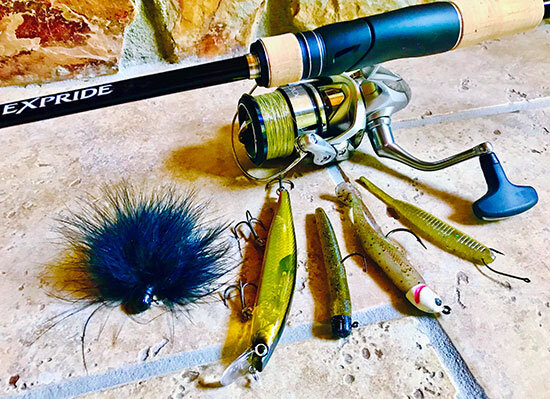
The lures I relied on most included (L-R) a 1/8-ounce marabou jig, Shimano World Minnow 115-SP, 3/8-ounce Hildebrandt Drum Roller swimbait, Ned-rig 4-inch Yamamoto Senko and a 1/2-ounce drop-shot Shad Shape Worm.
An hour later, Garmin’s head tech, Darrell Rollins, went to work. It didn’t take him long to find the problem either. The transducer cable was badly crimped where it entered the bilge area. From that point on, it was a slow, tedious process of snaking a replacement and, by the time the job was complete, I had only a couple of hours to fish.
On day 3, I decided to launch at the Waddington ramp and check some spots from years past.
In one particular area, I found a large school of shallow smallies. Although they appeared to be in the mood, I struggled to get any of them to bite. Rather than spend a lot of time trying, I stored the waypoint and moved on.
From there, I hit several deeper spots, scanning them first with my electronics. I found small groups of fish in two specific current seams. They were aggressive, too. Each drop with a Yamamoto Shad Shape worm produced a bite, but none larger than 2½ pounds.
Up on top of the shoal, I noticed a huge smallmouth sitting behind a shallow rock. She had to be better than six pounds. With her were a couple of 3-pounders. I didn’t even make a cast. I simply let the boat drift off the spot and headed back to the ramp, believing I had found a good backup.
Competition Time
On day-1 of the competition, I decided to run to the schools of smallmouth I found near Chippewa Bay. Forty-five minutes later, I arrived at the first waypoint and began casting the 4-inch Senko on a Ned rig,
I got bit on my first cast. And after a lengthy battle, I lifted a 5-pounder over the gunnel. A few minutes later, I boated a 3-pounder.
No sooner was that one in the box when I noticed a big, black smallmouth sitting directly beneath the boat. I dropped the Ned rig down, but she just swam slowly away. Quickly, I grabbed another rod rigged with a black marabou jig and launched it out ahead of her. She bit immediately, and when I got her aboard, she weighed over six pounds!
Off to a great start, I continued down the flat, alternating with the Ned rig, marabou jig and the World Minnow —scoring a number of 3 to 4-pounders. Later that afternoon, I boated another one weighing five. When I got them to the scales, I had more than 25 pounds of smallmouth and was leading the tournament.
The next morning, B.A.S.S. paired me with FOX Sports cameraman Tres Bruce. We hit it off from the start. I told him we were in for a lengthy run, but that he didn’t have to worry about a pounding. We had calm conditions and nothing but positive vibes for the day ahead.
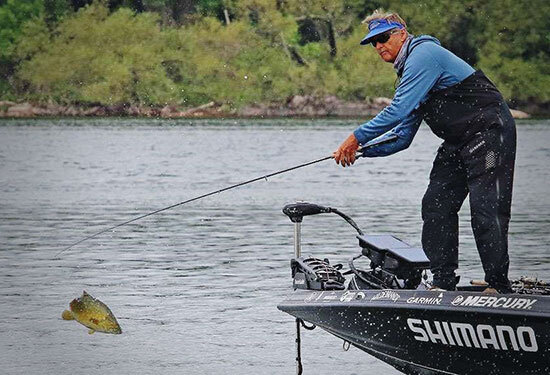
Battling an airborne smallie in the 4-pound class.
When we arrived at my starting spot, things happened quickly. My first fish was a solid 4-pounder. The next was five. Both fell for the Ned-rigged Senko.
A little later, we moved to another part of the flat where I hooked up with a pair of fours. The next few hours yielded a flurry of 3-pounders and, by day’s end, I had culled to a solid 22-pound stringer.
My lead increased by another pound heading into the weekend.
Surviving Saturday
Paired with my same cameraman, we headed back to the flat where most of my success had come on days 1 and 2.
Things changed, however. The wind was now blowing from the northeast against the current, and the skies were overcast — not the best conditions for mid-depth smallmouth. Nonetheless, I started fan casting the flat where most of the better fish had come from.
An hour later, I had one 3-pounder in the boat. A little later, I caught another close to three. But after hitting the remaining sweet spots to no avail, I decided it was time to move to my backup area — a place I fished the previous year. A place that was so well hidden, I felt no one would ever find it.
As I snaked through a group of small islands and shoals, I could see a competitor boat in the distance. It was sitting squarely on my waypoint. As I came off pad, I realized it was Hunter Shryock. I asked him how he was doing and he said he had about 18 pounds. I asked how long he had been fishing the area and he said “all three days!”
My heart sank. Hunter was high up in the standings, and I could only assume most of his weight had come from that one area. Knowing there were several sweet spots, I fished away from him, hoping he had overlooked one of them.
Relying on my Garmin LiveScope, I spotted a group of 3-pounders hugging bottom in a 6-foot sand hole. They were eager, too. In just thirty minutes, I was culling to a respectable stringer.
Wanting to save some for the next day, I pulled the trolling motor and raced back toward Waddington, stopping briefly to try several key spots along the way. On two of them, I upgraded my catch. When it was time to check in, I had put together a 18-pound stringer. Not what I hoped for, but enough to advance into Sunday’s top-10 round.
The Final
Tied to the take-off dock the next morning, I pondered the day ahead. I told my cameraman Tres, we were in 5th place with nothing to lose. And when our number was called, we exited Waddington and raced to the same flat that had produced so many big fish earlier in the tournament.

Hand lifting a big smallmouth, as no nets are allowed on the Bassmaster Elite Series.
Arriving under low skies and a stiff northeast breeze, I made a few random casts with the Ned rig then pulled out a spinnerbait. My first bite was a fat 3-pounder. Minutes later, I added another. A half-hour later, I scored another. From there, I moved a couple of hundred yards down the flat and finished my limit.
Tres was keeping score, claiming I was well over 18 pounds. I thought otherwise, as I knew none them were any better than three.
From there, we ran to the area where I had encountered Hunter Shryock. Because he hadn’t made the final cut, I now had it all to myself. I culled numerous times, but I was only gaining ounces. I needed pounds!
I told Tres we were rolling the dice … gassing up and running all the way back past Waddington to the dam. I wanted to try the area where I saw the huge, rogue smallmouth on day 3 of practice.
An hour later, we sped by Waddington, then 12 more miles to the northeast. When I got to the shallow shoal, the big fish was gone. Apparently she had taken the pair of 3-pounders with her, as they were gone too.
About the time I made that realization, a fleet of large cruisers exited the lock and was headed our way. There were more than I could count, and they were throwing huge wakes. I knew immediately they would trash the shallows, so I told Tres to pack his gear and we headed back toward Waddington.
The remaining two hours yielded only 2 to 3-pound fish. The day slipped away and I was stuck with a 15-pound bag — a bitter disappointment, especially after having the lead for two days.
The Elite Series tour returns to the St. Lawrence next season, so I’ll get another shot. And hopefully, then, I’ll be able to close the deal.
Follow Bernie Schultz on Facebook and through his website.


I love it when I start to feel that cooling in the air, because I know fall is arriving and the fishing’s gonna pick up. The fall season is my favorite time to throw topwaters, especially on western fisheries, because I know I can count on good quality and numbers of fish.