2025 Mississippi River B.A.S.S. Elite
Posted by Bernie Schultz on Oct 1st 2025
The Upper Mississippi River is nothing like its muddy self to the south. Winding its way between Minnesota from Wisconsin, the river is normally quite clear with a slight tannin tint. It’s also lush with vegetation.
The river supports a healthy population of smallmouth and largemouth, and having Pools 7, 8 and 9 as our designated playing field, we had plenty of water to spread to.
Besides a wide variety of aquatic plants, the river also features sandbars, riprap banks, wing dams, docks and laydowns. Some would say it’s a target rich environment. My plan going in was to flip and frog as much matted vegetation as possible, then find a backup pattern in the current.
Practice Begins
Launching at Stoddard’s Landing in Pool 8, I idled just a few hundred yards and dropped the trolling motor. Around me was a sea of topped out grass in three to five feet of water. The sky was gray with no wind.
Starting with a Reed Runner hollow-body frog, Hildebrandt buzzbait and Shimano World Pop, I wanted to cover as much water as possible. By mid-morning, the rain started to fall. And with it, the bite improved.
In two key areas, I found quality largemouth on the edge of the grass. Some wanted the popper, others the frog. It was fun and the fish were of the right size to compete.
By late afternoon, I had covered much of the flat adjacent to Stoddard’s Landing. My next stop was to some backwater pockets downstream, just off the main river channel. Formed by small riprap break walls, each spot held fish — most relating to the current. The popper and a drop-shot Roboworm in Morning Dawn produced fish after fish. Unfortunately, most were shy of the 14-inch length requirement.
On day-2, I launched and headed upstream to fish the maze of channels near Goose Island. Numerous tournaments had been won there in the past, and I wanted to be sure I wasn’t overlooking something.
Like day-1, the forecast called for cloudy skies and intermittent showers.
By late morning, I discovered a reliable bite by pitching a 5/16-ounce Texas-rig YamaCraw to undercut banks. So long as there was current and sufficient depth, the fish were there — not in good numbers, but enough to make it worth pursuing.
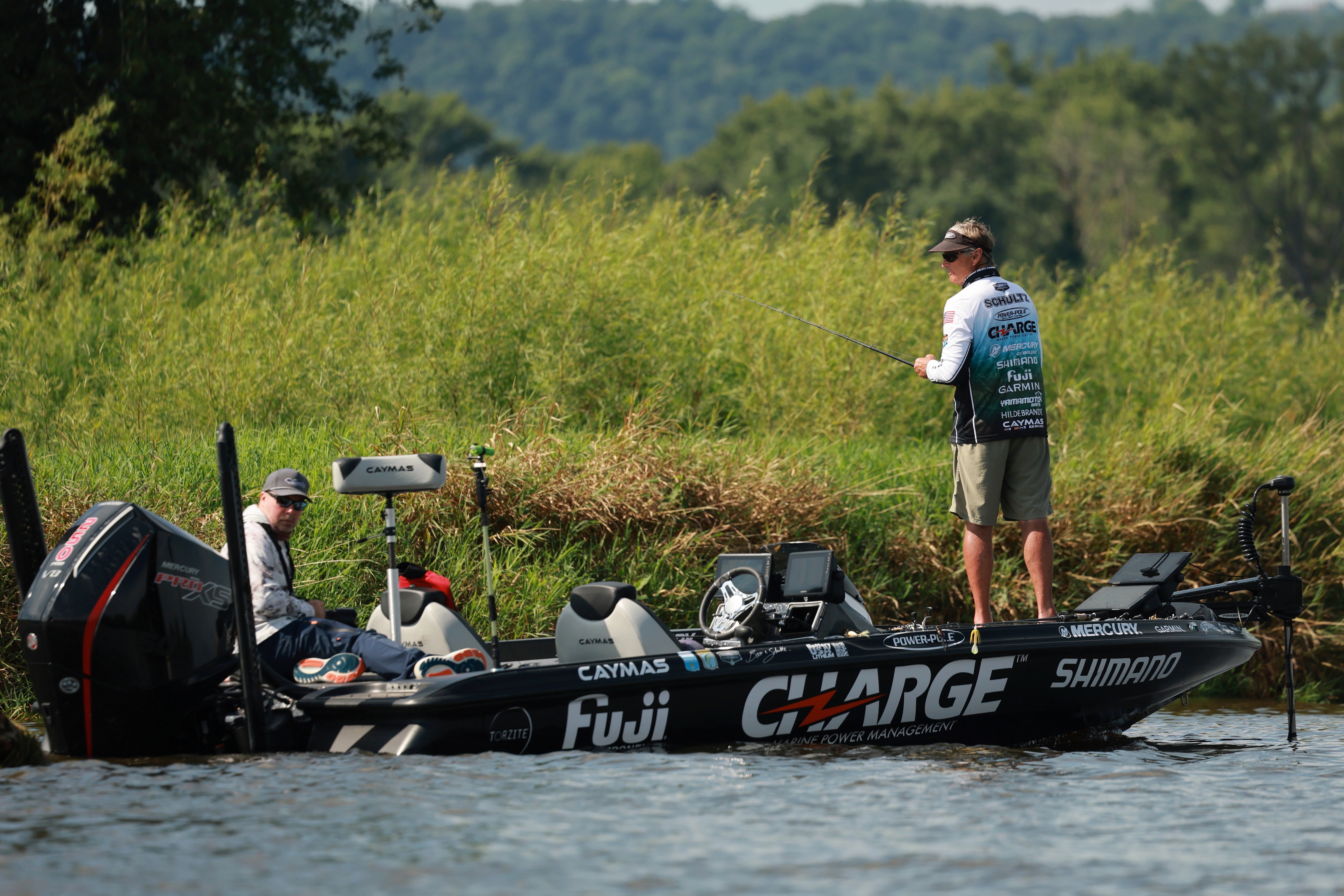
The remainder of the day was spent fishing wing dams and isolated snags along the main river channel.
On day-3, I launched in Pool 7, at Lake Onalaska. From there I fished my way to the spillway flowing into Pool 8. In one area, I found solid fish holding along an edge of topped-out grass. Most were two pounds, but some were bigger. And all fell for the drop-shot rig tipped with a Roboworm.
Although I liked the area and the pattern, the boat traffic was concerning. Other competitors and numerous locals were fishing the same water. Knowing I would have a late draw in the take-off order (based on my AOY standing), I figured there was little chance of getting there ahead of them.
From there, I ventured upstream to fish several cuts leading into a chain of small islands. Although I got bit in several locations, none gave me the confidence to go back. So I moved across the river to fish the riprap along the train tracks.
Using the World Pop, I caught smallmouth after smallmouth wherever there was current and decent depth. Most were short of the length requirement, but some were solid keepers.
My last stop was to a sandbar near the lock. There I caught a mix of smallmouth and largemouth, but no big ones. By late afternoon, I called it a day and headed back to the cabin to prepare my tackle for the competition ahead.
Tourney Time
Mired among the last boats in the take-off order, I wondered who might beat me to my starting spot. When my number was finally called, I exited the public ramp in downtown La Crosse and headed straight to Stoddard’s.
Upon arrival, I found a number of other competitors, but none where I wanted to start. Once in place, I dropped the trolling motor and went to work with the popper.
In minutes, I had my first fish — a solid 2-pounder. Shortly after, I caught another slightly smaller. When the sun crested the treeline, the bite died.
Hardheaded, I kept throwing the topwater anyway … hoping for a couple more bites. They never came. At 11am, I switched to the frog and started traversing the flats, targeting isolated mats of topped-out grass.
Eventually working my way shallow, I threw the frog against a hard bank, right at the waterline. With one twitch of the rod tip, a fish struck from beneath. As soon as I set the hook, line stripped from the reel. On the end was a large bass carving sideways beneath the mat. Finally, after what seemed an eternity, I extracted a solid 4-pounder from a thick wad of grass.
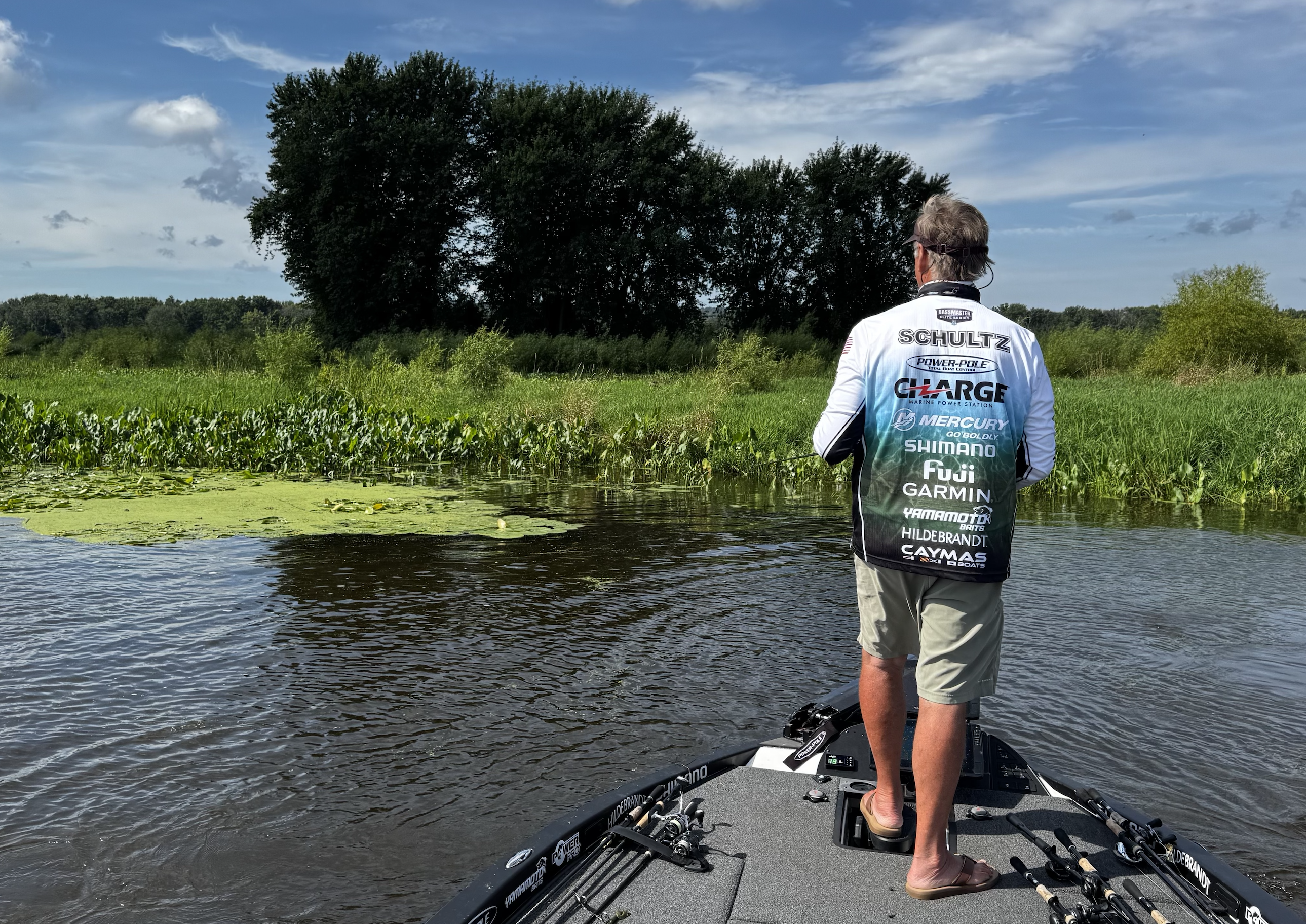
With that fish in the livewell, I knew what I would do the rest of the day.
Continuing along the same shallow bank, I quickly got another blowup. But as I set the hook, the fish came to the surface and pulled free. Quickly, I threw the frog back to the same spot, hoping for a follow-up. But it never happened.
Minutes later, the same scenario played out. At that point, I was pissed.
Thirty minutes later, another quality fish blew up on my frog. As I tried winching it from the weeds, it too managed to tear free. Shouting a string of expletives, I asked God, “Why … why me?”
That was the last keeper bite I had throughout the remainder of the day.
One Last Shot
The next morning, the take-off order reversed and I was among the first to leave the dock. I exited take-off and proceeded to the main river channel. While idling through the no-wake zone, I noticed how much the river had fallen. Seeing that, I decided to change my game plan.
Once I reached the main river, I crossed to the far side and dropped the trolling motor. Ahead of me was a familiar bank of riprap with an interconnecting wing dam.
My hope was to catch one or two big smallmouth there, then go looking for largemouth. Unfortunately, after an hour of trying, all the rocks yielded were non-keepers.
Moving to a secondary channel, I began pitching the Texas-rigged YamaCraw against undercut banks. And within minutes, I had my first keeper of the day — a solid 2-pounder.
Near there was a logjam. Pitching the craw into every nook and cranny, I caught several fish — some smallmouth, some largemouth. Unfortunately, none met the minimum 14-inch size requirement.
Moving farther downstream, I stopped at another undercut bank. There, I caught my second keeper and missed another.
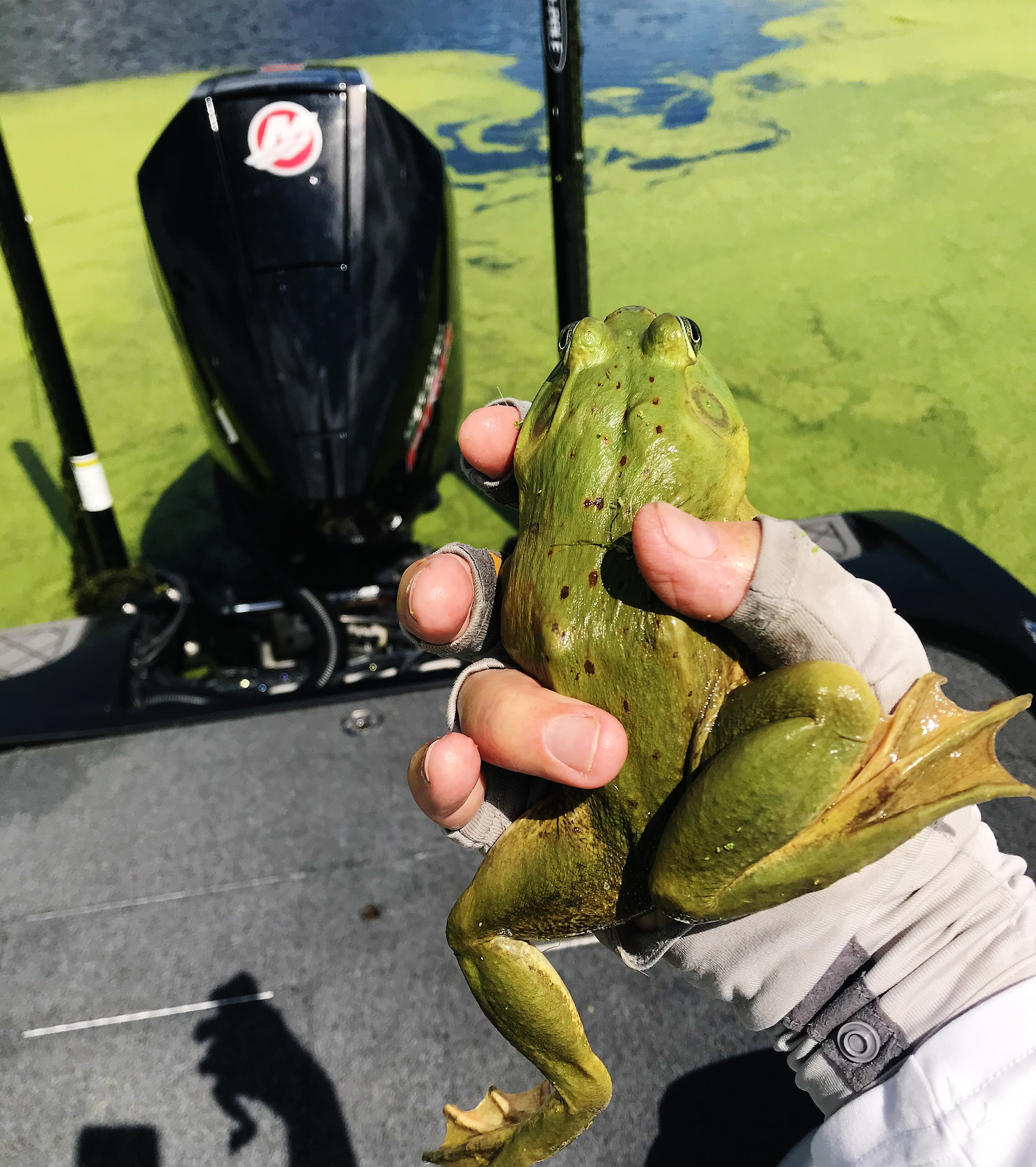
Hopping to the next island over, I continued pitching the YamaCraw to swift, undercut banks. When I rounded the corner, I came upon a mat of duckweed. Switching to the frog, I cast to the shallowest part of the raft and began hopping the frog across the surface. As the frog neared the edge of the mat, a large fish exploded up out of the weed, missing my frog completely. I tried throwing back to the same spot several times — even flipped it with the craw — but I was unable to make the fish bite.
A few minutes later, it happened again. This time, however, the fish took the Reed Runner frog on a follow-up cast. Dragging it through the mat, I boated a solid 3-pounder. Once the fish was in the livewell. I made another cast and got another bite. The fish pulled the frog under, but when I set the hook, it was gone. I tried several follow-up casts to no avail.
Further downstream, I found a large field of duckweed. I spent a solid hour working the frog over as much of it as possible, but never got a reaction. With no more rafts of duckweed in sight, I returned to pitching the craw to undercut banks.
On one particular stretch, I pitched to a stump and my line went tight. When I set up on the fish, it bound itself in the roots. Trolling within reach, I lunged to the gunnel and frantically reached for the fish, barely touching it. But no matter how much I tried, I couldn’t get it in my grasp and I eventually had to give up.
At that point, I told my marshal that we were running to Stoddard, to try the shallow frog fish I lost on day 1.
When we arrived, it was obvious the water had fallen even more. I tried anyway, hoping the fish had held. But they were gone. An hour later, I was throwing to the remaining mats in deeper water. But those, too, proved worthless.
Realizing the clock was ticking away, I raced back to the mat I fished earlier, hoping to change my luck.
On my very first cast, a huge fish blew up on the frog. When I set the hook, it ran beneath a half-submerged log and pulled free. Disgusted, I threw my rod to the deck and kicked it. Never had I experienced such a poor ratio of strikes to lost fish.
After regaining my composure, I made several more casts to the duckweed. Again, a fish struck. This time, I was able to wrench it from the weeds and lift it over the gunnel. It was my last bite of the day.
Back at weigh-in, I bagged my fish and headed to the scales … still wondering why my percentages were so poor.
When my turn came, I entered the stage and handed the fish to the tournament director. Once the weight was called, I thanked B.A.S.S., the crowd, my family, friends and sponsors … knowing it was likely the last time I would cross the stage as an Elite Series angler.