Lefebre Tackles Tidal Water with Swim Jigs
Posted by David A. Brown on Jun 8th 2020
By David A. Brown
The daily ebb and flow of tidal environments creates a tremendous amount of fluctuation. However, Dave Lefebre knows he can always depend on, at least, one point of consistency: the swim jig.

Easily placing this reaction bait in his top tier of tidal choices, the accomplished pro appreciates the ability to confidently fish a variety of habitats with a tool that’s big on performance. Rising and falling water opens and closes windows of opportunity; and that emphasizes the need to fish efficiently.
“In a nutshell, it’s a hybrid type of presentation; it’s like a jig, which is one of my favorite ways to fish, plus it’s a spinnerbait, it’s a crankbait — it’s all those things and there’s not a whole lot of baits you can say that about,” Lefebfre said. “You can fish it super fast and cover a lot of water, but you can really slow down and nitpick with it. I think the versatility of a swim jig is the main thing..”
THE RIGHT TOOL
Every time he fishes tidal waters, Lefebre keeps a selection of swim jigs rigged and ready. Different scenarios call for different setups, so he breaks it down this way:
For open water and/or finicky fish, he’ll use a light wire Terminator swim jig. As Lefebre points out, clarity varies in tidal fisheries and sometimes, you gotta throttle back on the boldness.
“Those tidal fisheries aren’t always muddy; it isn’t always a power-fishing bonanza,” he said.
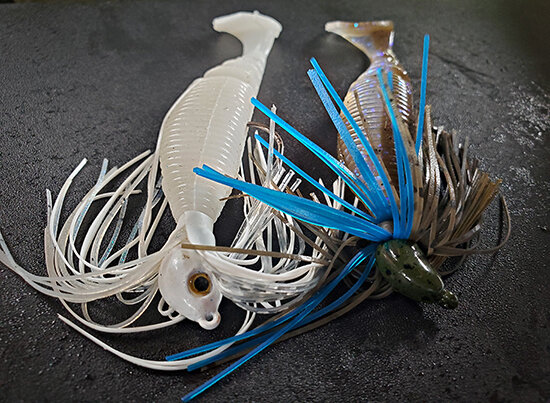
In those more common scenarios, in which heavy cover and more turbid water come into play, he’ll reach for his homemade swim jig. Built to his personal specs, Lefebre’s model carries a heavy gauge hook that stands up to more strenuous braided line work.
Skirt: Lefebre said he likes to trim his swim jig’s skirt short — at least to the back of the hook. This, he said, creates a bushy look that flares enticingly when he starts and stops the bait, while also allowing his trailer more room to work.

“I like my swim jig to be short and compact, especially in those sloppy situations,” Lefebre. “Mainly it’s the way it looks, because when you stop the bait and fluff that skirt, it really does shoot out like a pom pom.
“It’s not about a long skirt waving in the water; it’s about twitching the rod and making that skirt flare. What I do is shake the rod to pulse that skirt and make that trailer look more alive. Also, the hook-up ratio is better. When they eat it, they got it.”
Thirdly, Lefebre knows that a compact swim jig skips better. With a properly trimmed skirt, he’ll target the shadows beneath docks, undercut banks, overhanging bushes, the holes in grass or reeds or the openings in duck blinds.
Trailers: Lefebre fits his swim jigs with either a Yamamoto Double Tail Grub, a Paddle Tail Zako or a Flappin’ Hog. He’ll typically trim about a half an inch off the front of whichever one he uses to promote that stubby profile he prefers.
Lefebre also cuts the legs off his Flappin’ Hog and leaves only the body and the pinchers, which he uses as a modified chunk trailer. The benefit over a traditional chunk is a more streamlined form as he threads the Flappin’ Hog onto his jig hook, as opposed to hanging a standard chunk. Also, a more substantial trailer helps flare the skirt and aids in skipping.
Colors: Lefebre simplifies his trailers with black/blue, white, green pumpkin and watermelon colors. He typically matches jig and trailer color, but contrasting options often get the call; as do orange or chartreuse accents.
TARGETS & TACTICS
Lefebre finds legitimate swim jig targets practically everywhere throughout a tidal fishery. There’s no lack of obvious stuff, but he encourages anglers to work such waters with an open-minded approach.
“It’s not just the pads, the duck blinds, or skipping it up on marshy banks; a lot of times, it’s about fishing the ‘stupid water’ that nobody fishes,” he said. “When (the obvious spots) are getting so hammered, you want to find the overlooked spots.
“I’m not necessarily looking at something and saying: ‘That looks like swim jig water.’ I’m throwing it in places that aren’t actually textbook type swim jig places.”
In other words, Dave Lefebre won’t hesitate to fish a swim jig in open water, sparse grass or anywhere he thinks a bass might find his bluegill or baitfish impersonator appealing. Ever see a 4-wheeler or dune buggy rolling down a residential street? An effective bait isn’t limited to the habitat for which it was created.
Now, with that traditional swim jig stuff — the thick grass, arrowheads, spatterdock, shoreline junk — Lefebre said his strategy is one of immediate enticement. It starts with a stealthy approach that avoids spooking shallow fish, but he wants to make sure he’s ready to capitalize on the opening opportunities.
“I’m usually trying to throw my swim jig up onto something like the shoreline or in a clump of pads; I’m not just throwing it out there and plopping it down,” Lefebre said. “Usually, on that shoreline cover, I’m sliding it into the water off of stuff and waking it for those first few turns of the reel handle — those first 4-5 feet right off the bank. Usually, you see fish coming, whether they move the pads or the grass, or you actually see the wake of the fish.”
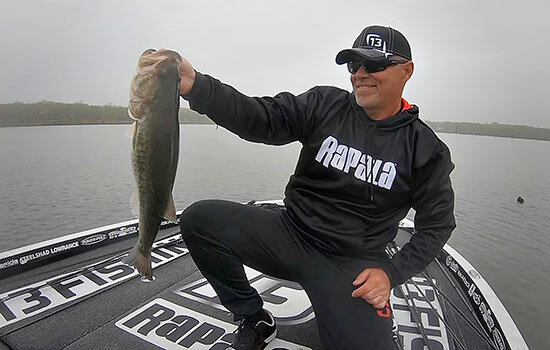
Tackle Specs: Lefebre says he can present and retrieve his bait best with a shorter rod, so he uses a 7-3 medium-heavy 13 Fishing MG Black, which has a sufficient tip for sending his bait into precise areas, but enough backbone to get them out of cover. He’ll fish the light wire jig on 12- to 14-pound Suffix Advanced fluorocarbon, while the stouter jig works best with 50-pound Suffix 832 braid.
“I’ll use a 13 Fishing Boss reel with an 8.3:1 gear ratio, because a lot of times, fish will track your jig, wake behind it, eat it and swim faster than you’re reeling,” Lefebre said. “You always want to be able to reel because there’s no faster fish than those tidal river fish. They always want to try to beat you to the boat.”
Stick It To ‘Em: Setting the hook on a swim jig bite can be tricky, as those generally aggressive bites tend to make us step on the gas. However, Lefebre advises a more measured response.
“In all the tidal rivers, it’s either bank fishing, or it’s massive weed bed fishing, and I think people can use equipment that’s too heavy for it,” he said. “You want the fish to inhale the bait and really get it, but not set the hook too fast. Don’t be in a hurry with it; it’s really not about setting the hook. Just let them bend the rod and start reeling.”