Beatin' the Bank - 2020 Lake Chickamauga B.A.S.S. Elite
Posted by Bernie Schultz on Nov 19th 2020
By Bernie Schutlz
Considered one of the best fisheries on the planet, Lake Chickamauga is home to both northern and Florida-strain largemouth bass. It also supports a modest population of spots and smallmouth.
To win, however, it’s essential to pattern the larger Florida fish.
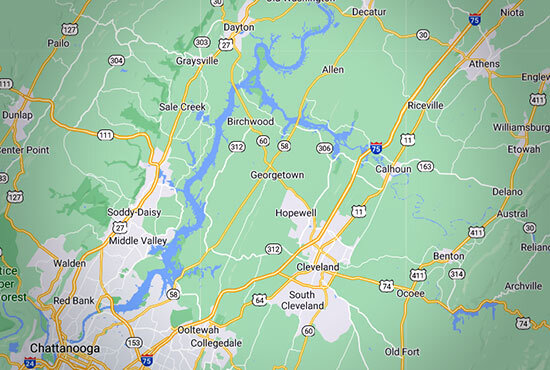
Chickamauga is a large, riverine reservoir, fed by the Hiawassee and Tennessee Rivers.
“The Chick,” as it’s commonly referred to, stretches 59 miles from dam to dam and is fed by two major tributaries — the Tennessee and Hiawassee rivers. Normally, the Hiawassee is less productive than the rest of the impoundment, but that wasn’t the case in this derby. Numerous top finishers found success by plying its riverine banks of rock and wood.
The rest of the field keyed on the abundance of grass found throughout the larger portion of the reservoir. And, as the week progressed, schooling fish became a factor.
Practice Begins
My first day of practice began on the lower end, at Dallas Bay. From there, I had easy access to the heart of the lake.
I started at the back end of the bay, traversing a shallow flat of hydrilla and eelgrass. Although I could see random fish busting, I couldn’t make them bite. And after two hours of trying, I abandoned the area and headed to the main lake.
My next stop was to a large mat of hydrilla adjacent to the main river channel. There, I punched a 1-ounce, Texas-rig Yamamoto PsychoDad. That produced several bites, which I shook off because of other boats in close proximity.
From there, I visited a couple of narrow coves — places that produced for me in the past. I expected to find schooling fish, and I did. Unfortunately, they were difficult to fool and most appeared to be short of the 15-inch length requirement anyway.
My next stops were to the backs of several shallow creeks, where I scored a few more fish. The largest was a 3¾-pounder that fell for a 4-inch swimbait in a shad pattern. Although that seemed promising, there didn’t appear to be enough fish to share, should others find them.
On day 2, I accessed the river at Point Park in Dayton — headquarters for the event. I went straight to the confluence of the Tennessee and Hiawassee rivers.
In one particular grassbed, I got several bites with a frog. Then a school of bass erupted on the mat’s edge. All were keepers. Filing it to memory, I left and headed upriver toward the dam.
Throwing a Chatterbait with Zako trailer on isolated clumps of grass, I probed several creekmouths and shallow flats. After no luck there, I moved to the tailrace of Watts Bar Dam, where I caught a couple of short smallmouth.
My last stop was to the back of a small creek, where I found some fish holding in a mat of hydrilla. Most appeared to be keepers.
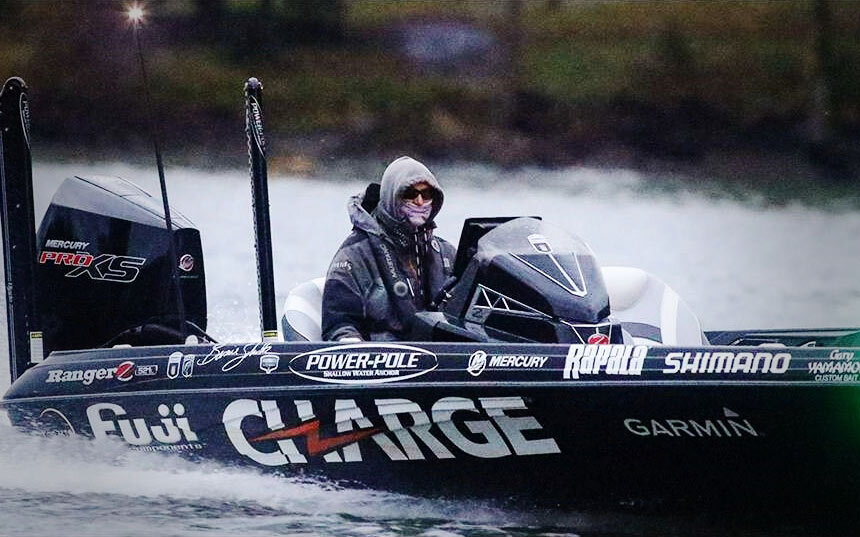
Mornings were cold and brisk, but later warmed into the 70s..
On day 3, I returned to the junction of the two rivers, hoping to expand on what I had already found. Having little luck on the main lake, I moved to Sale Creek and found a promising area. It featured a massive, topped-out field of grass with schooling bass busting shad along one edge.
After fishing through the entire area, I returned to the hotel to prep for the actual competition.
Tournament Time
On day 1, when my number was called, I exited Point Park and headed straight to the mats at the mouth of the Hiawassee. Upon arrival, I found another boat already sitting on the best spot. Rather than trying to squeeze in, I rerouted to the back of Sale Creek to try the mats there.
In the first hour, I caught several undersized bass. Nothing more. Knowing what lived there, I pounded it for hours … unfortunately, to no avail. With the clock ticking, I headed back to the mouth of the Hiawassee, hoping the other competitor was gone … and he was.
I spent more than an hour without a strike. In near panic, I decided to pull the trolling motor and race upriver to the small creek where I had found a few fish in practice. When I arrived, the spot was vacant and I went to work.
My first keeper finally came aboard at 3:30 pm. In the remaining minutes, I caught two shorts and lost a 2½-pounder in the grass, then it was time to head back.
When I reached the scales, I learned the bite was tough for most everyone. A mere 7 pounds was the cut. I thought to myself, if I could catch just 10 pounds on day 2, I could at least salvage some points. And with a little luck, I might even get to fish Saturday.
With that in mind, I left to gas up and prep my tackle for the next day.
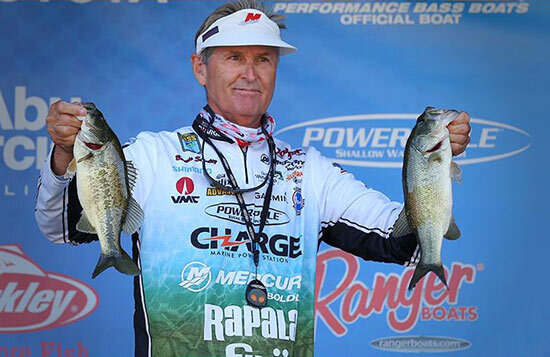
Even small fish like these are critical to year-end totals.
Having an early draw on day 2, I knew I would be first on the mat at the Hiawassee. When I arrived, I barely got the trolling motor in the water when Seth Feider showed up. Apparently he was the angler I saw the day before, as he plowed aggressively to the opposite side of the grassbed, then began throwing in my direction.
I watched as he puffed anxiously on a cigarette, periodically hitting his trolling motor at full thrust.
Neither of us got a bite. The mat was dead.
Eventually, Seth left and I had the spot to myself. And just as it happened in practice, a school of bass blew up within range on the mat’s edge. I fired a swimbait into the mix and boated three quick fish — all were keepers. Then things died.
An hour later, I fooled another keeper with a Hildebrandt Tin Roller spinnerbait. Although none of the four exceeded two pounds, I was glad to have them. And, in the end, those modest sized fish helped me salvage some very necessary points.
With one event remaining, I’m just seven points from the cutline to the Bassmaster Classic. Stay tuned!