Beatin' the Bank - 2020 Santee-Cooper B.A.S.S. Elite
Posted by Bernie Schultz on Nov 16th 2020
By Bernie Schultz
Santee-Cooper Reservoir is comprised of two connecting lakes — Marion and Moultrie. They’re located just to the northwest of Charleston, South Carolina.
Fed by the Congaree and Wateree Rivers, the pair offer more than 170,000 surface acres of prime fishing habitat — accented by large stands of cypress trees, rafts of water hyacinths and various other forms of aquatic vegetation.
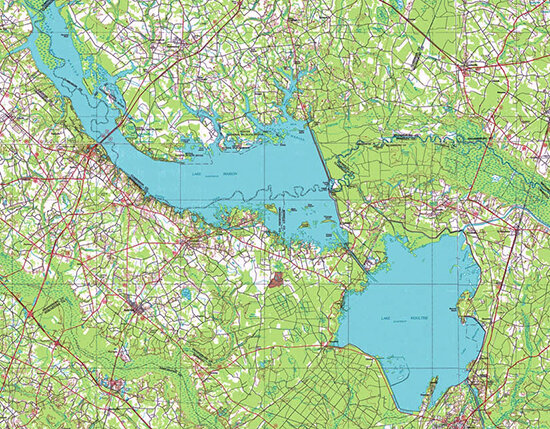
Lakes Marion and Moultrie are connected by what is known as the Diversion Canal. Combined, they provide an overwhelming amount of shallow water bass habitat.
Originally scheduled for late spring, the 85-man Elite Series field was now confronted with the prospects of a tough fall bite.
Practice Begins
Having secured a cabin near the dam on the upper lake, my first stops were to Potato and Wyboo Creeks. I started on the bank, throwing a variety of topwater lures around docks and water willow. After no success with those, I switched to a swim jig and shallow-running crankbait. Those also failed to produce, and by 9 o’clock, I was done with the bank.
From there, I moved to a stand of cypress trees on the main lake. The very first tree I threw at, I got a bite from a solid 3-pounder. That was all I needed.
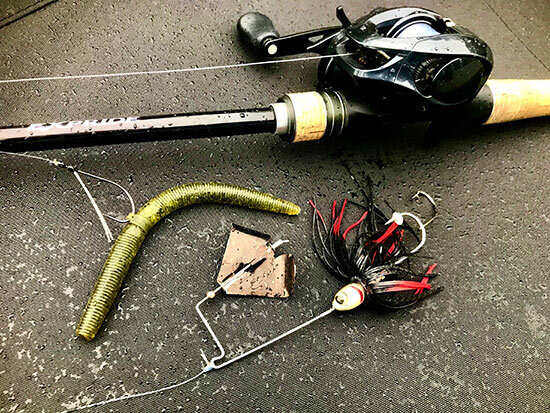
A wacky-rigged 5-inch Senko and black, 1/2-ounce Hildebrandt buzzbait accounted for all of my fish in this event.
For the remainder of the day, I spent my time dissecting cypress trees at various depths. And though the bites seemed somewhat random, I saw enough to know the pattern was solid.
Because of a lack of rainfall, the reservoir was much lower and clearer than normal. I could easily see bottom at three feet. Taking that into consideration, I opted for a wacky-rig 5-inch Senko in a watermelon/green pumpkin pattern. The rig included a 1/0 VMC Weedless Neko Hook attached with a VMC Crossover Ring, which gave me the option of positioning the hook inline or perpendicular to the worm.
My tackle included a 7’ medium-action Shimano CI4 Complex spinning rod with Sustain 3000 reel, spooled with 10-pound Sufix 832 Braid. To its end, I tied a length of 10-pound Sufix Advance Fluorocarbon leader. It was the perfect package.
I began day 2 of practice on the lower lake, starting with a prop bait in a backwater pond. There, I got several bites — one of which was a quality fish. I filed it to memory, then moved to the main lake to fish some cypress trees.
Again, the pattern proved solid. Although the bites were fewer and farther between, I did catch enough to know I was on the right deal. The key was stealth. By using my Power-Poles, I could silently secure the boat, then make long presentations to each target. It was an approach that would pay huge dividends in the competition.
On day three, I worked my way north on the upper lake to Jack’s Slough — where I found lush rafts of hyacinths, small lotus pads and other forms of submerged grass. Scattered among them were isolated cypress trees.
It was almost too much habitat to read.
I flipped the hyacinths to no avail, then swam a jig through the pads. That produced a few fish, but nothing of any size. What concerned me more was the number of other competitors testing the same water. Jack’s was too popular, and I felt my chances would be better on the main lake.
The rest of my day was spent in the Stump Hole at the north end of the upper lake. Again, the best action came from isolated cypress trees — but that area, too, was receiving too much pressure.
Content with my search, I retreated to the cabin to prepare my tackle for the actual competition.
Tournament Time
Having a late draw in the take-off order, I sat and watched as boat after boat exited John C. Land III Park — official site of our tournament. Eventually, my number was called and I followed suit.
My first stop was to a stand of cypress trees adjacent to the boat lane, outside the take-off creek. In minutes, I had my first fish — a solid 2-pounder — then a long lull set in.
Moving from the denser trees, I began targeting those standing alone in shallower water. The bite was slow, but by day’s end I put together a respectable 12-pound stringer.
Day 2 was tougher. It was 9 o’clock when I connected with my first fish. The next came at 10:30. During that time, I contemplated running to the lower lake, but something told me to stay.
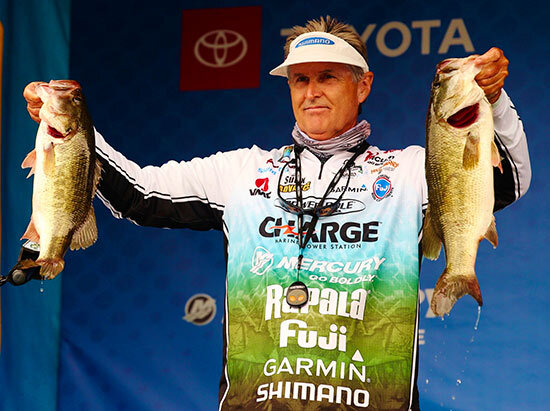
This pair of buzzbait fish made a huge difference. Both came on the third morning of competition, under rainy conditions.
An hour later, as I approached a sandbar featuring several super-shallow trees, I got a crucial bite on the first tree — a 3½-pounder. That single fish told me that I had been fishing too deep. On the very next tree, I caught a 5½. I knew then that a high finish was well within reach.
By weigh-in time, I put together a 17-pound stringer — one of the largest of the event, and enough to position me well inside the cut.
With half the field eliminated, I couldn’t wait to see what the next day would bring.
Fishing on the Weekend
On Saturday morning, we awoke to steady rain and blustery winds. Seeing that, I decided to try a buzzbait in a field of super-shallow lilypads. It was the right call. My first fish was just a keeper, but then I caught a 4-pounder. The next weighed six.
Although the bite was brief, it was just what I needed to jumpstart the day.
From there, I moved to the cypress trees and finished my limit with the Senko. By day’s end, I had another 17 pounds of Santee-Cooper bass — more than enough to guarantee my slot on Championship Sunday.
That night, while prepping my tackle, the weather report predicted light rains for the following morning. It was almost too good to be true. The ideal conditions would repeat themselves and, hopefully, so would my morning buzzbait bite. I couldn’t wait.
At 5 o’clock the next morning, it was obvious the weatherman had confused the forecast. I could see a sky full of stars. Pondering the situation, I decided to go with the buzzbait anyway.
When the tournament director finally released the top-10, I raced directly to the same shallow field of lilypads.
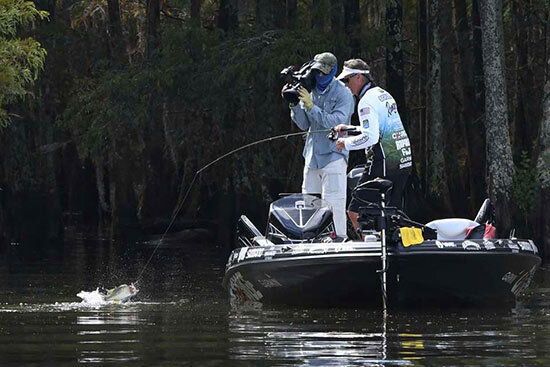
A cameraman captures the action on Championship Sunday, as I pull a fish from Lake Marion's shallow cypress trees.
As I lowered the trolling motor, I noticed things were still … too still. Nothing was moving. Dismissing the signs, I picked up the buzzbait and began dissecting the outer contours of the pad field.
An hour later, I had nothing to show for the effort.
Disappointed, I pulled the trolling motor and headed for the main lake. Two hours later, with nothing in the livewell, I made a move to the opposite side of the lake. And that’s’ when I finally connected with my first fish
Over the next few hours, I skipped a Senko beneath what seemed like hundreds of cypress trees — Power-Poling up and down the whole time. When the clock finally ticked down, I had put together a 12-pound stringer and salvaged the day.
Back at the scales, that weight put me in fifth place. It was a solid finish, but I still felt cheated by the lack of a morning bite. Nonetheless, I gained considerable ground in the Angler of the Year standings, and climbed back inside the cut for the Bassmaster Classic.
With two events remaining, anything can happen. Stay tuned!