Beatin' the Bank - 2021 Lake Fork B.A.S.S. Elite
Posted by Bernie Schultz on May 2nd 2021
By Bernie Schultz
Frequently referred to as the “Crown Jewel of Texas Bass Fisheries,” Lake Fork is home to a tremendous population of Florida-strain largemouth — big ones, too. Double-digit fish are commonly caught there, in a variety of ways.
Having such a large population of trophy bass with a full moon approaching, we all knew it would take heavy weight to win this event. And while that was certainly on my mind, getting back in the AOY race was just as important. After finishing dead last in the previous event on the Sabine River, I wanted redemption.

Gary Yamamoto's Sugoi Lakes Lodge was my "home" throughout the event.
Here’s an account of my experience on Lake Fork — an event that gave me hope initially, but then stung me in the end.
Practice Begins
On day 1 of practice, I launched at the Minnow Bucket Landing. From there, I ran directly to the causeway bisecting the northern part of the lake from the south.
Starting on the bridge, I alternated with a large Jackall swimbait and a walking topwater lure, watching my Garmin Panoptics to see what type of response those lures would get beneath the surface. On several occasions, I could see large fish rise up, but then fade away. I tried varying the retrieves but that didn’t help. I then tried a jerkbait. Still nothing.
Anxious to press on, I moved to a nearby grassbed where I swam a jig. Nothing there, either.
My next move was to a creek near the dam, where I thought I found bedding fish in the shallows. Unfortunately, I also found plenty of competition both from weekenders and fellow pros.
After marking a number of quality fish, I moved north to the next major creek. Again, I found spawning fish, but not in the same numbers or size. So I picked up and moved to the next creek to continue the search. By day’s end I had marked countless beds — all with 3-pound or better sized fish on them.
On day 2, I moved to the opposite side of the lake. Running a series of shallow water points, my hope was to find bass feeding on spawning shad. I never did, and when the sun got up, I resumed my search for more bedding bass. In several pockets, I found the quality fish, some of which included big females.
On day 3, I returned to the same general part of the lake to fill in any gaps I had left in my search.
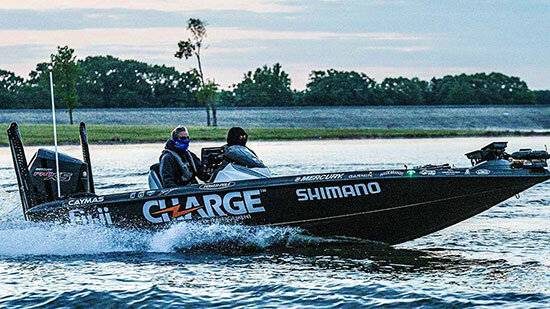
Official take-off was near the dam, only a short run to the areas I targeted during the competition.
By noon I felt I was getting too spread out, so I decided to review some of the places where I had marked the biggest fish on days 2 and 3. That’s when I discovered many were gone. It was deflating, to say the least.
I moved quickly to cover as much water as possible to see what was left. My last stop was to a pocket near the ramp — a place where several 4-pounders had remained. My confidence was renewed.
Competition Time
Drawing boat number 7, I decided to start in that nearby pocket holding the 4-pounders. most of which I could reach from a single vantage point. My logic was to Power-Pole down in one key spot and take control of the area.
While working the first fish, numerous other competitors did drive-byes — all of them wanting to access the spot. Fortunately, my boat positioning discouraged them.
After countless presentations to that fish, I finally gave up and moved to the next one; a 2¾-pounder that bit right away. Minutes later, I added a 4-03. Then everything stopped.
Two of the other 4-pounders were gone, and the one I started on wouldn’t bite. So I raised the Power-Poles and moved to the next pocket, hoping to improve my weight.
Two hours later, I had a decent limit. At that point, I decided to work on a specific pair of spawners holding on a super shallow sand flat. Both were in the 5 to 7-pound class. Although the smaller one seemed too wary, the bigger one showed promise. And after 45 minutes of coaxing her with a wacky-rig Thin Senko, she finally bit.
The fight was epic.
Rather than run for deeper water where the stumps were, she swam shallower toward the bank — shaking her head and thrashing on the surface. Finally, after what seemed an eternity, I eased her toward the boat. That’s when she gave one last headshake and the hook popped free.
I was beside myself — pissed that my biggest fish of the day had just come unbuttoned. Though I tried, I couldn’t shake it off.
Hours later, at the very end of the day, I found a 10-pounder holding just outside of a bed adjacent to a large log. In just a couple of casts, I could see she was agitated and not quite ready. Rather than pester her, I opted to save her for the next morning.
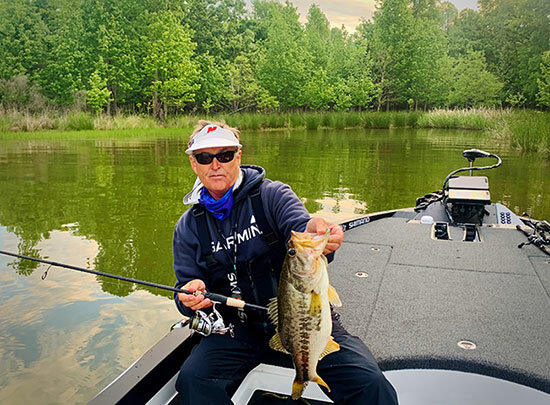
Fish like this healthy 4-pounder are abundant throughout the reservoir.
Back at check-in, I recorded a stringer just shy of 17 pounds. Although it was less than I had hoped for, I was still well within range of making the weekend cut.
A Run for the Money
The next morning, tournament officials announced our day would be shortened due to an approaching storm front. We would now have two hours less to fish.
The take-off order was reversed, and I was now boat 93. When I arrived to the spot where I saw the 10-pounder, no other competitors were there.
Slowly, I moved in — hoping not to alert the big female to my presence.
Once in range, I made a long cast to the end of the log where the bed was located. In the dim light, I could barely make out the big fish as it swam across the sand toward deeper water. Flanking her was the male. Thinking I had blown my chance, I soon realized my line was moving with them.
Heart in my throat, I set the hook immediately, hoping it was the big female I was about to battle.
Unfortunately, it was the male. And after a short fight, I brought him aboard to be weighed and released. During all of that, the female somehow disappeared. Even after several return visits to that spot, I never saw her again. Only the shell-shocked male remained on the bed.
The rest of the day was spent trying to upgrade my weight.
In one area, I worked on a pair of bedders positioned beneath the catwalk of a shallow dock. The male bit immediately, but then took me around a piling and broke my line. An hour later, I caught the female. She weighed 4½ pounds.
Eventually, the storm clouds rolled in. And with them came the wind. Hunkered down in a small pocket, I spent the remaining minutes working a 4-pound male. Although it looked like he would bite, the clock eventually ran out.
Considering the conditions and the shortened time to compete, it wasn’t a bad day, but I narrowly missed the cut by 8 ounces, and that stung. Except for the one I lost on the dock and the 6-pounder on day 1, I had fished cleanly and thoroughly. I simply came up a bit short