Beatin' the Bank - 2021 Neely Henry B.A.S.S. Elite
Posted by Bernie Schultz on May 19th 2021
By Bernie Schultz
Smaller in comparison to most Elite Series venues, Neely Henry is one of Alabama’s most productive bass fisheries — particularly when it comes to Coosa River spots. It can be tricky to fish, however, as this winding, riverine reservoir challenges even the best anglers to its ever-fluctuating water levels.
Near mid-lake, there’s a choke point called Minnesota Bend. From there, south to the dam, the water can be well below normal pool, while simultaneously to the north, it can be out of its banks and into the trees. Because of torrential rains occurring during the week of our event, we actually experienced both of those extremes.
Follow along as I share what became one of the most challenging bodies of water this season.
Practice Begins
On day 1 of practice, I elected to launch at Neely Henry Dam. From there, I could check for a morning shad spawn on the dam’s riprap wall and any adjacent points.

Here's a view of the bridge at Coosa Landing, our official checkpoint during the event.
Although I found shad spawning in each of those places, I never saw any bass pursuing them. The few bites I got were unrelated, and they came on topwaters and crankbaits. All were spotted bass of no real size.
From there, I ventured to the backs of several creeks, hoping to find some bedding fish. Instead, I found a few largemouth schooling on shad where small ditches entered the lake. They were decent fish, but other competitors had found them as well.
My next stops were to the side pockets of those same large creeks. In several, I found bass on beds or cruising the shallows. I marked the waypoint of every decent fish on my Garmin GPS and sped up the search.
By late afternoon, I had marked a good number of fish, then a band of thunderstorms rolled in.
On day 2, I accessed the lake at our official checkpoint at Coosa Landing in Gadsden. From there, I explored numerous backwater areas — some of which held some spawning bass.
By late morning the storms returned, but this time they were much more severe. An alert from the National Weather Service called for heavy rains, hail and the potential for tornadoes. Soon after receiving that alert on my phone, a massive squall enveloped the area.
With lightning popping all around, I sought cover under the nearest boathouse. Small pellets of hail began to pound its metal roof in no time. With that came a sudden drop in temperature. The ensuing downpour was so thick, I couldn’t see the opposite shoreline.
The wind changed directions, gusting to 35 miles per hour. Then the sky turned an ominous shade of dark gray.
Huddled beneath the boathouse for more than two hours, I watched as the water turned a reddish-brown. By the time the storm passed, sight-fishing was no longer an option. So I picked up a Chatterbait and covered as much water as possible.
An hour later, a second band of electrical storms approached. As a result, nearly every competitor left the water … myself included. As I trailered the boat, I noticed the lake had risen well above its previous level.
Believing the upper lake was trashed from the storms, I decided to return to the dam the following morning. When I arrived, I was surprised to see the water level five feet lower than before and still clear. How could that be, I thought? The area had received six inches of rain overnight. Where did all that water go?
Baffled, I tried the riprap … this time connecting with a couple of nice spotted bass. But that was it.
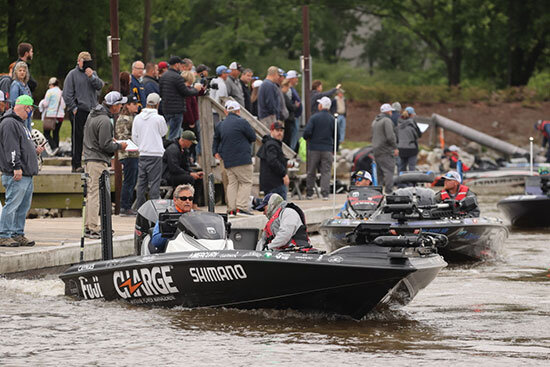
Leaving in single file from Coosa Landing in downtown Gadsden, Alabama.
From there, I hit a couple of main-lake points — throwing topwaters and jerkbaits. With no results there, I pondered my next move.
With the water so low, I knew the schooling fish in the backs of the creeks were done. So, I decided to gamble and go way up the river — hoping to find some inflows holding schools of big spotted bass.
As I ran north past Minnesota Bend, I could see the lake was dramatically higher. When I got above Gadsden, it was out of its banks and into the trees. I stopped to try several spots, but I never got a bite.
From there, I moved upstream to crank the riprap below Weiss Lake Dam. The shad were so thick, I could barely get my bait back to the boat without snagging them. And after 30 minutes of no action, I abandoned the upper river altogether.
Back in Gadsden, I entered the same backwater areas I had fished on day 2. The water had settled some and I was seeing fish again. Because it seemed more stable there, I decided that would be my starting spot in the competition.
Tournament Time
Drawing out in the third flight, I figured most of the areas nearby would be taken. To my surprise, however, the backwater area I had elected to start in was unmolested.
I immediately went to work with a wacky-rig, casting to every likely spot along the bank. In minutes, I had my first keeper. An hour later, I added a 2-pounder. Soon after, another weighing 1½ pounds came aboard. Then a long lull set in.
Sometime before noon, I finally caught a fourth fish. But it, too, was small.
Although I wanted to leave numerous times throughout the morning, something made me stay. And, by early afternoon, I caught my fifth keeper — another 2-pounder.
With that one aboard, I left the protected backwater and went straight to a main river grassbed. Spending the remaining time there, I finally got a blowup on a white swim jig. Although the fish failed to connect, that single strike convinced me to take a chance on that spot the next morning.
At weigh-in, my 5-fish limit of largemouths totaled a whopping 7 pounds, 11 ounces. It wasn’t the start I wanted, but it wasn’t all that bad either. The cut was right at 9 pounds, so I knew I was within striking distance.
The next morning, I raced straight to the main river grassbed and started fan casting the white swim jig. In minutes, I had several blowups, but none of them connected with the lure. Frustrated, I changed to a Chatterbait, and, in just a couple of casts, I caught my first fish of the day — a fat 2-pound spot.
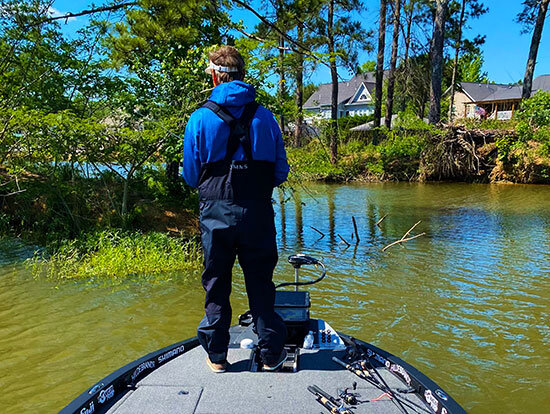
This is the backwater pond I focused on at the start of competition.
A few minutes later, I caught another. At that point, I knew I had made a good choice.
A while later, I noticed a big fish blow up in the thicker water willow. I grabbed the swim jig and fired a cast in its direction. The fish reacted, but it wouldn’t eat the lure. I switched to a Jackall Kaera Frog, but it only swirled at it, as well. Next, I tried pitching a green-pumpkin Yamamoto Fat bBaby Craw into the grass. Still nothing.
Out of ideas, I decided to mark the spot for later and continue down the shoreline.
In another hour, I had my limit. It wasn’t big, but it was far better than my first-day effort. And I knew I was close to the cutline.
Later in the day, I returned to the spot where I saw the big fish blow up. Once more, I launched the swim jig in its direction. As the lure slithered through the patch of water willow, the fish exploded — missing the bait entirely. Immediately, I sank the Power-Poles and detailed the spot with a variety of lures and presentations. But I was never able to make the fish bite.
Eventually, I left that stretch of grass to try some other areas, but nothing came together. I still had the same five fish I started with.
At the scale, they weighed 9 pounds, 8 ounces. And by the time weigh-in concluded, I had missed the cut by little more than a pound. Disgusted, I loaded the boat and headed back to basecamp — the whole way pondering how I had managed to blow another event.
Having only three stops left in the schedule, time is running out. In order to make the Bassmaster Classic, I’ll need some serious breaks. So please stay tuned.