Beatin' the Bank - 2021 Tennessee River B.A.S.S. Elite
Posted by Bernie Schultz on Mar 11th 2021
When the Tennessee River was announced as part of this year’s schedule, my thoughts went immediately to the 2018 Bassmaster Classic and how the anglers caught them in that event. Although our derby was slated a few weeks earlier, I believed the same patterns would produce.
It wasn’t until I discovered the water temperature had dipped to the low 40s that I began second guessing things. Two major winter storms had blown through the Knoxville area just prior to our arrival, bringing snow and freezing rain with them. Water temps plummeted as a result. It was certain we were in for a tough time.
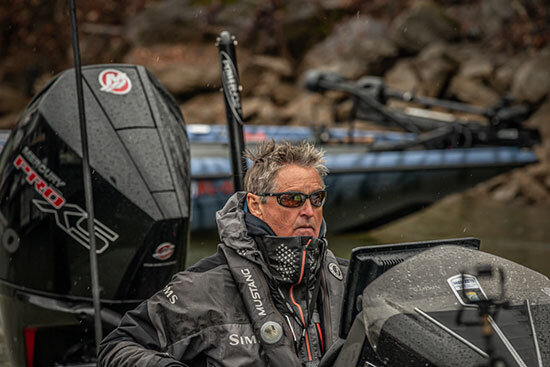
Frigid temperatures and cold rain pounded us throughout the event.
Our playing field included lakes Tellico and Loudoun, but my focus was on Loudoun — the larger of the two.
Practice Begins
On the first morning of practice, I put in at mid-lake and started targeting shallow, flat points. My lure selection included various lipless and diving-bill crankbaits, in red and shad-colored patterns. If the shallows extended far from the shoreline, I’d throw the lipless. Anything steeper, I alternated through the various diving models.
Everything looked good — water color, cover features and the amount of bait — all but the temperature. I never found water above 45 degrees, and I never had a single bite in twelve hours of trying.
On day 2, I put in near the Fort Loudoun Dam. Again, I targeted shallow, flat points adjacent to the main lake, concentrating on those with little or no current.
Finally, around 9am, I caught my first fish — a 15-inch keeper weighing about two pounds. A few hours later, with no more bites, I decided to try a marina. By jerking a Megabass One Ten along some floating docks, I managed to fool another fish. Unfortunately, it didn’t meet the minimum length requirement of 14 inches.
After hours of no additional action, I pulled the trolling motor and moved to a feeder creek upriver. Starting at the mouth, I fished my way to the very back. Though the shad were thick and the water slightly warmer, I never got a bite.
At sunset, I retreated to the cabin with no clue as to what to try next.
On day 3 of practice, I decided to fish upriver on some main river flats featuring isolated snags and rockpiles. It turned out to be a good decision — one that pointed me in the right direction.
On the very first spot I tried, I got two bites. After shaking those off, I hit two more flats but struggled to repeat the pattern. Still, I felt I was closer to solving the puzzle.
At 2pm, I decided to try a major feeder creek further upriver toward the City of Knoxville. When I finally reached the destination, I knew immediately I was in the right area. It had everything: rocky banks, flats with isolated snags, and docks littered with brushpiles. Even better, it offered warmer water with just the right amount of stain.

Back at check-in, I bagged 10 pounds of fish on day 1.
In a matter of minutes, I got my first bite on a shaky-rig Thin Senko. Marking that spot, I moved further into the creek, getting several other bites along the way. An hour later, I found a rocky bank with some submerged brush. There, I was bit on three consecutive casts — all of which I shook off. In another stretch, I got bit on an isolated snag.
By that point, I knew I had found a place to survive what was sure to be a tough event.
Competition Time
Having a late draw in the take-off order, I sat patiently at the Knoxville City Landing, waiting for my name to be called. Like the St. Johns event, we were forced to endure a fog delay. This time, however, it was brief, and soon the take-off sequence was underway.
When I finally arrived at the feeder creek, I noticed a number of other competitors already there. Fortunately, none were in the stretches I wanted. And in just a few casts, I got my first bite — a non-keeper. Minutes later, another. Then another.
At that point, I began questioning my choice. Was I shaking off short fish in practice?
Finally, I got a solid bite — a 4-pounder, in fact. Shortly after, I caught a 2-pounder. Those two fish erased any doubt.
Soon, a cold, hard rain set in. It poured for hours. Soaked and shivering, I finally added a third keeper to the box. And, right before time to leave, a fourth fish came aboard.
Back at the scales, I recorded a weight of 10 pounds, 3 ounces which placed me just inside the top 20. Ecstatic, I loaded the boat and headed to the cabin to re-rig my tackle, wondering how the next day might go.
When day 2 got underway, I raced directly to the spot where I finished the previous day. Casting to a large snag adjacent to the creek channel, I hooked up with a 2½-pounder. Right after, I threw at a large laydown and caught another keeper. Then a long lull set in.
Finally, at the end of the day, I put a third fish in the box. That gave me a two-day total of more than 17 pounds. I knew it would be enough to survive the cut.
Fishing on the Weekend
Knowing half the field was eliminated, I figured my creek would see far less pressure than it had previously … and I was right. Only three other competitors went there on Saturday.
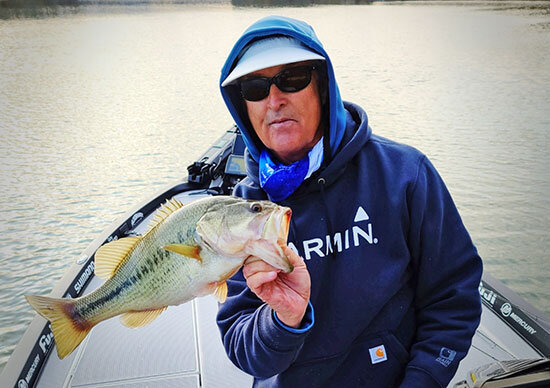
My best catch came on day 3 of the competition.
Again, I started on shallow wood adjacent to the main creek channel and scored a quick keeper. But then things got tough.
Around 10 o’clock, another rainsquall set in. Fishing through the downpour, I noticed the water color beginning to change, and that concerned me. Would the fish still bite with less visibility? I thought to myself, “Nothing’s tougher than a frigid, muddy water bite.”
To my surprise, however, things got better.
Cranking a stump in super shallow water, I hooked up with a fish approaching five pounds. Not long after, I connected with one well over three. I knew at that point, if I could fill out a limit, I would fish on Championship Sunday.
An hour later, I pulled my crankbait through a laydown and caught a fat 2-pounder. I was only a keeper away. Try as I might, however, I never got another bite.
Although disappointing, thinking back on how brutal practice had been, the outcome was easier to accept. I was solid in the points and making money in one of the toughest events I can remember, and that ain’t all bad.
Now, on to the next one.


I love it when I start to feel that cooling in the air, because I know fall is arriving and the fishing’s gonna pick up. The fall season is my favorite time to throw topwaters, especially on western fisheries, because I know I can count on good quality and numbers of fish.