Roy Hawk's "Secret" Buzzbait Setup
Posted by Mark Fong on Sep 23rd 2020
By Mark Fong
There are few anglers who have more in-depth knowledge of the GYCB product line than long time Western and current MLF Pro Roy Hawk. So when he offered to give the Inside Line readers the “deets” on his secret buzzbait setup, we were on it.
Hawk has been a big fan of the Yamamoto Buzzbait for years. “It's built exactly the way I would want if I were building it myself and I'll fish it as is straight out of the package,” he said. “It's got a narrow head, a hand tied skirt, a super sharp Gamakatsu hook, and a squeaky blade.”
A Break From Tradition
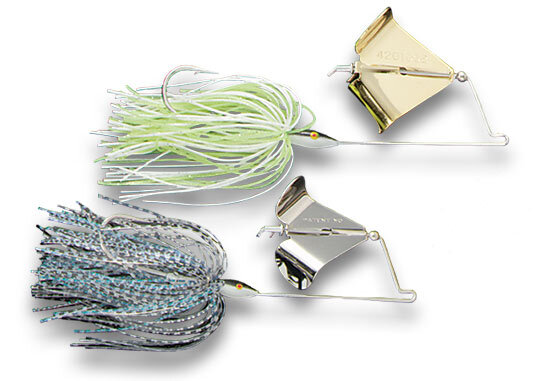
For the past few years, professional anglers have been replacing the skirting material on their buzzbaits with soft plastics. Plastics provide many advantages including: altering the bait's profile, making it more weedless, making it easier to skip under cover and increasing hook-up efficiency.
“When a bass strikes a lure, he flares his gills and tries to inhale it,” explained Hawk. “With a buzzbait there is just the skirt, the head and the hook. There is nothing really of substance for the fish to grab onto. With a piece of plastic, the bass has something substantial to hold and this makes for better hookups.”
Hawk's Secret Weapon
“The Yamamoto Buzzbait is perfect for fishing with plastics because you can easily slide the plastic up and over the head,” revealed Hawk. “It all becomes one piece, because you’re not just putting the plastic on the shank of the hook with a keeper, instead you're using the head as the keeper for the plastic.”
One of the main benefits of sliding the plastic over the head of the buzzbait is that it shortens the overall profile of the bait and eliminates the need for a trailer hook. “The problem with a regular buzzbait is that when you take the skirt off and put a piece of plastic on it, the plastic sticks way back and then you need to use a trailer hook,” Hawk explained. “The plastic gets torn up and then you have to take the keeper off your hook and then put the trailer hook back on and it just becomes a nightmare. Trailer hooks also tend to get snagged a lot. I can alleviate the trailer hook by sliding the plastic up over the Yamamoto head. The bait is more weedless and the hook is situated perfectly right at the back of the plastic.”
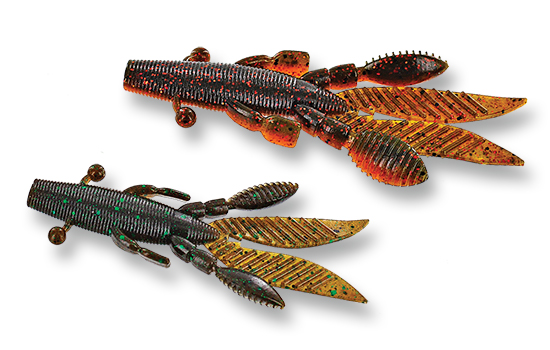
Of course the buzzbait is only half the equation. Selecting the proper soft plastic is equally important. “So many of the Yamamoto soft plastics work perfectly,” said Hawk. “The first time I started experimenting with this modification, my first thought was Lake Mead and putting a D-Shad on there. Now you not only have the perfect shad silhouette, but also the D-Shad adds extra weight for casting because of the salt in the plastic. It’s dynamite.”
When Hawk wants to present a bigger profile with more movement, he likes to go with either a Cowboy or a Mermaid. There are times when the fish want more of a traditional toad shape and this is where the Yama Frog fits the bill.
If there is one drawback to using a soft plastic, it is that if the plastic is not rigged perfectly straight, the buzzbait will not track correctly. “When you put a piece of plastic on a buzzbait, it has angles,” explained Hawk, “If the plastic shifts at all, it's gonna make the bait run funny. For example, if I get a bite and the bass knocks my plastic off center, now it's not gonna run right. Even casting the bait can cause the plastic to move. With a skirt that's not the case. You just need to pay a lot more attention to your bait to ensure that it is fishing correctly.”
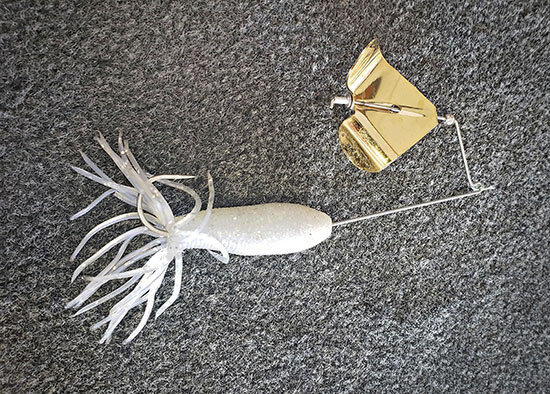
While Hawk routinely uses a number of different Yamamoto soft plastics, there is one in particular that he relies on the majority of the time. “The Fat Ika is the most perfect thing you can put on a buzzbait,” he said. “With the Ika you basically have an extra half ounce of casting weight and it doesn't matter if a fish knocks it because it's round and doesn't have any angles, it runs perfectly straight all the time. It’s got a great profile that mimics the shape of a bluegill or a shad.”
More Details
The Yamamoto Buzzbait weighs in at ¼ of an ounce and is available with either a small or a large blade. Hawk prefers the small blade for clear water situations when he really wants to work the bait fast. Lake Mead in the summer time is a prime example of when speed matters. On the other end of the spectrum, when he fishes stained water such as the California Delta, he opts instead for the large blade to create more disturbance.
“If I want to imitate a bluegill or if the water is stained, I like a gold bladed buzzbait,” said Hawk. “When shad are present or if the water is clear, then I’ll go with a silver blade.”
In a similar fashion, Hawk selects the color of his soft plastic based upon the forage base and water clarity. His favorite bluegill imitator is Green Pumpkin w/black flake (297) which he modifies by adding a tint of chartreuse to the tails with dye. For low light conditions, Black w/blue flake (021) works well. In clear water, Blue Pearl w/silver flake (021) or Smoke w/purple & blue flake/Watermelon w/blue flake purple (953) are among his top selections. If the water is ultra-clear and he wants the perfect shad imitation, a D-Shad in Pearl White (364) or Smoke Shad (958) is hard to beat.
For all his buzzbait fishing, Hawk employs his namesake 7' 4” Roy Hawk Heavy Reaction Taipan Casting Rod paired with a Daiwa Tatula Casting Reel (7:1:1 gear ratio) that he spools with 40lb braid.
When and Where It Works
“The buzzbait bite really comes alive during the post spawn period and the shad spawn,” said Hawk. “But don't overlook the bluegill spawn as well because a buzzbait can be tremendous. Later in the summer the fish set up on targets like docks or bushes. When this happens you'll want to run your bait by the structure to trigger the bass. In the fall, you'll get a mass migration of fish back into the shallows, so using a buzzbait around cover works really good.”