Summer Bass - Some Stay Shallow
Posted by David A. Brown on Aug 18th 2020
By David A. Brown
Fish have tails and they do what they want. Case in point: summertime patterns. In lakes with a true “offshore” range — ledges, drop-offs, deep brush, etc. — we tend to envision a massive postspawn migration from the shallow spawning areas to these greater depths. However, bass are notorious for defying the one-size-fits-all concept.
Realistically, just about every lake will see some percentage of its bass population remaining shallow year-round. That’s not to say some of those homebodies won’t sneak out and back a few times, maybe sniffing out irresistible bait schools; but all throughout summer’s swelter, diligent searches will turn up quality catches in less than a rod length of water.
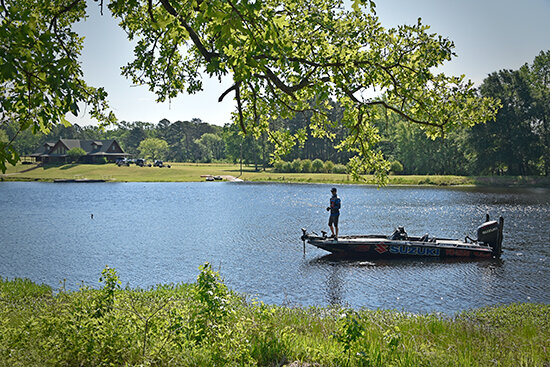
Bassmaster Elite angler Brandon Card says the motivation centers around food choices. While the offshore fish feed mostly on shad, the shallow bass prefer heftier cuisine.
“I think the number one deal is the bluegill spawn,” Card said. “I think there’s a population of bass that, for whatever reason, don’t chase shad; they settle into the shallows and eat bluegill all summer.
“The bluegill spawn starts it and they can gorge on bluegill. Even after the bluegill spawn, a lot of those (panfish) stay shallow, so the bass stay up there and keep feeding on them the whole summer.”
As Card notes, the much briefer Mayfly hatch, which can occur well past the namesake month — depending on latitude — also influences shallow bass, both in terms of direct feeding and indirectly with bluegill, white bass and other forage species distracted by the insect buffet. That being said, Card says it’s safe to assume that fishing for shallow summer bass means targeting “bluegill-eaters.”
Here’s how he likes to do it.
WHERE TO FIND ‘EM
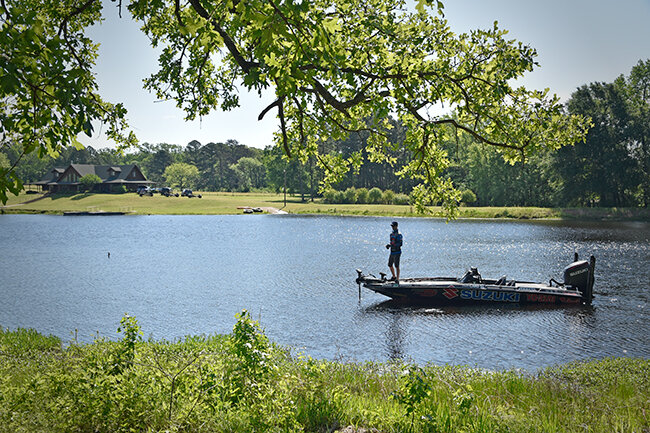
Food or no food, shallow water receives tremendous sun exposure during the hot summer months, so you have to consider the comfort zones. On lakes with significant vegetation, Card looks to grass mats, duckweed and particularly milfoil. The latter offers good overhead cover with more spacious caverns below the surface mat.
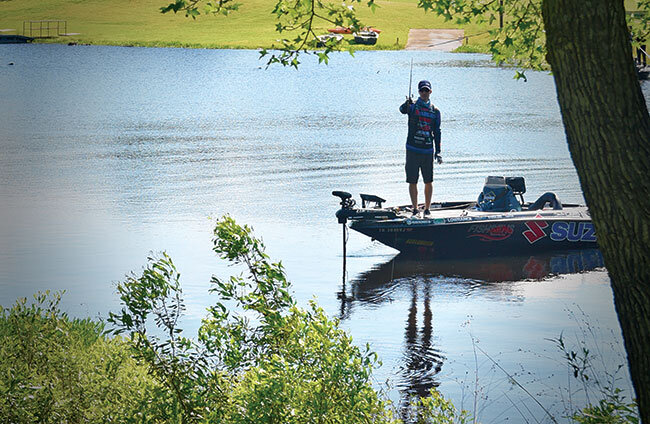
Absent the soft vegetation, Card looks for wood cover such as overhanging willow trees, bushes, laydowns and docks. Also, note that standing timber and big cypress stumps will offer shade lines that move with sun positioning.
“In the summertime, other than the morning, you pretty much have to focus on shade; that’s a really big deal for those shallow bass,” Card said. “They’ll sit in the shade where they feel a little cooler and comfortable and wait for a bluegill to swim by.”
HOW TO TEMPT ‘EM
Keeping an open mind to the day’s options, Card does his best to leverage the fish’s natural tendencies to his shallow summer advantage.
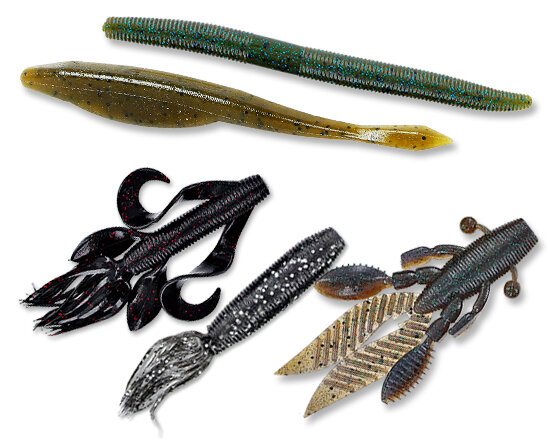
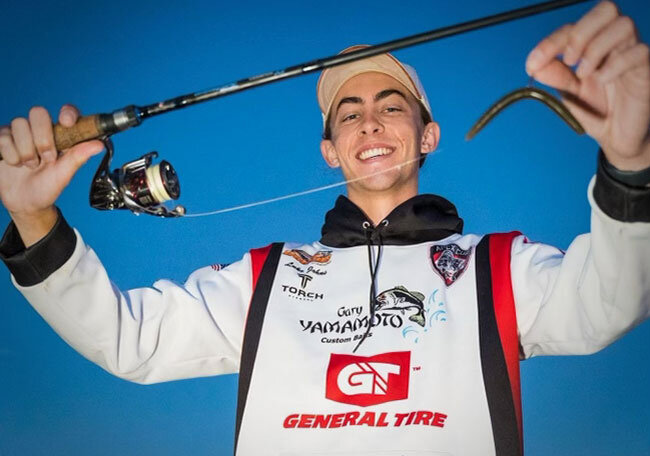
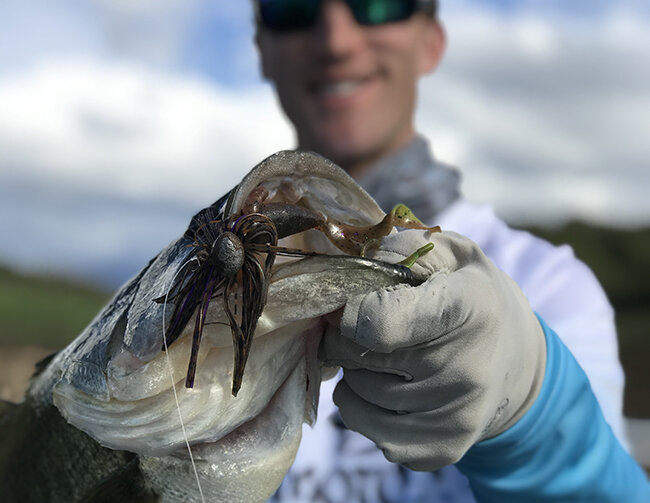
In the Nursery: While many are throwing topwater prop baits, swim jigs, etc., Card said his go-to will always be a wacky-rigged Senko. Nothing wrong with the other choices, but he likes the ability to stealthily slip his bait into the area and work it through the strike zone.
“A lot of times, these bluegill are going to be spawning in relatively shallow water, so that skip cast — where you get that wacky Senko skipping a long way — is going to draw the bass towards the bait,” Card said. “Once you start working that Senko back through those bream beds, that’s an appealing look.”
Top colors here are green pumpkin blue with chartreuse tail dips.
Under Cover: When he’s seeking shallow bass around docks and related seawalls, Card likes the Yamamoto D-Shad rigged on a wide gap hook or a wacky-rigged Senko. Both, he said, present a convincing bluegill impersonation, while allowing him casting efficiency and unlimited reach.
“Docks and seawalls are places you don’t want to slow down too much; you want to stay mobile so you can hit as many as possible,” he said. “Those two baits let me move through an area pretty quickly.”
To help sell the ruse, Card goes with green pumpkin baits and dips the tails in chartreuse. Of course, success depends on putting that bait in front of a fish, so Card does his best to thoroughly fish each structure.
“When you’re coming up to a dock there’s always going to be a shadier side, based on the sun angle, so you’re going to want to start there,” he said. “I’d make a couple of casts down that edge where it’s shadiest and then I’ll skip directly under the dock several times. I’d just skip over the side where the sun is shining thorough.
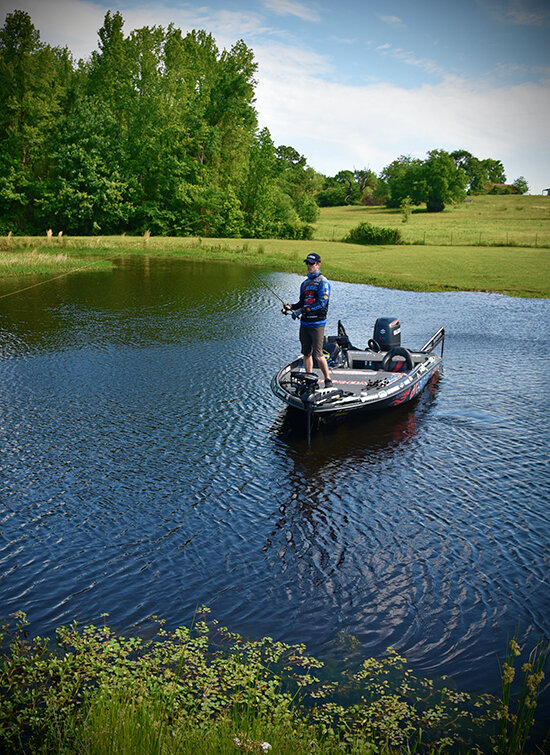
“I’ll do the same thing with the walkway leading to the dock. I’ll skip my D-Shad down that edge and fish the shady side of that walkway. With seawalls, anywhere it turns, there’s going to be shade on one side.”
Punch Power: Pure grass mats or random accumulations known as “trash mats,” the magnetic appeal of dense overhead cover never fails to draw summer bass into the shadows. They’ll roam the perimeters during low-light periods, but when the sun’s full strength, bass huddle underneath where they’ll quickly respond to the sudden appearance of a heavily-weighted soft plastic like a Yamamoto Kreature, a Fat Ika or a Flappin’ Hog.
“A lot of guys like hydrilla and coontail, but I like to find milfoil matted up with a nice canopy,” Card said. “If you can finds milfoil with duckweed mixed in, that’s even better, but I’ll be targeting areas in and around where I feel like the bluegill are spawning or were spawning.
“On a calm day, I definitely want to be hearing bluegill under those mats sucking up insects and feeding on all the life that’s under those mats. It’s really important to listen for those bluegill because that will tell you if you’re in a good area.”
In closing, Card addresses the right perspective for fishing shallow on a hot summer day: “You need to have the mindset where you’re not going to be catching a ton of fish, but there are big ones up there.
“It’s really easy to go out off the bank, idle around to find schools and catch lots of numbers, but after the first two or three weeks of the offshore game, those big fish leave the schools. So there will be a nice quantity of fish still out there, but I feel like those bigger bass go up shallow and start feeding on those bluegill. Lower your expectation of quantity and go for a handful of quality bites.”