Reese's Winter Bass Faves
Posted by David A. Brown on Feb 2nd 2021
By David A. Brown
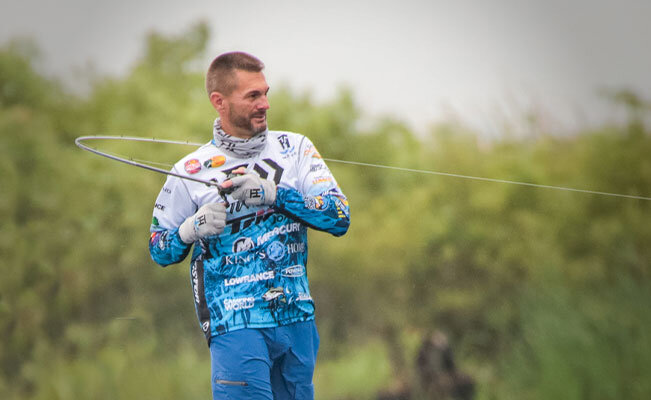
Not sure if Jimmy Reese enjoyed Disney’s Frozen, but he and Elsa definitely agree on one thing: The cold never bothered them anyway.
The decorated tournament veteran from Winter Springs, Calif. has clearly demonstrated his abilities across the calendar. But give Reese his preference and he’ll put winter high on the list.
For one thing, there’s often fewer boats on the water. Unless it’s derby day, a lot of folks are less inclined to undertake a frosty launch — at least until mid-morning. Also, winter tends to concentrate fish, so finding one often means finding a pile.
“I’ve had some of my best days ever in the wintertime,” Reese said. "A lot of it has to do with weather, but if you get some of those calm days, you can crush them.
“The cold is not a problem as long as you’re prepared.”
More on this in a minute.
Let’s look at how Reese likes to target the three black bass species during winter’s chill.
LARGEMOUTH
For big green ones, Reese’s winter go-to is a jerkbait. Throwing this on 10-pound fluorocarbon, he’s focusing on flats with rocks, but the most important element is the fall-back zone.
“I generally want to be where they have deep water access,” Reese said. “That might be a little ledge or a flat adjacent to that deeper water. You have to have a stair step so they can move up and down easily.”

Long casts are essential for staying off the fish and allowing himself plenty of retrieve length to entice lethargic fish. Reese said he’s typically working the 5-foot zone and for him, it’s all about consistency.
“The wind can make it harder to fish correctly because you have to fish slowly,” he said. “With that jerkbait, I’m often pausing it 10-30 seconds, so I have to be able to stay on my spot and make efficient retrieves.”
Reese will balance the slow twitching presentation with the steady retrieve of a squarebill. Deflecting off rocks often makes the magic happen, so it’s a simple chunk and wind kinda deal.
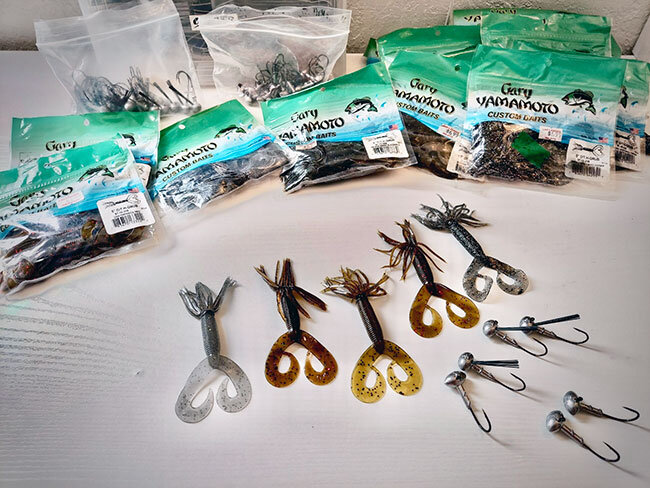
When the largemouth need a slower presentation, Reese breaks out the 3/8-ounce football jig, pairs it with half a 5-inch Senko or a Double Tail Grub and drags it around rocky bottom. Covering water is essential, but given the pace of winter jig dragging, he relies heavily on his Lowrance units to dial in his search.
“In the wintertime, they can still be shallow, but there are still a lot of fish down in 20 feet — you just have to find the schools,” he said. “Electronics are huge this time of year. You find the bait, you find the fish.”
SMALLMOUTH
When he’s dragging around south-facing main lake points for the brownies, Reese typically starts with a small football jig. If he can get ‘em to bite the full-size package, great; if not, he’ll scale back on the meal size.
“It depends on how ‘winter’ winter is,” he explained. “If it’s really cold and the fish are less active, I might go to a light ball head to finesse them. They’re not eating as often, so that smaller profile might make them bite.”
Fish mood also determines trailer choice. When they’re “on,” Reese goes with a Double Tail Grub or a Fat Baby Craw, but if the fish are just nipping, he’ll slim down to that half Senko. Green pumpkin’s a common color choice, but smallies tend to favor accent colors, so Reese usually adds a touch of orange or chartreuse to the tips.
“I’m generally just dragging it on the rocks, but I’ll drag it consistently for 8-10 feet and it just takes the right action off the right rock to trigger a bite,” Reese said. “I assume they’re always looking at, so I’m just trying to make the bait do something that makes them commit. That could be when it (deflects) from one rock to the next.
“The key is they want it moving. It seems like if I stop it, I have to start the whole cast over. The bites usually come right when it comes off a rock.”
(If he thinks the fish really need finessing, Reese goes to a Ned head with a 3-inch Fat Senko.)
SPOTS
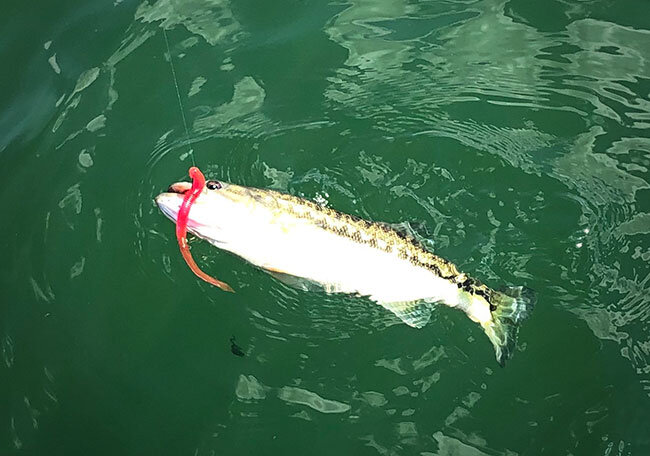
Spotted bass aren’t terribly picky, but Reese has found he’s most consistent for winter spots when he’s dragging a Frenzy Nail (shaky head) with a Yamamoto Kut Tail Worm on 8-pound fluorocarbon with a light action rod. A super slow pace with periodic shaking is the key to banner days.
Reese won’t pass up a nice warming trend, but he’s observed an interesting weather correlation: His best days of spotted bass action have always involved the white stuff.
“During a past trip right after New Years, we launched at Lake Shasta when it was snowing and within an hour there was half an inch of snow on the deck,” Reese said. “We started throwing shaky heads around the islands and we crushed ‘em. They weren’t the little pound to pound-and-a-halvers; they were 2- to 2 1/2-pound fish.”
Reese’s technique tip: Don’t overthink this. Make long casts, drag with a steady pace and use that rod tip to throw in a few twitches. The rig does a lot of the work for him and he’s seen spots attack during intervals of minimal action, as well as on those moments of pronounced shaking.
WINTER WISDOM
When considering a winter fishing trip, Reese keeps a few key points in mind: “The most important thing is fishing slow. You can always go catch some jigging spoon fish, but, for consistency, slower is better. The key is being prepared with the right weather gear so you can focus on proper technique.”
Noting that it’s better to “overdress,” Reese said he wears two pairs of wool socks under sturdy, insulated boots, a warming base layer, two sweatshirts (one a hoodie) over a performance t-shirt, SIMMS rain gear and gloves with fingertip sensitivity for operating his touchscreen electronics.
A knit hat helps retain heat on the top end, while hand warmers stuffed into his gloves, boots and jacket pockets keep things toasty. Fact is, the more Reese can minimize the cold’s distraction, the more he can focus on detecting and leveraging the day’s fishing cues.
“Pay attention to what’s going on down there,” he said. “You’ll start to figure out what they like and then you can focus on making those exact presentations.”
And what does Reese do with each bass caught during a winter fun fishing day?
Let it go, let it go…
I’m sorry — too easy.