Late Summer Tips from Tai Au
Posted by M.L. Anderson on Sep 1st 2020
By M.L. Anderson
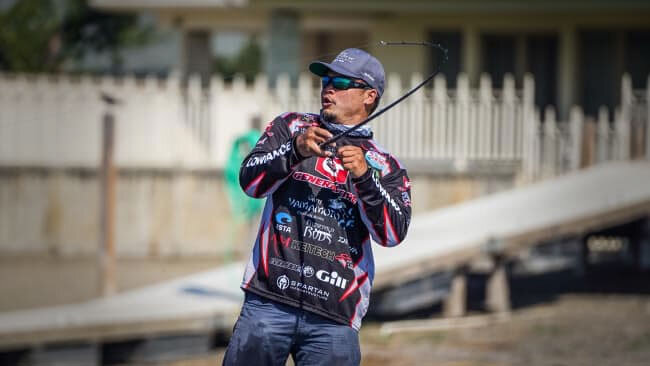
We caught up with Tai on his way to the Delta for the FLW Toyota Series in late August (where he got a top ten finish, by the way), and he shared some of his best tips for late summer bass fishing.
Temps were supposed to be 110 degrees even at the Delta, and Tai says that pretty much wherever you are this time of year, everyone is dealing with the heat, so this seemed like the perfect time to ask him how he fishes so successfully when the weather is scorching. If it’s windy or cloudy, like during monsoon season, he says to check the barometric pressure. During high pressure fronts, he won’t throw topwater even if it’s calm, but during a low pressure front he gets more aggressive.
Observe Birds and Insects
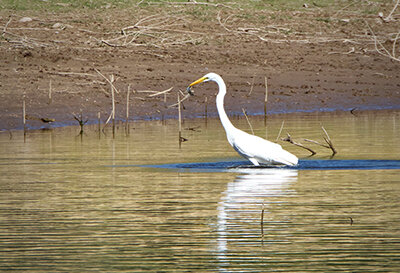
Birds on the water's edge usually means that baitfish are up shallow. The egret has caught a minnow.
One of the key attributes that makes Tai Au such a great fisherman is his power of observation. Previously, he shared his observations about keying in on changes in barometric pressure with Inside Line, and that is one thing that always factors into his strategy no matter what time of year it is. In addition to watching the barometer, Tai keeps a sharp eye on the animals and even insects at the lake. “Everyone knows to watch for birds,” Tai says, “when they are active on shore you know the baitfish are up, and probably the bass are active.”
In the morning, he watches for herons in the backs of coves. If they are there, then the fish are probably shallow and he will throw a spinnerbait. If the bluegills are active in shallow water he’ll throw a JackHammer with a green pumpkin Zako trailer. This shallow-water morning bite dies fast in Arizona and hotter climes, so once that’s over you have to go deep. Tai says that usually the shallow morning bite only lasts an hour or so after first light, so you definitely need to have a backup plan.
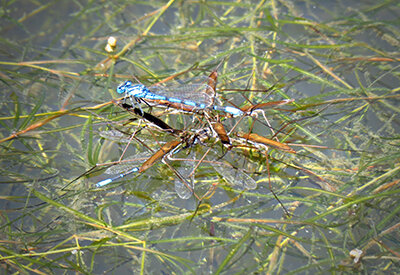
Tai looks not only for birds, but also for dragonflies. A cove with a lot of dragonfly action is a great place to throw topwater.
Tai has noticed that dragonflies usually get active around noon in the backs of coves. At this time of day he is usually out fishing the thermocline, but he makes a point of checking out the backs of coves. “Lots of guys look for signs of baitfish up shallow,” he says, “but I look for dragonflies in the backs of coves.” When he sees them, he starts throwing topwater baits. His favorites are buzzbaits, poppers, and the YamaFrog, or a double buzz with a YamaFrog trailer. If you’re lucky, he says, you can run into a magic cove filled with dragonflies and big bass that are already thinking about transitioning to fall areas. However, if the wind kicks up it’s gone, and you have to move back out to deep water.
Observe Your Graphs
Again, observation is the key – this time, it’s paying attention to his Lowrance graphs. “Look for the thermocline,” he says. “You’ll see all the activity at twenty-five to thirty feet at Lake Pleasant, for instance. The thermocline is a cooler zone that holds more oxygen so fish prefer to stay at that level most of the time.” Once he’s determined the depth of the thermocline, he watches the map on the Lowrance to find areas where structure like points, humps, channels, bluffs, etc., intersect with that depth.
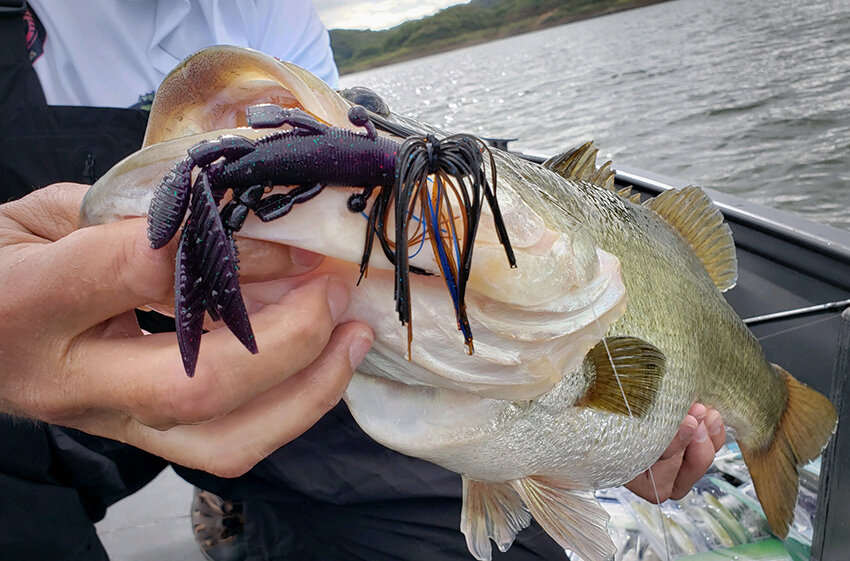
“Fish that zone with Texas rigs, Neko rigs, a 4- or 5-inch Senko, or a Ned Rig,” Tai says. He likes to keep colors basic: shad or bluegill colors, plus a few craw colors constitute his go-to baits. For example, if he’s fishing a Neko rig he’ll use a 3/32-ounce jig with a green pumpkin Senko on a Fitzgerald spinning rod with 8-pound-test Sugoi fluorocarbon line. He also loves to throw Hula Grubs to imitate craws, and he puts them on ½-ounce football head jigs. He prefers unpainted jigs and his go-to colors for Hula Grubs are green pumpkin for his craw color and smoke sparkle to imitate shad. If the water is super clear he’ll throw a baby bass color (305).
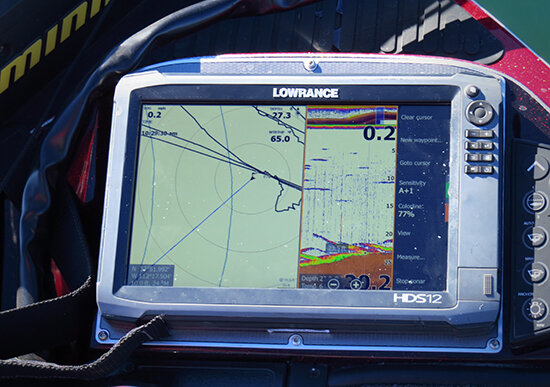
His Lawrence graphs are a major factor in Tai's tournament successes.
Crawl any of these baits across points or bluff walls with shade, he says. In fact, shade is another target to shoot for. If you can find shade near the thermocline, don’t pass it up. He will also flip any cover he sees, especially if it is making shade.
Late Afternoon
Later in the day when shadows get longer and it starts to get cooler, the fish move up and it’s back to the buzzbait, popper, Horny Toad, Super Spook, YamaFrog, or Berkley Choppo topwater bait. In the evening, you get a bonus topwater bite, and this time of day he likes to throw white baits. Once it gets dark, though, he likes to have a black buzzbait ready – you can extend the topwater bite by a half hour or so, he says, so try this when the white bite stops. Another great bait for dusk to dark is a black and blue YamaFrog.
Fish can see the silhouette of a dark bait better at night, and Tai starts throwing the darker colors when it is still light out but starting to get dark. He thinks that it takes the fish longer for their eyes to get accustomed to low light than it does for us, and he gives them a little help. This help can come in the form of a buzzbait to send vibrations to the lateral line or darker colors so the silhouette shows up in lower light. Also, he says, use a trailer hook when you can get away with it to make up for short strikes. If you’re in an area where snagging isn’t a big issue, definitely put on that trailer hook.
Rivers and Tidal Waters
On rivers, Tai targets current and shade pockets. Generally speaking, rivers are not as deep and they have no thermocline, says Tai, so pay attention to current and to vegetation – these are what provide oxygen. This time of year he focuses on main river current, especially points, turns, bends, etc. – not shallow backwaters unless the baitfish are active back there. You’ll find numbers of fish where they are most comfortable – they’ll tuck in under cover, so deeper mats with current running through are great. Forget stagnant water.
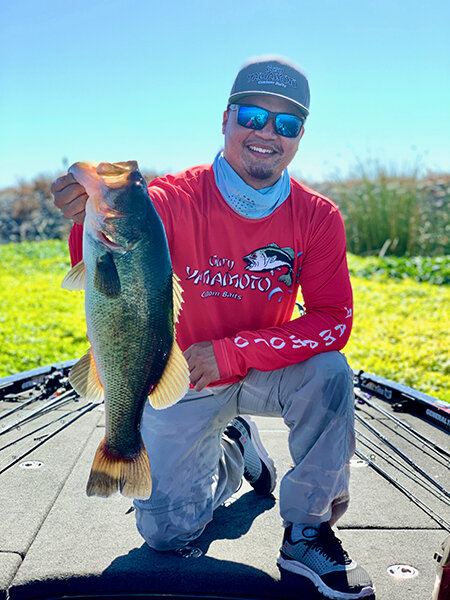
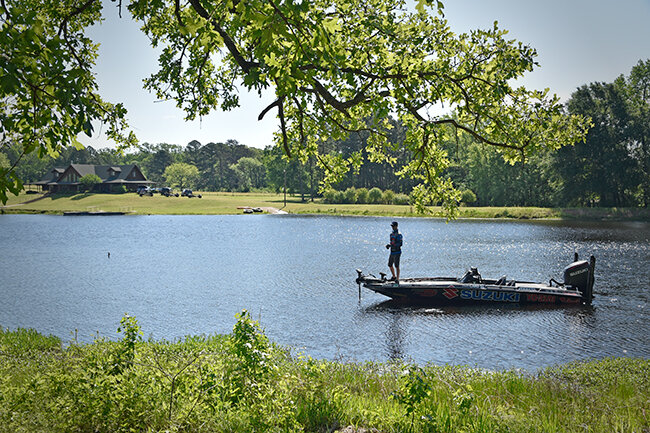
Tai targets big bass by being observant.
Tides affect both depth and current, so if he wants to fish a deep mat he won’t do it at high tide – that makes way too much to cover. Instead, he’ll go there when the water drops, because the fish will usually pull out to the edge, where they are much easier to target. At high tide he’ll fish things like corners, bends, and isolated structure, and at low tide he moves to edges of grass and those edges of mats of vegetation. He just follows the fish up and down.
Docks on rivers are awesome, Tai says – he loves to fish the shade underneath them after the morning bite. Sometimes entire schools of bass can be under a dock if the depth and conditions are right. He likes to toss jigs under the docks – a 3/8- or ½-ounce jig with a weed guard and a 5-inch Hula Grub. Deeper water calls for the heavier jig most of the time, but he says to experiment, because sometimes they just want a faster or slower fall. If you want to make more of a ruckus and move some water, he says to switch to a Flappin Hog or a Cowboy on a hair jig. Those both move a lot of water.
Observe the Docks
Another thing Tai pays attention to is the docks themselves – the part out of the water. If there are rod holders on the dock, he assumes that the owners like to fish. Often, those fish-loving owners will sink a brushpile or two close to the dock. Keep an eye on your graphs while you move around and see if you can spot any. Those can be real honey holes. If you do find a brush pile, try a Texas rig with a Flappin Hog and a 3/8-ounce bullet weight, or a Neko rig. A wacky-rigged Senko is perfect to pitch to a brushpile under a dock. His favorite colors, again, are simple and natural colors: green pumpkin, blue gill, baby bass, and smoke sparkle.
Tai says to keep it simple – skip a Chatterbait under the docks if the fish are more aggressive, or use a spinnerbait. You can even throw a buzzbait – just play it by ear and base your choices on how active the fish are. Are they slamming it? Go faster. Pay attention to what is around you, and pay close attention to the fish. Not only how aggressive they are, but the kinds of places you are catching them. The more observant you become, the more you will learn about bass fishing.