"Video Gaming" the Shad Shape Worm
Posted by Shane Beilue on Dec 21st 2020
By Shane Beliue
The onset of the winter months leading to frigid water temps drive shad populations into tight balls that spend the winter roaming deep, meandering creek channels. This action by the shad schools also guarantees packs of aggressive bass are always nearby. It’s very common for these balls of shad to be suspended in the middle of these deep creek channels, meaning if the bass want to eat, they can either wait in nearby deep cover for the shad pod to swim by, or they can simply follow the bait by suspending alongside the shad, attacking at will.
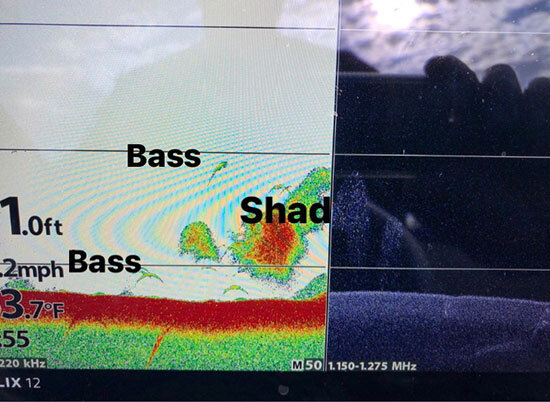
Suspended bass were once thought almost uncatchable due to the difficulty of making a precise presentation to them; however, today’s electronic technology allows an angler to get a better visual of what’s actually taking place in the water column over the old flasher units of yesteryear. Today, technology like the Garmin Livescope allows an angler to literally see what’s going under the boat in real time, but even if you don’t possess the latest in sonar tech (like me), you can target and catch suspended bass with traditional 2-D sonar and some time dedicated to understanding what the sonar is telling you. The tool of choice for this approach is a 3/8 to 1/2 oz drop shot weight and the Yamamoto Shad Shape worm, which is a perfect profile of the shad.
Vertical fishing demands you spend some time idling with the dash unit to find where these balls of shad are grouped before moving to the front deck. Depending upon the reservoir’s overall depth and water clarity, it’s typical to find the shad in the first 1/3 of major tributaries. The depth they position can vary, but the clearer the water, the deeper these shad balls will be positioned. This is a time of year they tend to just suspend over the deepest part of the channel, not necessarily positioned on the channel ledges. The image you’re looking for is a ball of shad with small groups of bass nearby. Marking a waypoint over the school can be helpful, but these shad pods are always moving, so the waypoint may only be a general reference point. By staying within the confines of the channel, you will intercept them again with your front graph once you move to the front deck and drop the trolling motor.
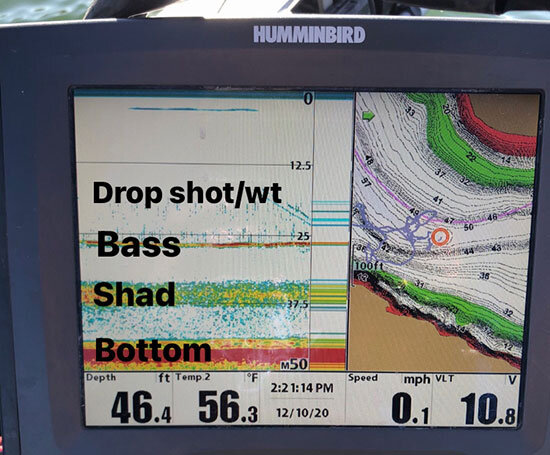
Once positioned on the front deck, grab your drop shot rod and have it at the ready as you watch your front sonar for the presence of shad (indicated by a thicker band of red/yellow), as well as bass (thinner lines across your sonar screen). Without the presence of these thinner lines representing individual bass, don’t bother dropping the bait. Once located, release the bail and allow the heavy drop shot weight to quickly fall as close to the front transducer as you can. If properly positioned, you can see the weight and Shad Shape worm fall to the depth where the thin lines are showing on screen, often watching the bass rising to meet your drop shot as it descends (represented by an ascending line). Flip the bail and allow the Shad Shape worm to do its thing with subtle quivers of the rod tip until you feel the slight tug of the bass eating the bait. To clarify, the weight is not on the bottom – just suspended right in front of the bass - whatever depth that may be.
This is a general overview of the technique; therefore, the specifics regarding how the fish respond to your lure, how to recognize when a strike is imminent or even when you need to pick up and look for another school, requires a time commitment to get on the learning curve. Once that first bass is caught, however, your confidence will climb and you’re on your way to catching suspended bass with regularity.
Equipment Notes:
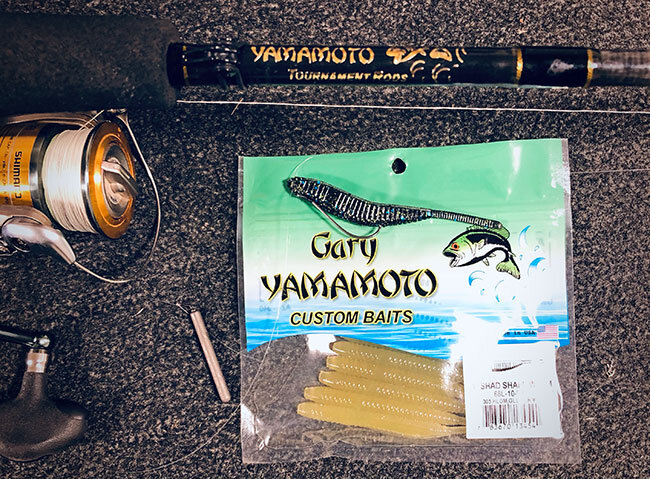
Of course, Yamamoto is renowned the world over for their soft plastics, however, the 6’6” Yamamoto Drop Shot Spinning rod (available at baits.com) is ideal for vertical fishing. It has a very soft tip for handling light line and surging bass. 15# braid tied to a 6-8# fluorocarbon leader will allow you to maximize sensitivity and minimize line stretch on a deep-water hookset.
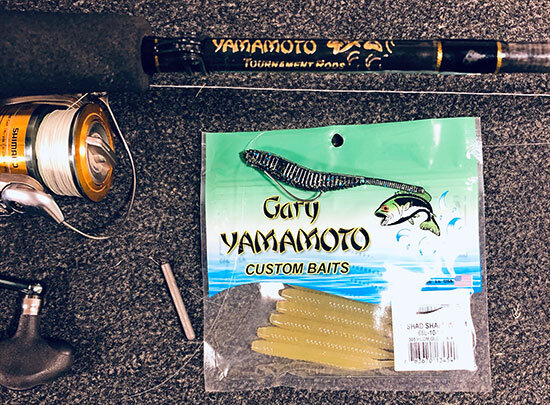
The Shad Shape worm is 3.75” long and perfectly mimics the profile of a shad. Color choices are virtually limitless; therefore, the clearer the water, the more muted my color selection becomes. You can’t go wrong with (939) Baby Bass/Crystal laminate, (305) Baby bass or (306) Natural Shad in clear water (5-10’ visibility). Darker colors like (214) Smoke w/chartreuse flake may work better under cloudy conditions or less water clarity.
Finally, a couple of electronic notes: turn the screen speed on your front sonar unit to maximum, which will refresh the image faster on screen to give you an image closer to real-time. Also, choose the narrowest cone angle for your front transducer, as this will show you what is immediately under the boat and allow you to be more precise in presenting your drop shot to the bass.