Shryock's 4 Must-Have Bed Fishing Baits
Posted by David A. Brown on May 13th 2020
By David A. Brown
Throughout his career in professional fishing, Fletcher Shryock has met a lot of people. He’s also met a lot of bass. The connection — lots of different personalities. And just as he’d take the appropriate conversational approach based on who he’s chatting with, the accomplished pro from Newcomerstown, Ohio knows he has to calculate various bass dispositions.
“Fish all have different personalities, so it’s important to have a couple things to throw at them,” Shryock said. “Sometimes, they may not be interested in one thing and you pick up another bait and they’re right on it.”
That’s particularly relevant to the bass spawn. The reproductive season happens at different times, based on geography, but there’s no denying the relevance of bed fishing. Shryock’s multi-faceted approach to this shallow water theater bespeaks the wisdom of keeping a variety of baits handy.
IN PLAIN VIEW
For the obvious stuff, the visible beds he can spot and approach with relative ease, Shryock uses this one-two punch.
Straight Talk: In most cases, Shryock’s first choice for bed fish is an unweighted Senko. Texas-rigged on a 5/0 Trokar TK135 flipping hook, this classic bait can reach into just about any spawning habitat with a subtly intrusive look.
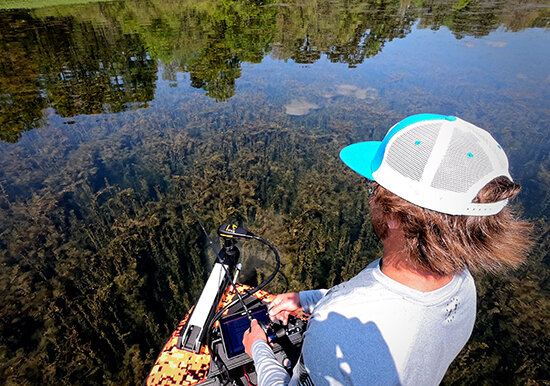
Sleek and easy to cast, this bait’s efficiency complements its role in gauging a fish’s temperature. As Shryock explains, the Senko lets him know who’s in the mood to chew and who has the pouty face.
“It’s important to know that there are a large number of bed fish that are uncatchable at certain times,” he said. “I feel like a lot of it comes down to the timing of when you find that fish, as far as how far along they are in the spawning process. Have the eggs been laid? How aggressive is that fish?
“One fish may be deemed uncatchable on Tuesday and then you roll in there on Wednesday and she’ll bite anything that comes near the bed. It just comes down to the fish’s personality and there are a lot of factors that go into it.”
Boat pressure and weather definitely influence this deal, but Shryock knows that the best fish to find are the ones that have something to lose.
“You want to find that fish when the eggs are laid and she’s in a guarding mood,” he said. “So, the timing if probably more important that any one thing. If you get a pair of fish in there and they’re rolling around, those fish are extremely difficult, if not impossible to catch. Acknowledging all of this is pretty important to all of these factors when you’re evaluating bed fish opportunities.”
Technique: Shryock pitches his Senko well past the bed and slowly works the bait into the bed. Bombing a bed fish usually shows you a departing tail, so ease into the presentation.
“I start with a very subtle shake and then, at that point, you’re reading the fish,” Shryock said. “The Senko is a very good bed fishing bait so it helps you figure out the mood of that fish — if it’s going to bite, or if it’s deemed catchable.
“If you pitch in there and you don’t splash it on the bed, but you just drag it into the bed and she’s gone and doesn’t come back, keep moving on. But if she stays on the bed, or she leaves but turns around and comes back, that one typically can be caught — maybe not with a Senko, but you’re reading the fish and figuring out that it is aggressive.”
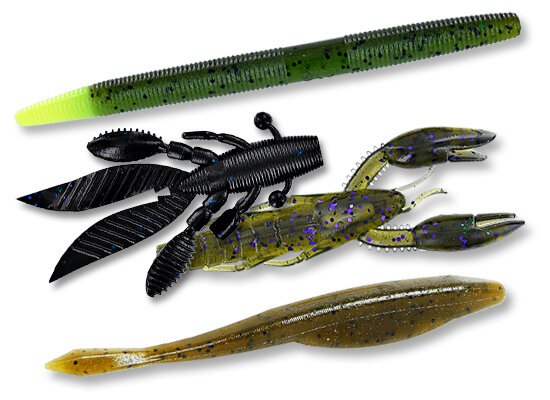
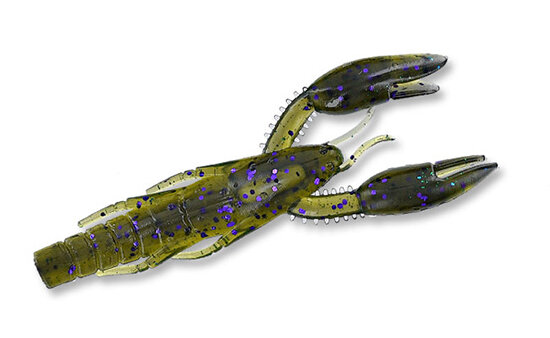
Step It Up: If the fish snub the Senko, Shryock switches to the more active and irritating look of a Yamamoto PsychoDad. A craw imitator designed for an upward posture, this bait sits in the bed like a crustacean raider and if that doesn’t push the fish over the edge, it’s probably not going to bite.
“I rig this the same way as the Senko,” Shryock said. “A lot of times, I can unrig the Senko and throw on the Flappin’ Hog as I’m trying to figure out the fish.”
ON THE HUNT
It’s nice when you roll up to your first bank and find it loaded with beds, but that’s the rarity of which we dream. More commonly, it’s a hunt; covering water to look for beds is just part of the spring routine. Shryock’s cool with that, but he doesn’t accept the notion of covering water and only looking.
“When I’m looking for bedding fish, I like to use a green pumpkin Yamamoto D-Shad with a chartreuse dyed tail on a spinning rod with light line,” he said. “As I’m looking for beds, I’m casting that thing way out in front of me where I think one may be on a bed or up cruising.
“I’m able to pick up fish while I’m looking because it doesn’t take a lot of action. You give it a twitch every now and then and it has that shimmy to it. You can cover water, but you don’t have to be looking at the bait; you can stay focused on looking for bedded fish.”
THE UNSEEN
Shryock stressed that while “looking at ‘em” is certainly more straightforward, he actually prefers conditions that conceal bed fish. Dim, overcast day can do that, but so can lower water clarity. Bass generally want to spawn in the cleanest water they can find, but Shryock knows that turbidity can shift the advantage in his favor.
“Once I see fish on the bed, I try to find dirtier water and catch fish spawning that I can’t see and that can’t see me,” he said. “They’re a lot more aggressive and that’s when I like to flip a Flappin’ Hog to them. That’s where you’re blind bed fishing where you think they’re going to be spawning around laydowns, bushes, seawalls, inside corners of dock posts; things like that.
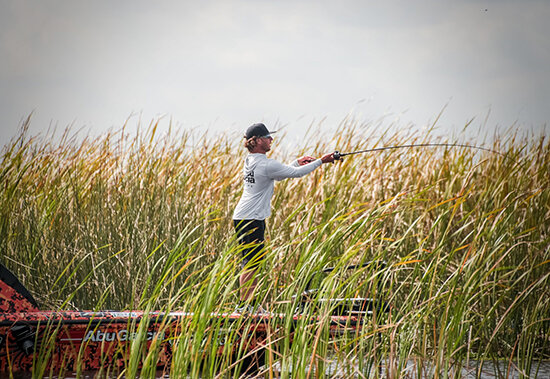
“I don’t like to just go down the bank dragging. Definitely identify targets you see them spawning around in the clear water and do that in the dirtier water. Try to visualize bedded fish in and around that same stuff in the same pattern.”
Shryock rigs his bait on a 4/0 HOOK with a 1/4- to 5/16-ounce weight. Unlike targeted bed fishing where he’s trying to hit that well-defined patch of cleared bottom, the dirty water theater requires more of an educated guess. He’ll pitch to a promising area and drag that bait to, essentially, search for unseen spawners.
“If I’m in and around heavy cover, the weight is (tightly) pegged and if I’m not, it’s not pegged,” Shryock said. “If I’m around dock posts or seawalls, I’ll slide the bobber stop up about 4 inches because I feel like you get more bites if it’s not (tightly) pegged and the bait has more action. I’ll just slide the bobber stop up and down depending on what I’m flipping into.”
Last piece of advice from Shryock: Keep your distance. Whether searching, dragging or looking at ‘em, the more space you put between yourself and a bedding bass — seen or unseen — the better your chances of catching that fish.

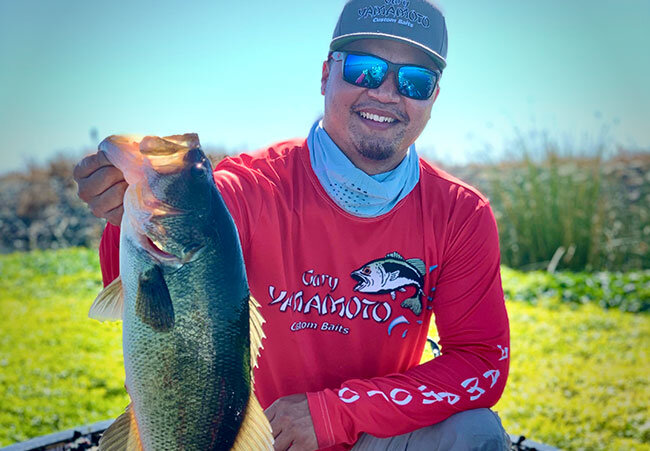

Luke Johns is a relatively new member to Team Yamamoto. He’s been fishing the Wild West Bass pro-ams, team events, and college events, and is now fishing the Pro-Ams and the Apex Tour. He’s definitely an angler you’ll want to keep an eye on.