Rods & Rigs - Top Summer Offshore Tactics
Posted by David A. Brown on Jul 7th 2020
By David A. Brown
With summertime now upon us, we’re faced with the year’s hottest weather; but if you lather on the sunscreen and drink lots of water, you can enjoy some incredible fishing action. In most lakes, once they’re down with their postspawn period, fish will move offshore where they’ll spend several weeks in the deeper water.
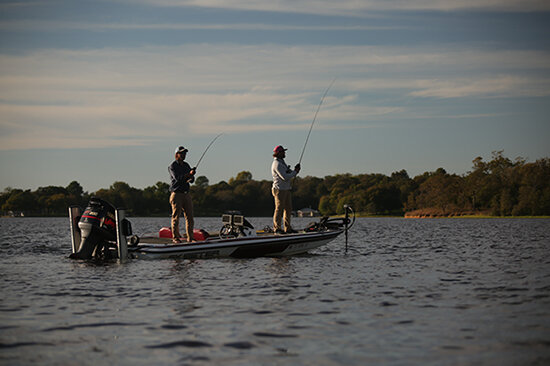
Photo by Search Engine Pro on Unsplash
Now “deep” can mean different things in different parts of the country. For example, in Western fisheries such as Lake Shasta and Oroville, deep might be several hundred feet; while in Lake Fork or Kentucky Lake, deep water might only be 20 feet.
Regardless of the actual depth range, you can expect fish throughout the country to move to dominant offshore structure. For example, the rock piles in Clear Lake get loaded up in the summertime, while on Kentucky Lake, everyone fishes the ledges. On Lake Fork, the fish go out to humps.
One of my favorite offshore scenarios is what I call a “saddle.” This is a long point or ridge coming off the bank, dropping down and coming back up. Some people call it a cut, but the main feature is that depth change. Smallmouth, largemouth and spotted bass all love these saddles because they provide the safety and comfort of deep water with significant shallow areas for feeding.
Whatever scenario dominates your lake, this offshore move happens every year; and the cool thing about the summertime is they load up in spots. So once you find them, many times, you don’t even have to move the boat. You might sit there and catch 30 fish without leaving your spot.
RIGHT PLACE, RIGHT TIME
You will want to be aware that the action typically doesn’t last all day; rather, it comes during particular periods. There always seems to be a really good morning bite and then it slows down during the middle of the day. But they will feed again heavily at some time later in the afternoon.
I can remember one time on Lake Fork, we really knew we weren’t going to catch them until about 2 o’clock during the hottest part of the day. Until then, it was like they weren’t even there, even though we could see them on the graph. We’d caught them there the day before and at 2 o’clock, it was like someone flipped a light switch. So, we caught them early, we caught them mid-afternoon and then, in the evening, we caught them again.
You’re still going to pick off some scattered fish in the middle of the day, but at some point, they will go into a feeding frenzy; they’ll eat anything that comes by. The key to capitalizing on these frenzies is to realize there’s usually a sweet spot. It may a single big rock, a stump or a point off the side of the drop — whatever it is, the fish will cluster around this spot.
Once you find where that spot is, you can literally make the same repeated cast over and over and over. When you fish around and find the sweet spot on a piece of offshore structure, it’s like magic. To dial in the fish’s specific location, you have to try different angles to see what they want.
TOP BAITS
When I come up to a hump or an island top, the first thing I like to throw is a deep diving crankbait like a Norman DD22 or a Strike King 6XD — many guys even throw the 10XD. I like to start with cranking because I want to pick off the aggressive fish first.
I’ll throw my crankbaits on a Champion 805 CB — an 8-foot rod specifically made for those deep diving crankbait. Most of the time, I’ll use 10-pound P-LIne CSX, which is strong, but has a small diameter that allows me to get a lot of depth out of my baits.
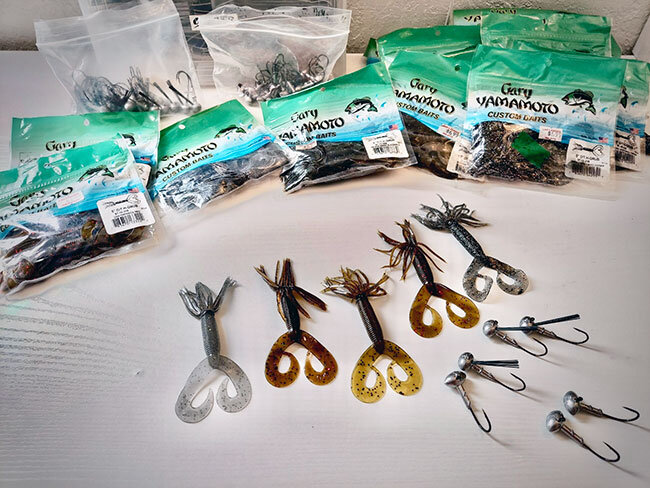
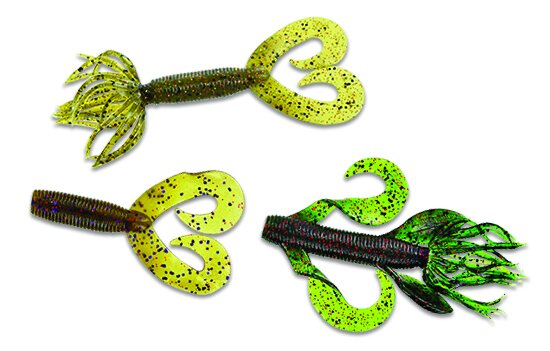
Once I’ve made numerous casts and I’ve picked off all the fish I feel like I can catch on that crankbait, I’ll go with a jig presentation. I like a 1/2-ounce football head with a Yamamoto Double Tail Trailer or a 5-inch Single Tail Grub, or a homemade football jig with a 5-inch Hula Grub. (The homemade jig has four keeper barbs that prevent the Hula Grub from slipping.) For all of these trailers, I like green pumpkin and cinnamon purple flake.
I fish my crankbaits pretty fast, so for the ones that won’t react to that presentation, will usually respond to the slower dragging look of a football jig. With this technique, it’s like I get a whole other group of fish.
I know a lot of guys like heavier jigs, but feel that the 1/2-ounce offer a good balance of efficiency. It’s heavy enough that I can fish it fast and cover a lot of water, but it’s less likely to get snagged in the bottom.
I’ll fish my jigs on a DX 744 C or a Champion 744 C — both are great jig rods. Most of the time, I’ll use 12- to 15-pound P-line fluorocarbon, but if I’m around heavy cover, I’ll go with 20-pound test.
My third choice is a Carolina rig with a 4- to 6-foot leader. Some people like lizards; I like the Yamamoto Kreature, but whatever you like, that slow rise and fall presentation will often trigger a whole different group of fish that didn’t react the crankbait or the jig. That way, you can pick up some of the remainders.
Many times, I can’t get a bite on the crankbait or the jig, but I throw out that C-rig and catch on on the first cast. My approach to summertime offshore fishing provides a very effective 1-2-3 strategy — you pick off the ones that are super aggressive right away, then you show them progressively slower looks until they respond.
Sometimes, the crankbait will catch a whole bunch, but other times, a crankbait will catch one or two and then the jig will catch a whole bunch. But then, there are times when you’ll catch one or two on a crank, none on a jig, but all of a sudden a C-rig just lights them up. It’s just the mood of the fish at that time of day and what they’re looking for.