Ehrler's Schooling Strats
Posted by David A. Brown on Oct 28th 2020
By David A. Brown
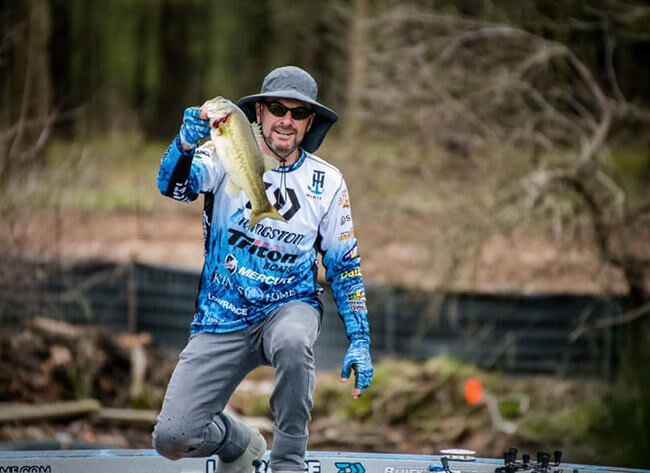
Fishing the inaugural Bass Pro Tour Redcrest event last fall at La Crosse, WI, Brent Ehrler experienced a dramatic turnaround that salvaged a potentially dismal day and propelled him to a solid finish. The key: schoolers, lots of schoolers.
Ehrler explains: “We fished the Upper Mississippi River and I had some structure spots, some shallow grass spots and I was mixing it up. The first morning, I caught a few but I was not in the hunt to do well. I was well out of the cut, but I pulled into an area, I drop the trolling motor and make a cast with a worm and they come up schooling.

“I reel in my worm and throw my topwater out there and catch one; then I catch another one and I catch another one. Now I’m scrambling because I wasn’t planning on doing this.”
Ehrler recalls rushing to tie on a jerkbait and a different topwater to target those schooling fish. The effort paid off with a huge surge in productivity.
“I went from 30th place to 10th place in about an hour and a half,” he said. “I caught like 30 pounds really fast and that set the tone for the rest of the tournament. I fished schooling fish the next three days and made the finals in the tournament.”
No question, when bass chase baitfish to the surface, the opportunity to sack ‘em up rises exponentially. It’s definitely one of fishing’s most random occurrences, but Ehrler offers his thoughts on how to dial in the game.
When It Happens
Ehrler describes schooling as a timing deal. It often feels like a hit-or-miss proposition, but one worth pursuing.
“Whether you’re in a tournament or fun fishing, when the fish turn to a schooling scenario, you can’t beat them doing something else,” he said. “When they’re schooling, I rely heavily on it.”
One thing Ehrler stresses is the often unseen grouping common to fall. Even when surface activity is nowhere to be found, there’s often a lot going on below.
“They may not be schooling (at the moment), but they’re wolf-packed up,” Ehrler said. “When you catch one, he has 10 with him. It may not be a 100- to 500-fish school, where they’re sitting in one area and schooling all day long, but they are in that schooling mode. They’re hunting and moving.”
Another key point: There are different types of schoolers. As Ehrler explained, you may find highly mobile types, as well as the homebodies. The latter, he said, may be holding on a point, in a bay or the back of a creek, or on a bridge piling.
“Those active schooling fish will be in an area that you can go back to consistently over a couple of days,” he said. “The second type of schooling fish are like pelagic tuna. They’re here and in 30 seconds they’re over there and by tomorrow, they’re 5 miles down the bank.”
During a past U.S. Open, one of Ehrler’s practice days yielded a huge wave of schoolers that came up on his topwater and followed the bait to the boat. The fish never committed, but the school of several hundred bass swirled around and under Ehrler’s boat long enough to give him a great sense of optimism.
“I never found that school of bass again because they were so far gone,” Ehrler said. “Had I found that school in the tournament, I would have won. You can’t rely on fish like that, so what you do is get into an area — it might be a 10-mile stretch of shoreline — and you bob and weave; constantly running and gunning and cover a ton of water with a topwater or jerkbait.
“You’re running, running, running; and two or three times a day, you’re going to throw that bait out there and one’s going to bite it and there’s going to be 10 with it. Usually, when there’s 10 with (the first fish), you can catch two or three out of that group and then they disappear.”
Most days, Ehrler finds early mornings and late afternoons most conducive to schooling — probably due to sun angles. That being said, his La Crosse schoolers showed up midday.
Tactics and Technology
Taking advantage of schooling opportunities, Ehrler notes, demands constant preparation. And while those pelagic schoolers defy summation, the homebodies will offer clues to some level of regularity.
“If you can time it several days in a row, you might be able to say ‘I’ll go flip for the first few hours and then at 11, I’m going to chase schoolers.’ Or, it it’s early schooling, you might do that until 9 and then go do something else.
“You can’t know this with one day on the water, but with multiple days on the water, you can develop a pattern so you know where your windows are.”
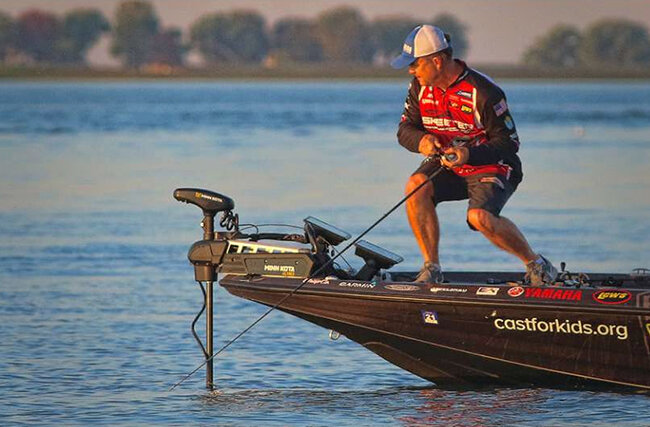
Given the schoolers’ aggressive nature, Ehrler’s not concerned over boat positioning as long as he can make a productive cast. In fact, he believes that a boat shadow actually resembles a school of bait, so fish in the schooling mood may actually draw close out of curiosity.
Two pieces of technology that Ehrler relies on are his Hyrdowave (set to “schooling” or “blitz” patterns) and his Garmin Panoptix LiveScope. While the former helps trigger schooling activity, the latter gives him an advance view of the playing field that promotes time management by facilitating educated casts.
“I can actually see a school of fish making a move toward the surface even before they come up,” Ehrler said. “If you can see them coming up, you can lay your bait on the water right where they’re going to school.”
Bait Selection
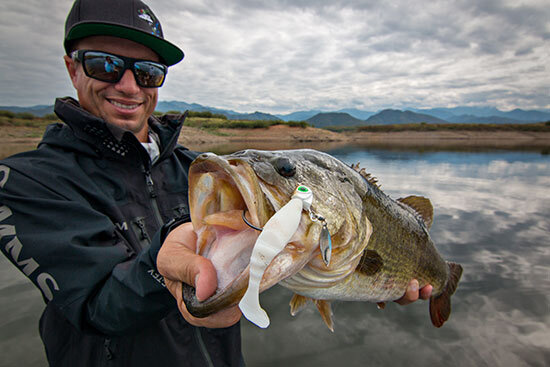
The fast-paced, here-and-gone nature of schooling activity makes topwaters the ideal option. Ehrler favors a Lucky Craft Gunfish, but he’ll back that up with a Yamamoto D-Shad rigged on a 4/0 Gamakatsu EWG hook.
“I Texas rig the bait and leave the eye of the hook exposed because I feel like the bait tracks better,” Ehrler said. “The biggest key is having that bait perfectly straight. When you leave the hook eye buried in the bait, it spins a little. If the bait rolls and spins, you won’t get bit. You want it to dart.”
For enhanced attraction, Ehrler often targets schoolers with a twin D-Shad rig. The setup comprises two leaders, each with a D-Shad at one end and a swivel at the other. Sliding his main line through the open eye of the shorter leader before tying to the longer one gives him a staggered rig that can handle double hookups.
“The swivel on the main line is free floating, so if you get a double, the fish can run up your line,” Ehrler said. “With a (connected) rig, if your two fish run in opposite directions, they pull against one another and you’ll usually break off.”
Now, here’s a pro level tip that Ehrler has found helpful on many occasions: If the resident schoolers are not surfacing, they’re probably just taking a breather, maybe a digestive break. If that’s the case, he’ll switch from the topside presentations to something that’ll probe into the water column to see who’s hungry.
Top choices include swimbaits (Swim Senko or Zako), dropshot with a Shad Shape Worm, a Neko-rigged 5-inch Senko, a Neko-rigged Thin Senko or a 1/2-ounce Boss ball head jig with a 5-inch Yamamoto Double Tail.
“A lot of times, those fish hang out near the bottom…and when a school of bait comes through, the fish push them to the surface,” Ehrler said.
Between the flurries, you might as well keep the rod bent.