Robertson Considers Senkos His Fall Fave
Posted by David A. Brown on Oct 12th 2020
By David A. Brown
The autumn transition can be an unsettled time with bass roaming here and there as they gradually undertake the tradeoff between summer and fall patterns. This can be a confounding period — enough to make an angler wacky.
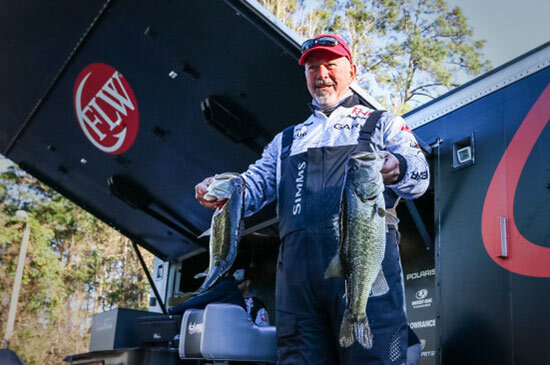
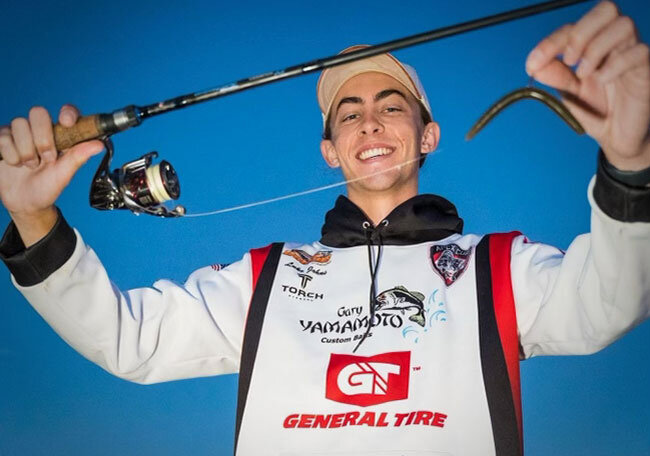
Darrel Robertson agrees, but the decorated pro from Jay, Okla. says that’s not a bad thing. In fact, he’s completely forthcoming with the fact that his early fall go-to is a wacky-rigged 5-inch Senko.
“I still throw a spinnerbait, I still throw a little crankbait or squarebill, but the most consistent way for me to catch fish is on a Senko,” Robertson said.
The Right Rig
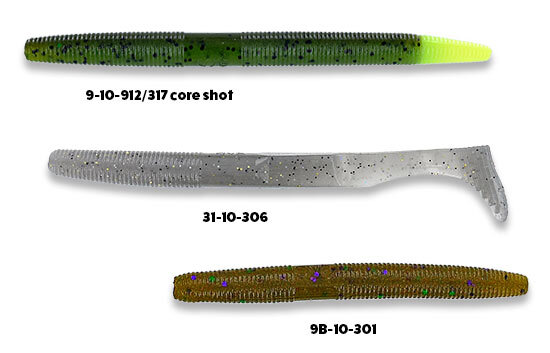
Robertson keeps his color selection simple, with some version of green pumpkin; such as green pumpkin black, green pumpkin red or green pumpkin watermelon laminate. Leveraging a bass’ natural forage recognition, he maintains consistency on a key accent element.
“Usually, I have just a touch of chartreuse dye on the end of my Senko,” Robertson said. “I don’t know what they think a Senko is, but a lot of times, if it has a little bit of chartreuse on it, they’ll think it’s a perch.”
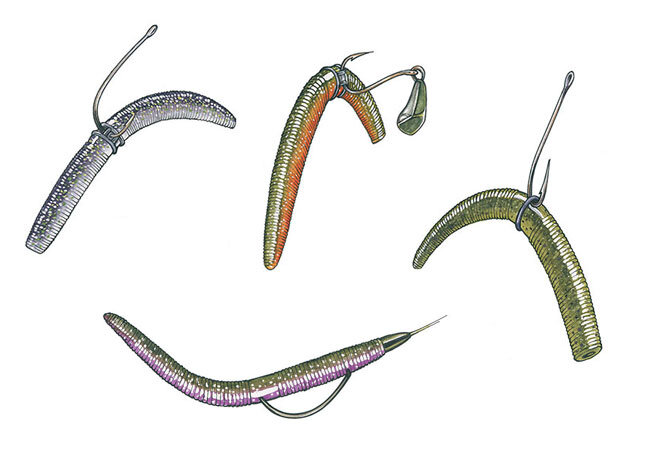
Robertson rigs his Senko on a Gamakatsu G-Finesse wacky/neko hook. Trusting a small hook with big fish takes confidence and Robertson said he has plenty.
“I’ve never thrown any type of hook that had a better bite-to-hookup ratio,” he said. “It’ll catch every fish that ever bites.
“I’ll go through the (Senko’s) egg sack with the hook. I don’t like the O-ring because I think it costs you bites and it costs you hook sets.”
Tackle for the Task
Robertson’s Senko set up might surprise some — until he explains his presentation strategy. For starters, he likes a 7-4 to 7-6 flipping stick and a 6.3:1 reel carrying 20-pound Seaguar InvisX fluorocarbon. The reel speed, he said, is actually not that critical, but the overall stoutness of his tackle allows him to fish a finesse rig more aggressively than normal.
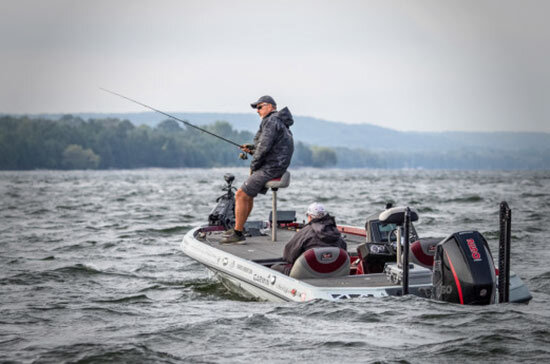
“Several of the places I fish it, you wouldn’t believe — docks, brush piles, event willow trees around the bank,” Robertson said. “You have to be pretty meticulous with it to keep from getting hung up and breaking off all the time. If you take it easy, you can do it.”
Sounds like an interesting point. Robertson elaborates: “If you pull into a limb, you’ll probably get hung up, but if you just pull up to the limb and touch it, you can pull the bait over really easy.
“You have to pay a lot of attention to what you’re doing. I get hung up every once in a while, but a lot of times, I fish all day with the same rig.”
Essential to his tactics is the confidence he gets from using an outfit more closely aligned with jigs and Texas-rigged baits. Robertson knows he can get bit just about anywhere with a wacky-rigged Senko, but he has to be ready for rough neighborhoods.
“A lot of people will think, I have to throw a wacky-rig on 8-pound line or 10-pound line with a spinning rod, but with that heavier line, it’s just like flipping cover with a jig,” he said. “Last year (2019), I caught two fish that weighed over 10 pounds each on a wacky rig.
“On a clear fishery, like Table Rock, you’ll want to go down to 12-pound line. But otherwise, I use 20-pound fluorocarbon almost all the time.”
About the only downside to Robertson’s beefy wacky rig tackle relates to dock fishing. He’s aware of the limitation, but finds his bait proves sufficiently tempting to do the trick.
“I’m not going to skip as far under these docks with a casting rod and 20-pound line as I would a spinning rod,” he said. “With a spinning rod, you can cut loose and throw it wherever, but with a casting rod, you’re usually 6-8 feet past the dock’s opening. That’s usually where I fish my wacky rig.”
Also In the Lineup
Robertson complements his wacky-rigged Senko with these proven bite-getters:
Make Some Commotion: A Swimming Senko’s slender body and paddle tail creates the enticing display Robertson wants for coaxing fish out of vegetation. He generally uses the same colors as he does with his wacky rig, but he dresses up his Swimming Senko with a flashy piece of terminal tackle.
“Fall’s a pretty good time for that Swimming Senko and I’ll throw it on an Owner Underspin; that makes a really good combo,” Robertson said. “If I’m fishing a lake that has any type of grass in it, that’s the main scenario. If there’s some wood in the back of a creek, that Swimming Senko is an awfully good bait.
“A lot of times, I’ll rig it with a 1/8-ounce weight and flip it like a jig. If you don’t have too heavy a weight on it, nothing swims any better when you’re flipping it in wood.”
On the Drop: Robertson admits he’s not big on finesse tactics, but he keeps a good supply of 3-inch Senkos in his boat, as this downsized form makes a tantalizing dropshot bait. Again, he sticks with his basic colors, usually with that chartreuse tip.
“When you find the shad out there in the coves, in 20 feet of water, the bass will be underneath them,” he said.
Certainly, Robertson would rather catch his fall fish with more active techniques, but when the bite gets tough; or if he need to fill a limit, a tiny Senko on the dropshot will often do the trick.
These three presentations combined provide Robertson with essential elements of an effective fall arsenal. A big element of angling consistency is belief in your program. Suffice it to say, Robertson is a true believer in Senko’s fish-charming power.
“I have such confidence in Senkos, that’s my No. 1 bait (family). That’s just all there is to it.”